
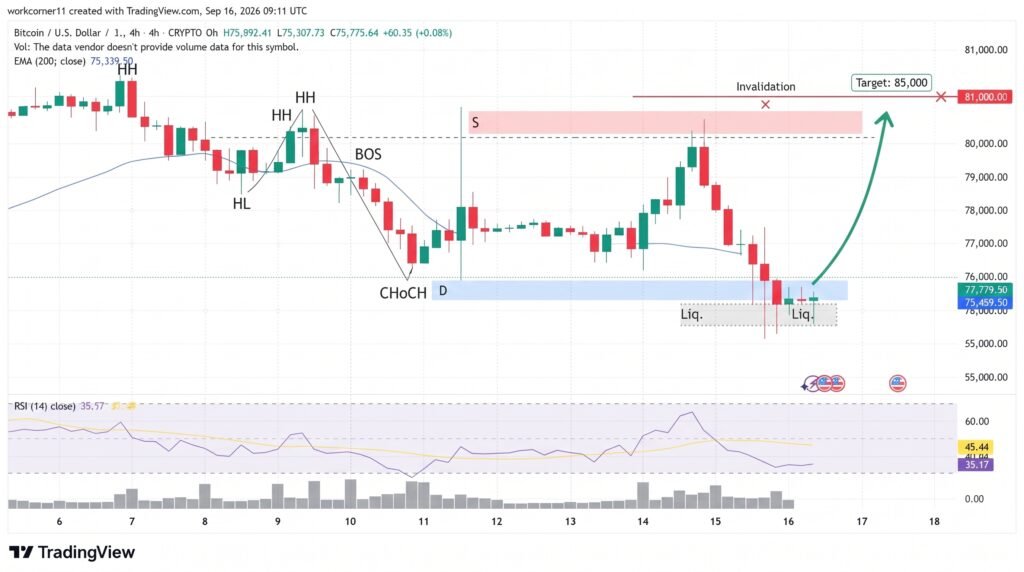
Bitcoin extended its decline Wednesday, falling 1.8% to $75,893.10 by 02:32 ET (06:32 GMT) after the U.S. Senate rejected a procedural effort to advance the Digital Asset Market Clarity Act. The vote came as investors also prepared for the Federal Reserve’s September policy decision, creating two major catalysts for the cryptocurrency market within a single session. Higher Treasury yields and renewed geopolitical concerns added to the pressure on risk-sensitive assets.
Senate Vote Deals Crypto a Setback
The Senate voted 49-50 against invoking cloture on the motion to proceed with H.R. 3633, the CLARITY Act. The measure needed 60 votes to advance. The bill seeks to establish a regulatory framework for digital commodities and define responsibilities between the Securities and Exchange Commission and Commodity Futures Trading Commission.
The legislation had attracted significant attention because clearer rules could define how digital assets, exchanges and related businesses are regulated in the U.S. The Senate vote does not permanently end the bill, but it prevents the legislation from moving forward under the current procedural step. Reuters reported that a future reconsideration remains possible.
The immediate market reaction was negative, with Bitcoin and several major digital assets moving lower after the vote.
- Senate vote: 49-50
- Votes required: 60
- Bitcoin: $75,893.10
- Daily decline: 1.8%
Fed Decision Adds Another Risk
The regulatory setback is arriving alongside a major monetary-policy event. The Federal Open Market Committee is meeting September 15-16, with the policy decision scheduled for 2:00 p.m. ET on Wednesday and Chair Kevin Warsh’s press conference at 2:30 p.m.
Markets have been pricing a 25-basis-point increase, which would lift the federal funds target range from 3.50%-3.75% to 3.75%-4.00%. At the July meeting, the Fed left rates unchanged, although three voting members preferred a quarter-point increase.
For Bitcoin, the policy guidance may matter as much as the rate decision. Higher interest rates can reduce the relative appeal of speculative assets by increasing the return available from interest-bearing investments. Elevated Treasury yields have added to that backdrop.
The September meeting also includes updated economic projections and the Fed’s interest-rate path, potentially giving investors more information about how officials view inflation and future policy.
Altcoins Extend Bitcoin’s Decline
The weakness was broad across the crypto market. Ethereum fell 2.7% to $2,407.47, while XRP dropped nearly 7%, according to the supplied market data. Solana and Cardano each declined more than 3%, while BNB slipped 0.1%.
Among major memecoins, Dogecoin fell 2.7% and the TRUMP token declined 4%. The broad losses indicate that the pressure was not confined to Bitcoin, with investors reducing exposure across several segments of the digital-asset market.
The combination of regulatory uncertainty, monetary-policy expectations and higher bond yields leaves Bitcoin facing several competing market forces. The next major signals will come from the Federal Reserve’s decision and guidance, while the future timetable for the CLARITY Act remains uncertain.
Conclusion:
Bitcoin is trading below $76,000 after the Senate failed to advance the CLARITY Act and ahead of the Federal Reserve’s September decision. The 49-50 procedural vote removes an immediate legislative catalyst, while the expected rate increase puts attention on Kevin Warsh’s guidance and the Fed’s updated projections. Broader weakness across major altcoins shows that the pressure is affecting the wider crypto market rather than Bitcoin alone.
Sources & Methodology
Primary-source standard: Market-moving facts should link to original data releases, regulator notices, company filings or official project announcements whenever available. Secondary reporting is used for additional context, not as a substitute for original evidence.
Page last reviewed: