
Saudi Arabian Mining Company (Maaden) expects domestic aluminium demand to climb to 1.6–1.8 million metric tons annually by 2030 from the current around 1 million metric tons, with potential to double within five to seven years. Ahmad al-Alshaikh, executive vice president for aluminium, attributed the surge to major expositions and the 2034 FIFA World Cup requiring construction of 15 stadiums, speaking Wednesday at the Fastmarkets International Aluminium Conference in Budapest.
Maaden’s Ras Al-Khair Complex: 780,000 Tons Primary Output, 85% Domestic Sales and $110bn Expansion Plans
Maaden currently produces approximately 780,000 tons of primary aluminium and around 1 million tons of cast metal annually at its Ras Al-Khair complex, selling 85% of output into the domestic market. The integrated facility includes a bauxite mine exceeding 4 million tons capacity, a 1.8 million-ton alumina refinery, the primary smelter, and a rolling mill producing roughly 380,000–460,000 tons of can sheet, auto sheet and related products.
In 2025 the company delivered near-record aluminium output of about 999,000 tons. Al-Alshaikh projected demand reaching 1.6–1.8 million tons by the end of the decade. The Iran-related regional conflict has had only a limited effect on Maaden’s operations, he said, thanks to Gulf Cooperation Council countries coordinating to reduce impacts.
Separately, Maaden has outlined a $110 billion capital programme over the next decade that includes doubling its aluminium business, with studies under way on projects that could lift annual capacity to approximately 1.6 million tons by around 2031, plus a recycling plant targeting 400,000 tons of low-carbon billets and slabs annually from late 2028.
Strong Domestic Demand Boosts Maaden Outlook as Global Aluminium Deficits Support Prices
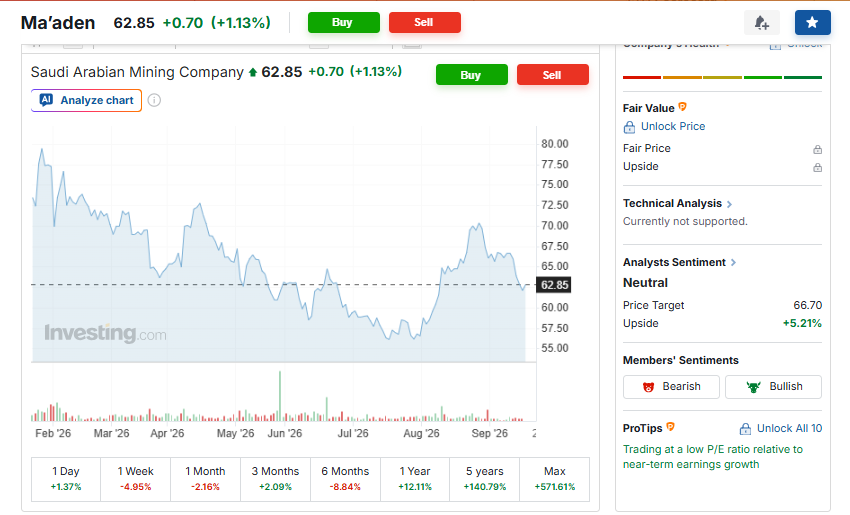
Strong domestic demand growth is constructive for Maaden, which already directs the large majority of its aluminium sales into Saudi Arabia and benefits from Vision 2030-driven infrastructure and industrialisation. Higher expected offtake supports utilisation of existing capacity and underpins the rationale for expansion projects. Aluminium prices have been supported by global deficits (estimated around 1.7–2.5 million tons in parts of 2026) and regional supply disruptions, while Maaden’s recent results showed aluminium revenue and margins strengthening on higher realised prices. Positive long-term volume visibility typically supports equity valuations for integrated producers with low-cost energy advantages.
Ras Al-Khair Complex and Vision 2030 Drive Structural Demand Growth for Saudi Aluminium
Maaden’s Ras Al-Khair complex, developed with an original investment of about $10.8 billion, is one of the world’s largest fully integrated aluminium facilities and the only major primary producer in Saudi Arabia. The company fully consolidated ownership of the aluminium and bauxite assets after acquiring Alcoa’s remaining stake.
Saudi Arabia’s aluminium consumption is being lifted by construction, automotive (including EV-related lightweighting), packaging, renewable-energy infrastructure and data-centre build-out under Vision 2030. The 2034 World Cup programme centres on 15 stadiums (11 new builds or major expansions and four renovations) across multiple cities, generating significant structural demand for aluminium alongside steel and other materials. Broader mining-sector targets aim to raise the industry’s GDP contribution substantially by the early 2030s. Global primary aluminium demand is expected to continue rising toward the high 80s–90 million tons by 2030, driven by transport, electrical and construction uses.
Maaden Advances Capacity Doubling and Recycling Projects to Capture Rising Saudi Demand
Maaden is advancing capital projects to more than double aluminium capacity and commissioning a recycling facility to meet low-carbon domestic needs. The company continues to prioritise serving the growing Saudi market while retaining export flexibility. Delivery of World Cup stadiums and related infrastructure, plus other mega-projects and industrial localisation, will determine the pace at which demand reaches the upper end of the 1.6–1.8 million-ton range. Investors and industry participants will watch project execution timelines, power and logistics availability, and any further updates on regional supply stability.
Sources & Methodology
Primary-source standard: Market-moving facts should link to original data releases, regulator notices, company filings or official project announcements whenever available. Secondary reporting is used for additional context, not as a substitute for original evidence.
Page last reviewed: