
The USD/CHF pair is trading around 0.8250 after reaching its highest level in roughly 16 months, keeping the Swiss franc under pressure against the US dollar. The dollar remains supported after the Federal Reserve raised interest rates by 25 basis points on September 16 and indicated that another increase could come later this year. Meanwhile, the Swiss National Bank has maintained its policy rate at zero, widening the monetary-policy gap between the two economies.
Fed Tightening Supports US Dollar
The Federal Reserve increased its federal funds target range to 3.75%-4.00%, marking its first rate increase since July 2023. The decision was unanimous, and policymakers’ latest projections point to at least one more 25-basis-point increase before the end of 2026.
The policy shift has strengthened the dollar against several major currencies as investors reassess the path of U.S. borrowing costs. The latest Fed projections also keep rates elevated through 2027, reinforcing the interest-rate advantage enjoyed by dollar assets.
The U.S. dollar has therefore remained firm against the franc despite the Swiss currency’s traditional safe-haven role. Current market data show USD/CHF trading close to 0.8260, with the pair near its 52-week high around 0.8264.
- USD/CHF: Around 0.8250-0.8260
- Fed target range: 3.75%-4.00%
- Additional 2026 hike: One projected
- SNB policy rate: 0%
Swiss Franc Faces Policy Divergence
The Swiss National Bank has maintained its policy rate at 0%. Its June monetary policy assessment also emphasized a willingness to intervene in the foreign-exchange market if necessary to counter a rapid and excessive appreciation of the franc.
That low-rate environment creates a different dynamic for the franc. Rabobank FX strategist Jane Foley said the market sees little risk of an SNB rate increase this year, raising the possibility that the CHF could increasingly be used as a funding currency for carry trades. At the same time, she noted that renewed market anxiety could quickly restore demand for the franc because of its safe-haven characteristics.
The result is a tug-of-war between interest-rate differentials and risk aversion. Wider U.S.-Swiss rate spreads can support USD/CHF, while geopolitical stress and financial-market volatility can encourage investors to seek the franc.
Dollar-Franc Outlook Remains Sensitive
The latest move in USD/CHF reflects the dollar’s broader rebound following the Fed’s hawkish policy shift. Reuters reported that the dollar index climbed to a seven-week high after the September decision, while markets were pricing around a 90% chance of another U.S. rate increase by year-end.
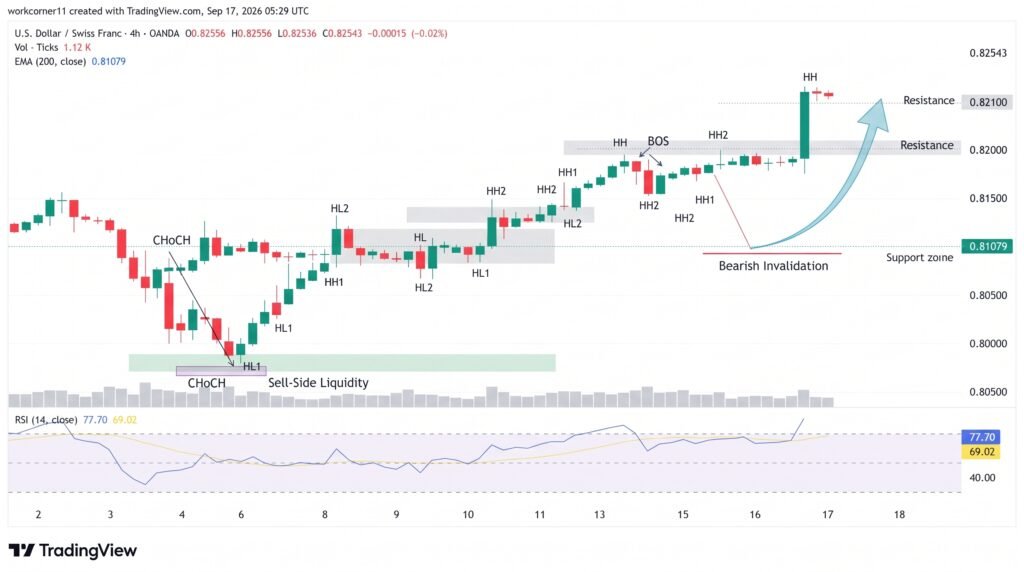
For USD/CHF, the recent 0.8250 area is now an important reference after the pair reached approximately 0.8264. A sustained move above that zone would keep the dollar’s advance intact, while a failure to hold elevated levels could trigger a correction toward lower support areas.
The opposing forces remain clear: U.S. monetary tightening favors the dollar, while the franc can regain demand when global risk aversion rises. That makes geopolitical developments, Treasury yields and expectations for the next Fed move important drivers alongside Swiss policy.
Conclusion:
USD/CHF remains elevated near 0.8250 as the Federal Reserve’s renewed tightening cycle strengthens the dollar’s yield advantage. The Fed has lifted rates to 3.75%-4.00% and projects another increase in 2026, while the SNB’s policy rate remains at 0%. That divergence supports the dollar, but the Swiss franc’s safe-haven role can re-emerge quickly if market stress increases. The 0.8250-0.8264 area is therefore a key reference for the pair’s next move.
Sources & Methodology
Primary-source standard: Market-moving facts should link to original data releases, regulator notices, company filings or official project announcements whenever available. Secondary reporting is used for additional context, not as a substitute for original evidence.
Page last reviewed: