
The AUD/USD pair is recovering around 0.7100 after falling to 0.7075 on Wednesday, its lowest level in almost a month. The rebound comes as the US dollar retreats slightly following the Federal Reserve’s latest policy decision, while expectations for another Reserve Bank of Australia rate increase provide additional support for the Australian dollar. Still, the Fed’s hawkish outlook and elevated geopolitical risks could limit the recovery.
AUD/USD Defends the 100-Day SMA
AUD/USD has regained ground above the 0.7100 area after finding buying interest near its 100-day SMA. FXStreet’s latest market analysis places that moving average near 0.7080, making it an important technical reference for the current rebound. Reuters also reported that the Australian dollar has recently come under pressure as the U.S. dollar strengthened and global risk aversion increased.
The pair has also moved back above the 38.2% Fibonacci retracement of the June-September advance near 0.7095. Holding above that level keeps the recovery structure intact, although momentum indicators remain less convincing.
The latest setup leaves several closely watched technical levels:
- Current zone: Around 0.7100
- 100-day SMA: Around 0.7080
- Immediate resistance: 0.7150
- Deeper support: 0.7051-0.7007
Fed-RBA Gap Shapes the Outlook
The U.S. monetary backdrop remains important for AUD/USD. The Federal Reserve raised its policy rate by 25 basis points on September 16 to 3.75%-4.00%, while its latest projections indicated that policymakers still see scope for another increase in 2026.
That keeps the U.S. yield advantage supportive for the dollar. At the same time, the Australian side of the rate equation is becoming more important. Reuters reported Thursday that the International Monetary Fund believes Australia may need additional rate increases because inflation remains elevated. Markets were pricing an 87% probability of a 25-basis-point RBA increase by the end of September, according to the report.
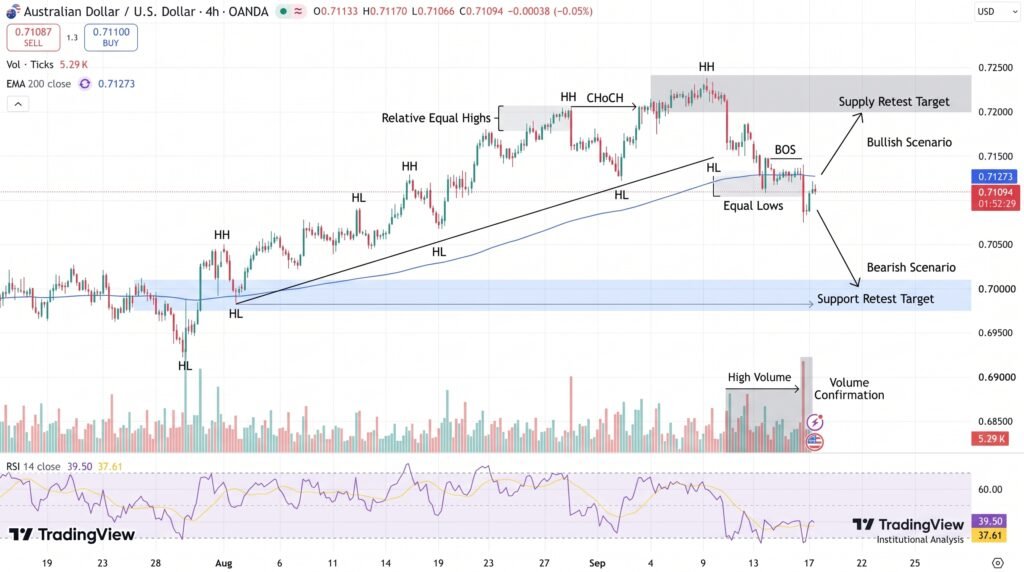
The combination creates a two-way market. A more hawkish Fed can limit AUD/USD gains, while stronger RBA tightening expectations can provide support. Commodity prices and Chinese economic conditions also remain relevant because of Australia’s export exposure.
Technically, the RSI near 45.6 shows weakening momentum without oversold conditions. Meanwhile, the MACD has turned negative, suggesting that the rebound is not yet supported by a strong momentum reversal.
Conclusion:
AUD/USD is attempting to stabilize above 0.7100 after defending the 100-day SMA near 0.7080. The 0.7095 Fibonacci level now provides nearby support, while 0.7150 is the first important resistance; a break above it would expose the 0.7238 swing-high area. On the downside, sustained losses below 0.7080 would shift attention toward 0.7051 and 0.7007. The pair remains highly sensitive to the balance between the Fed’s restrictive policy and expectations for further RBA tightening.
Sources & Methodology
Primary-source standard: Market-moving facts should link to original data releases, regulator notices, company filings or official project announcements whenever available. Secondary reporting is used for additional context, not as a substitute for original evidence.
Page last reviewed: