EUR/USD forecast for 2026, 2027 and 2030, including technical levels, Fed and ECB drivers, scenarios and long-term price ranges.
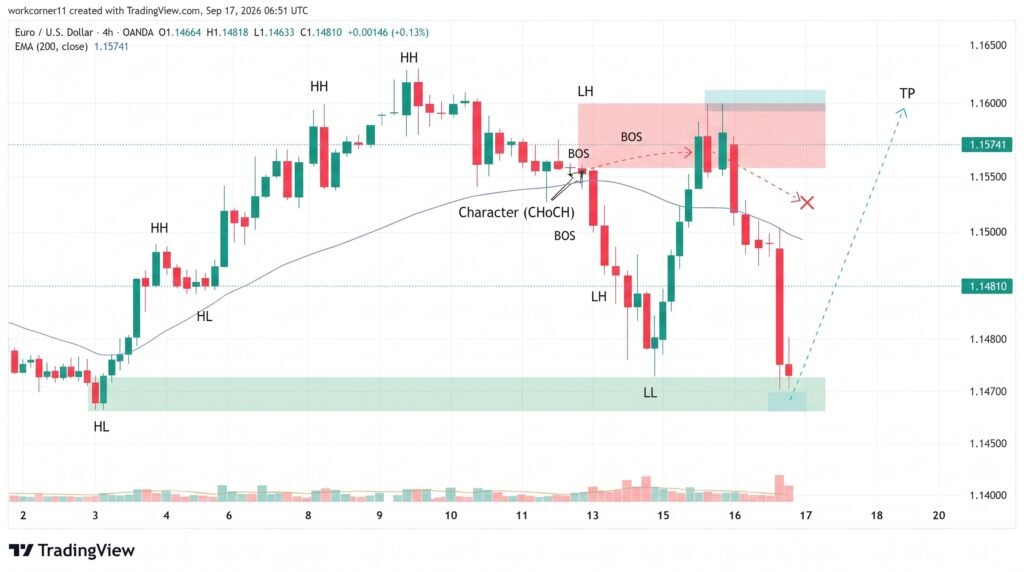
Visual update: September 18, 2026 GMT. Forecast ranges and technical levels retain the September 17 reference date. This page does not display a live exchange rate.
Quick Answer
EUR/USD was around 1.147 in the September 17, 2026 reference snapshot after the Federal Reserve raised rates by 25 basis points on September 16, while the European Central Bank lifted its deposit rate to 2.50% a week earlier. The near-term balance remains slightly dollar-supportive because the Fed’s September projections put the median federal funds rate at 4.1% for both 2026 and 2027. AAFX’s base case is 1.14-1.18 into the end of 2026, 1.16-1.21 during 2027 and a broad 1.15-1.25 structural range around 2030. A sustained move above 1.1585-1.1600 would improve the near-term euro outlook, while a break below 1.1435 and 1.1375 would increase downside risk.
For wider context, compare this outlook with our forex technical analysis, track scheduled catalysts in the economic calendar, review margin mechanics in our leverage trading guide, and explore the broader forex price prediction hub.
Compare the GBP/USD forecast for a second perspective on broad dollar strength and relative central-bank policy.
EUR/USD Forecast at a Glance
| Period | AAFX Base Case | Upside / Bull | Downside / Bear |
|---|---|---|---|
| Spot / Sep 17 | About 1.147 | Above 1.1500, then 1.1585-1.1600 | Below 1.1435, then 1.1375 |
| 30 Days | 1.13-1.17 | 1.18+ | 1.12 or lower |
| End-2026 | 1.14-1.18 | Above 1.20 | 1.10-1.12 |
| 2027 | 1.16-1.21 | 1.22-1.25+ | 1.10-1.14 |
| 2030 | 1.15-1.25 | Above 1.25 | Below 1.10 |
These are AAFX scenario ranges, not guaranteed targets. The further the forecast horizon extends, the wider the range should become because monetary policy, inflation, growth, fiscal policy and capital flows can all change materially.
EUR/USD Current Outlook
The short-term EUR/USD backdrop changed sharply in September. On September 16, the Federal Reserve raised its target range by 25 basis points to 3.75%-4.00%. Its new Summary of Economic Projections showed a median policy-rate path of 4.1% at the end of 2026 and 4.1% in 2027, implying that the Fed still sees a relatively restrictive policy setting as appropriate.
The ECB also tightened policy. On September 10 it raised all three key rates by 25 basis points, taking the deposit facility rate to 2.50%, effective September 16. The ECB simultaneously projected euro-area inflation at 3.0% in 2026, 2.5% in 2027 and 2.1% in 2028, while projecting GDP growth of 0.9% in 2026 and 1.4% in 2027.
That leaves the US policy rate materially above the ECB deposit rate. For EUR/USD, the key question is whether that gap widens further or begins to narrow. A wider US-euro area yield advantage generally supports the dollar, while a narrowing gap can make the euro relatively more attractive.
Raised 25 basis points
September 16 decision
Raised 25 basis points
Effective September 16
137.5 basis points: the Fed range midpoint exceeds the ECB deposit rate by 1.375 percentage points. This is a policy-rate comparison, not the Treasury–Bund market yield spread.
EUR/USD Technical Levels to Watch
EUR/USD was trading around 1.1465-1.1480 on September 17 after the Fed decision. Short-term technical studies cited immediate resistance near 1.1485, with additional resistance around 1.1529-1.1550 and 1.1585. Support is clustered around 1.1435-1.1465, followed by the 1.1375-1.1395 area.
The technical picture therefore remains fragile below 1.15. A recovery through 1.1585-1.1600 would suggest that the post-Fed dollar move is fading. A sustained break below 1.1375 would weaken the structure and increase the risk of a deeper move toward the low-1.10s.
EUR/USD Forecast Today and Next Week
For the very short term, AAFX’s bias is neutral-to-bearish while EUR/USD remains below 1.15-1.16. The Fed has just tightened policy and US short-term yields have risen, which keeps the dollar supported. However, the ECB’s own rate increase, resilient euro-area growth projections and any further decline in energy prices can limit euro downside.
For the next week, the most important signals are changes in US Treasury yields, German Bund yields, Fed and ECB rate expectations, inflation data and economic-surprise indicators. If US yields keep rising relative to euro-area yields, EUR/USD is more likely to test support. If the yield gap narrows and the pair regains 1.1585-1.1600, the balance would shift toward recovery.
EUR/USD 30-Day Forecast
AAFX’s 30-day base range is 1.13-1.17. This deliberately uses a range rather than a single point target. Published models are currently split: some statistical models project a dip toward the low-1.10s, while bank and provider consensus forecasts are more constructive into year-end.
The main upside path would require softer US inflation, lower Treasury yields or evidence that the Fed will not deliver the additional tightening implied by its September projections. The main downside path would be a renewed rise in US yields, another hawkish Fed repricing or weaker euro-area activity.
EUR/USD Forecast 2026
AAFX base case for end-2026: 1.14-1.18. The pair is starting from around 1.147, so the central scenario is not a dramatic directional call. Instead, it assumes that the Fed-ECB rate gap remains dollar-supportive but that part of that advantage is offset by the ECB’s tighter stance and by expectations that inflation eventually moderates.
What Could Push EUR/USD Higher in 2026?
- US inflation falls faster than expected and the Fed backs away from further hikes.
- Treasury yields decline relative to German Bund yields.
- Euro-area growth remains resilient and capital flows into European assets improve.
- Energy prices fall, easing pressure on European inflation and external balances.
- EUR/USD breaks and holds above 1.16, reopening the 1.18-1.20 area.
What Could Push EUR/USD Lower in 2026?
- The Fed delivers more tightening than markets currently expect.
- US inflation remains sticky and US yields stay elevated.
- Euro-area growth weakens despite higher ECB rates.
- A renewed energy shock hits European terms of trade.
- EUR/USD breaks below 1.1375 and fails to recover quickly.
EUR/USD Forecast 2027
AAFX base case for 2027: 1.16-1.21, with a central reference around 1.18. This is broadly consistent with the latest ECB Survey of Professional Forecasters, which expects the euro to appreciate gradually from around 1.16 in the second half of 2026 toward about 1.19 by 2031.
The latest provider consensus also points to modest euro appreciation rather than a straight-line rally. Exchange Rates UK reported a consensus around 1.1848 for the third quarter of 2027, but the provider range was much wider at roughly 1.10-1.21. That dispersion is important because it shows how sensitive the 2027 path remains to monetary policy and growth assumptions.
A stronger 2027 euro scenario would require the US-euro area rate gap to narrow, European growth to improve and global investors to increase allocations to euro-denominated assets. A weaker scenario would result if the Fed keeps rates structurally higher, US productivity remains stronger, or European growth and fiscal confidence deteriorate.
EUR/USD Price Prediction 2030
AAFX base case for 2030: 1.15-1.25, with 1.20 used only as a central scenario rather than a fixed target. Long-term currency forecasting is much less precise than a 3- or 12-month outlook because productivity, demographics, fiscal policy, reserve demand and capital flows can change the equilibrium exchange rate.
The ECB’s latest third-quarter 2026 professional forecaster survey no longer uses 2030 as its longest horizon. It points instead to EUR/USD around 1.19 by 2031. That is close to the 1.20 area used in earlier ECB survey rounds, but it should be treated as a survey assumption, not an official ECB target.
A structural bull case above 1.25 would become more credible if the US rate advantage narrows materially, European productivity improves and global reserve diversification accelerates. A structural bear case below 1.10 would become more credible if the US maintains a large growth and yield advantage or if euro-area fiscal and political risk weakens capital inflows.
What Other EUR/USD Forecasts Say
Forecast providers currently disagree materially, which is exactly why AAFX should not present a single external number as “the” forecast.
- Exchange Rates UK: About 1.1598 for Q4 2026 and 1.1848 for Q3 2027, with a wide provider range of roughly 1.10-1.21 by Q3 2027.
- CoinCodex statistical model, checked September 17, 2026: Its December 2030 projection showed an average near 1.11 and a maximum near 1.12. This is a time-stamped snapshot because statistical forecasts can change frequently.
- Traders Union statistical model: Around 1.109 at the end of 2027 and about 1.058 at the end of 2030.
These forecasts use different inputs and methodologies. Bank/provider consensus reflects published analyst targets, while statistical models often extrapolate historical price behavior and technical data. AAFX therefore uses them as reference points, then builds its own base, bull and bear scenarios from macroeconomic and market evidence.
What Factors Affect the EUR/USD Forecast?
1. Federal Reserve Policy
The Fed affects EUR/USD through interest rates, Treasury yields and expectations for future policy. The September 2026 projections are especially important because the median policy path of 4.1% for both 2026 and 2027 is above the current midpoint after the September hike.
2. European Central Bank Policy
The ECB raised its deposit rate to 2.50% in September. Further tightening can support the euro if it improves the relative return on euro assets, but rate hikes driven by an adverse inflation shock can also hurt growth, so the reason for the policy move matters.
3. US-German Yield Spreads
For currencies, market yields can matter more than official policy rates. A widening US Treasury yield advantage over German Bunds tends to favor the dollar. A narrowing spread can support EUR/USD.
4. Inflation and Energy Prices
Persistent US inflation can keep the Fed hawkish. In Europe, energy shocks are particularly important because they can lift inflation while simultaneously weakening growth and the trade balance.
5. Relative Economic Growth
Stronger US growth can attract capital and keep US rates higher. Stronger euro-area growth can improve the euro’s outlook, particularly when accompanied by better productivity and investment.
6. Fiscal Policy and Capital Flows
US fiscal deficits, euro-area fiscal credibility and international allocations to US or European assets can shift currency demand independently of short-term central-bank moves.
7. Risk Sentiment
The US dollar remains a major reserve and funding currency. During periods of global stress it can strengthen even when US domestic fundamentals are not improving.
AAFX Bull, Base and Bear Scenarios
Base Case
EUR/USD remains broadly range-bound into the end of 2026 before gradually recovering during 2027. The Fed-ECB rate gap stays dollar-supportive in the near term, but the gap stops widening as inflation pressures ease. Reference ranges: 1.14-1.18 into end-2026, 1.16-1.21 during 2027 and 1.15-1.25 around 2030.
Bull Case
EUR/USD moves above 1.20 and can extend toward 1.25+ if US inflation cools, the Fed stops or reverses tightening, European growth improves, energy prices stay contained and yield spreads move in favor of the euro.
Bear Case
EUR/USD falls toward 1.10 or below if the Fed tightens more aggressively, US yields remain structurally high, European growth weakens, energy costs rise or global risk aversion drives capital into dollar assets.
Watch: sustained recovery above 1.1585–1.1600.
End-2026 reference: 1.14–1.18.
Watch: sustained loss of 1.1375.
What Would Change the AAFX EUR/USD View?
AAFX would become more constructive on the euro if EUR/USD reclaims 1.16 on a sustained basis while US yields fall relative to German yields and Fed tightening expectations soften.
AAFX would become more bearish if EUR/USD breaks below 1.1375, the US-euro area yield gap widens further and the Fed’s expected path shifts above the September median while the ECB becomes less willing to tighten.
The long-term view would also change if there were a major shift in US fiscal credibility, euro-area political cohesion, productivity trends, energy dependence or reserve-currency demand.
How AAFX Calculates the EUR/USD Forecast
AAFX does not use one mechanical model for every horizon. Short-term forecasts give more weight to price structure, support and resistance, yields, event risk and central-bank repricing. Medium-term forecasts give more weight to inflation, growth, central-bank policy and market consensus. Long-term forecasts focus on productivity, fiscal policy, trade balances, capital flows and structural valuation.
The forecast is therefore expressed as a range with bull, base and bear cases. This approach is designed to show what must happen for the outlook to change rather than implying that a single precise exchange rate can be known years in advance.
EUR/USD Forecast Revision Log
Initial AAFX evergreen forecast recorded September 17, 2026: End-2026 base range 1.14-1.18; 2027 base range 1.16-1.21; 2030 structural base range 1.15-1.25. Future updates will preserve previous ranges in this section so readers can see how the forecast changed and why.
Frequently Asked Questions About EUR/USD
What Is the EUR/USD Forecast for the End of 2026?
AAFX’s base case is 1.14-1.18 into the end of 2026. The biggest swing factor is whether the Federal Reserve follows through with additional tightening after its September rate increase or whether US inflation and yields begin to cool.
What Is the EUR/USD Forecast for 2027?
AAFX uses a 1.16-1.21 base range for 2027, with a central reference near 1.18. The range is consistent with a gradual euro recovery but still allows for significant volatility if the Fed-ECB policy gap changes sharply.
What Is the EUR/USD Forecast for 2030?
AAFX uses a broad 1.15-1.25 structural range around 2030, with 1.20 as a central scenario rather than a guaranteed target. Long-term outcomes depend on productivity, inflation, fiscal policy, capital flows and relative US-European growth.
Will EUR/USD Go Up or Down?
Near term, the pair remains vulnerable while it trades below 1.15-1.16 and US yields stay firm after the Fed hike. Over a longer horizon, the latest ECB survey and provider consensus lean toward modest euro appreciation, but the range of published forecasts remains wide.
Can EUR/USD Reach 1.20?
Yes, 1.20 is plausible if the US-euro area rate gap narrows, US yields decline and euro-area growth remains resilient. A sustained move above 1.16 would be an important intermediate step, while continued Fed tightening would make a 1.20 move harder to sustain.
What Is the EUR/USD Forecast Tomorrow?
For the next session, watch 1.1435-1.1465 as support and 1.1485-1.1550 as resistance. Direction is likely to remain sensitive to Treasury yields, German yields, US data and any change in Fed or ECB rate expectations.
What Is the EUR/USD Forecast Next Week?
AAFX’s next-week bias is neutral-to-bearish below 1.15-1.16. A break above 1.1585-1.1600 would improve the recovery case, while a break below 1.1375 would strengthen the downside scenario.
What Affects EUR/USD the Most?
The most important drivers are the Fed-ECB interest-rate differential, US and German bond yields, inflation, relative economic growth, energy prices, fiscal policy, capital flows and global risk sentiment.
How Do Fed and ECB Interest Rates Affect EUR/USD?
EUR/USD often responds to the expected interest-rate gap between the Federal Reserve and the ECB. Higher expected US rates or Treasury yields can support the dollar and pressure the pair, while a narrowing policy gap can improve the euro outlook.
How Often Should a EUR/USD Forecast Be Updated?
The forecast should be reviewed after major Fed or ECB decisions, material inflation or employment surprises, and decisive breaks of important support or resistance levels. Long-term ranges need less frequent changes than short-term technical levels.
EUR/USD Forecast Summary
EUR/USD is entering the final part of 2026 with both the Federal Reserve and ECB tightening policy, but the US rate advantage remains substantial. That keeps the near-term outlook cautious while the pair trades near 1.147 and below the 1.15-1.16 resistance zone.
AAFX’s base case is 1.14-1.18 into end-2026, 1.16-1.21 during 2027 and a broad 1.15-1.25 structural range around 2030. The central view is therefore modest long-term euro appreciation, not a straight-line rally.
The forecast should be updated whenever the Fed-ECB policy gap, US-German yield spread, inflation outlook, growth differential or technical structure changes materially. Forecasts are estimates, not guarantees, and this analysis is for informational purposes rather than personalized investment advice.