
EUR/USD is recovering toward 1.1500 after the U.S. dollar strengthened following the Federal Reserve’s latest interest-rate decision. The pair is trading around the 1.1490 area in the supplied market snapshot, but its broader technical structure remains under pressure while price stays below the 100-day simple moving average.
The Federal Reserve raised its benchmark interest rate by 25 basis points to 3.75%-4.00% on Sept. 16, marking its first rate increase since July 2023. The central bank said inflation remains elevated and that the decision should support a return toward its 2% inflation goal.
The policy gap with Europe remains significant. The European Central Bank’s deposit facility rate stands at 2.50%, effective Sept. 16, leaving the U.S. policy rate substantially higher than the ECB’s benchmark deposit rate.
Euro Inflation Keeps ECB Focused
Euro-area inflation is adding another layer to the EUR/USD outlook. Eurostat reported annual inflation at 3.2% in August, up from 2.9% in July and well above the ECB’s 2% medium-term target. Services, energy, non-energy industrial goods and food all contributed positively to the annual inflation rate.
The inflation increase could keep monetary policy restrictive even as the European economy faces higher energy costs. ECB Vice President Boris Vujcic has also cautioned against focusing on energy prices alone, saying policymakers consider a wider range of economic indicators when assessing the appropriate policy stance.
For the currency market, the contrast between elevated U.S. rates and the ECB’s 2.50% deposit rate remains an important driver of the euro-dollar exchange rate. Reuters reported that the dollar strengthened sharply after the Fed decision before giving back part of those gains as Treasury yields retreated.
1.1550 Keeps Bears in Control
The supplied daily-chart setup shows EUR/USD trading below the 100-day SMA at 1.1550, keeping the near-term technical bias negative. The pair is also below the Bollinger middle band around 1.1595, while the Relative Strength Index near 38 indicates weak momentum without reaching the conventional oversold threshold of 30.
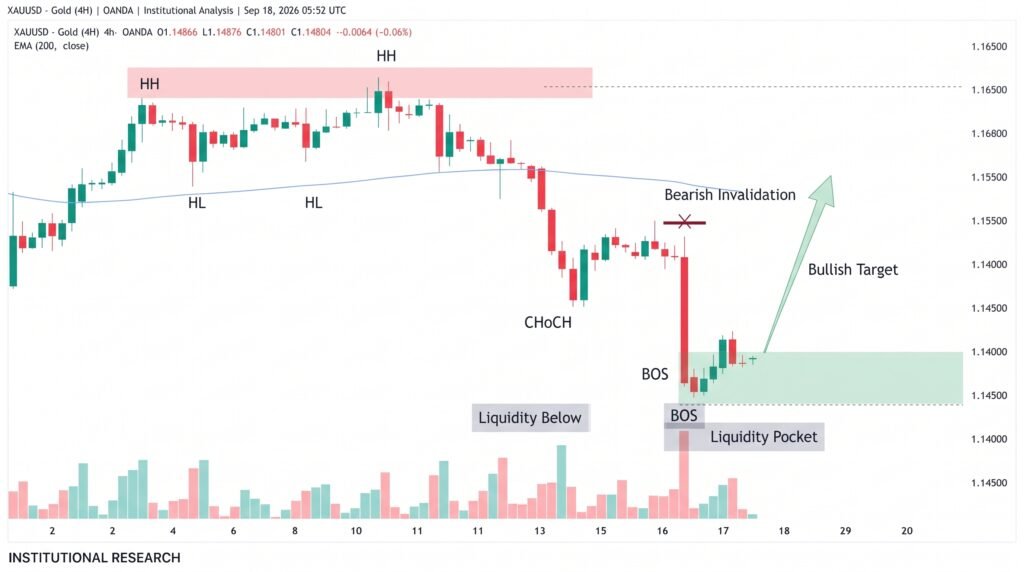
The main technical levels are:
- Immediate support: 1.1475
- Lower support: 1.1377 and 1.1324
- First resistance: 1.1550
- Higher resistance: 1.1595 and 1.1712
A sustained move above 1.1550 would weaken the immediate bearish structure and expose the 1.1595 Bollinger midpoint. A further break above 1.1595 could shift attention toward the upper Bollinger Band near 1.1712.
On the downside, a decisive break below 1.1475 would bring the July 13 low around 1.1377 into focus. Below that level, the June 24 low near 1.1324 becomes the next major reference.
Conclusion
EUR/USD is recovering toward 1.1500, but the pair remains below the 100-day SMA at 1.1550, leaving the near-term technical structure under pressure. The Fed’s move to 3.75%-4.00% continues to provide a significant policy-rate advantage for the dollar, while euro-area inflation at 3.2% keeps the ECB focused on price stability. A break above 1.1550 and 1.1595 would improve the technical picture, while a move below 1.1475 would expose 1.1377.
Sources & Methodology
Primary-source standard: Market-moving facts should link to original data releases, regulator notices, company filings or official project announcements whenever available. Secondary reporting is used for additional context, not as a substitute for original evidence.
Page last reviewed: