Quick answer: The long-term AUD/USD forecast depends on Australia’s relative investment returns, export prices and exposure to global growth, alongside the direction of the US dollar. AAFX’s September 2026 research used 0.68–0.74 for 2026, 0.70–0.78 for 2027 and 0.65–0.85 around 2030. These are dated analytical scenarios, not current trading levels or guaranteed outcomes.
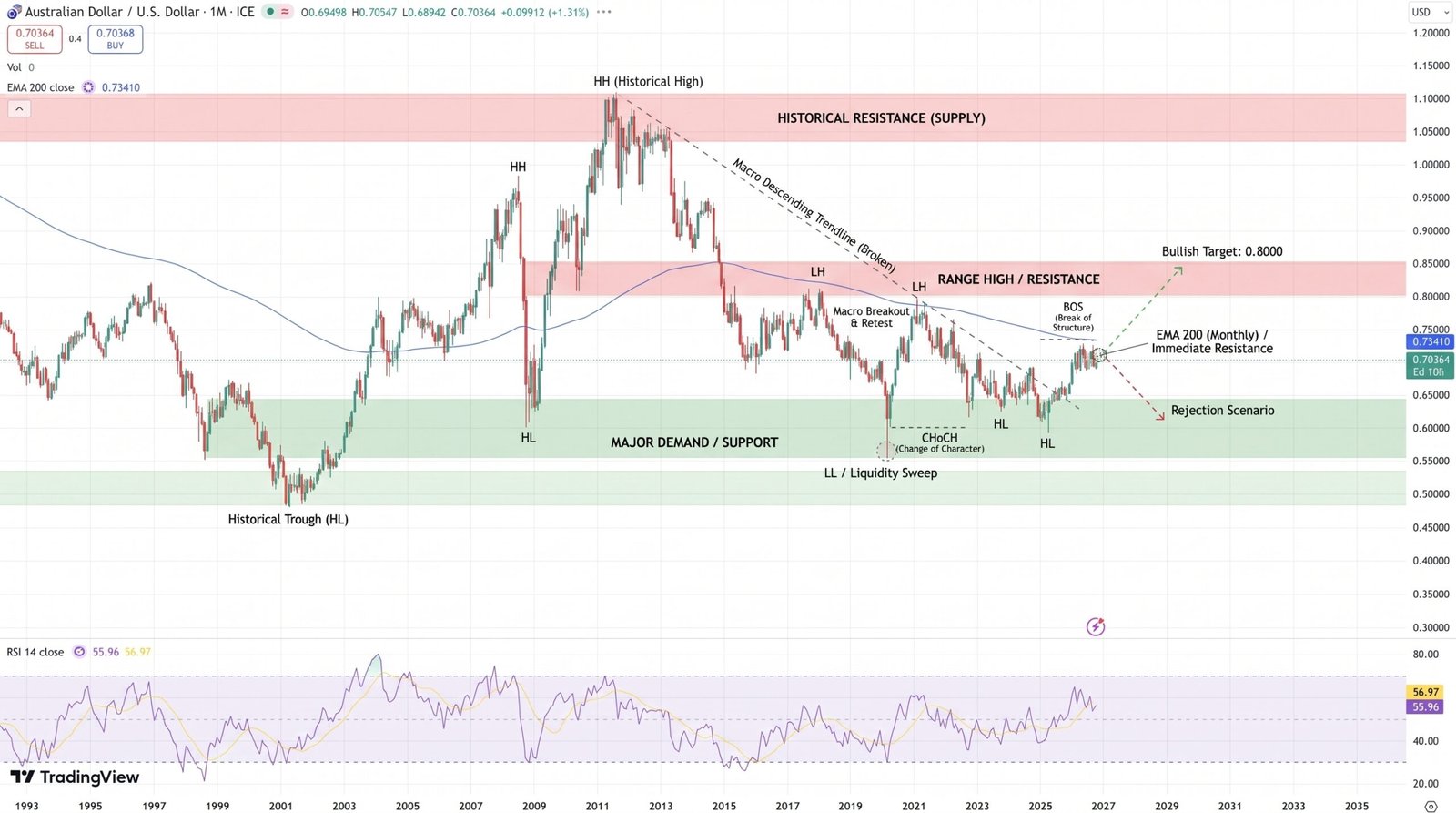
Evergreen framework reviewed October 28, 2026. Numerical scenarios originate from September 2026 research. This page does not display a live exchange rate.
AUD/USD tells you how many US dollars one Australian dollar buys. A rate of 0.70 means A$1 buys US$0.70. A rising pair indicates a stronger Australian dollar relative to the US dollar. A falling pair indicates the reverse.
The Australian dollar offers a useful way to study the interaction between interest rates, commodities and risk appetite. However, treating it as a simple bet on iron ore or China misses the dollar side of the exchange rate. A strong US-dollar move can outweigh improving Australian conditions. This guide sets out the assumptions to monitor alongside our broader forex forecast collection.
AUD/USD forecast ranges for 2026, 2027 and 2030
| Horizon | Original scenario | Central assumption |
|---|---|---|
| 2026 | 0.68–0.74 | Australian rate support and commodity demand offset periods of US-dollar strength. |
| 2027 | 0.70–0.78 | Relative yields and global activity become more supportive of the Australian dollar. |
| Around 2030 | 0.65–0.85 | Several possible commodity and policy cycles require a wider structural range. |
These ranges preserve the original September 2026 research record. They are not statistical confidence intervals, do not imply equal probabilities across the range and do not establish a floor or ceiling. The 2026 and 2027 figures describe broad scenario bands, not a promise about the final trading day of either year.
Why the RBA–Fed relationship matters
Investors compare the expected returns available in Australia and the United States. Changes in expected policy paths can therefore matter more than the current gap between the Reserve Bank of Australia’s cash rate and the Federal Reserve’s policy range. If both banks tighten, the relative pace and the market’s prior expectations remain crucial.
For example, an RBA increase that investors fully anticipated may have less effect than unexpectedly cautious guidance. Similarly, AUD/USD can decline even after encouraging Australian data when US data produce a larger upward revision to US rate expectations. Always compare both sides of the pair.
A practical research process separates three questions: what each central bank has actually decided, what markets appear to expect next and what the forecast assumes. Mixing those categories turns a conditional outlook into a misleading statement of fact.
Commodities, export prices and the terms of trade
The terms of trade compare export prices with import prices. A sustained improvement can support national income and the Australian dollar, while deterioration can work in the opposite direction. The RBA identifies relative interest rates and the terms of trade among the important drivers of the Australian dollar.
That relationship is a framework rather than a mechanical trading rule. A commodity rally driven by stronger global demand has a different economic backdrop from one caused by a supply disruption. Export volumes, production costs and the currencies in which transactions are settled also matter.
For an annual forecast, the key question is whether the commodity environment improves Australia’s relative income prospects over time. A one-day price jump does not establish a durable change in that outlook.
How China and global growth influence the outlook
Chinese activity matters through demand for Australian exports and the wider commodity cycle. Yet the composition of growth matters as well as the headline growth rate. Industrial production, construction, services and consumption do not create identical demand for raw materials.
Consider two possible outcomes. Broadly stronger industrial demand could improve export expectations and support AUD/USD if the US dollar is stable. Weak commodity demand accompanied by global financial stress could pressure the Australian dollar from both the trade and investment channels. Neither outcome follows automatically from one monthly data release.
Rather than relying on a single indicator, compare several releases and distinguish temporary stimulus effects from a sustained improvement in demand. Revisions and base effects can make an isolated strong growth number less informative than it first appears.
Risk sentiment and the US-dollar side of AUD/USD
Changes in global financing conditions can move AUD/USD even when Australian domestic news is quiet. Investors may reduce exposure to economically sensitive assets during stress, while demand for dollar liquidity can rise. These flows can overpower a modest interest-rate advantage.
To judge whether a move is mainly about Australia or the United States, compare it with other dollar pairs. Our EUR/USD outlook and USD/JPY outlook provide complementary policy frameworks. Remember that USD/JPY places the dollar first, so the direction of a dollar-strength move is reversed relative to AUD/USD.
AUD/USD outlook for 2027
The original 0.70–0.78 scenario assumes a more supportive combination of relative yields, export conditions and global activity. That could occur through improving Australian fundamentals, a weaker US dollar or both. It does not require a straight-line advance.
The scenario would weaken if Australian growth deteriorated, commodity demand softened or US real yields retained a stronger advantage than anticipated. Persistent inflation alone would not necessarily help the Australian dollar: its effect depends on the policy response and the cost to growth.
A stronger outcome would require evidence that the supportive conditions are lasting. A short-lived improvement in sentiment is less persuasive than a sustained change in relative returns and trade conditions.
AUD/USD price prediction for 2030
The 0.65–0.85 structural range reflects the uncertainty of looking across several years. Relative productivity, inflation, investment and the composition of exports can all change. A four-year forecast should therefore describe the economic path that might produce an outcome, rather than attach false precision to one decimal point.
Higher Australian productivity and attractive investment opportunities could support capital inflows. Weaker relative productivity or a prolonged deterioration in export conditions could have the opposite effect. Changes in global energy demand may benefit some sectors and challenge others; they should not be reduced to a single automatic currency conclusion.
The range is an editorial reference, not an estimate from a calibrated probability model. A major regime change can render it obsolete before the next annual review.
Bull, base and bear scenarios
| Scenario | What would support it? | What would challenge it? |
|---|---|---|
| Bullish AUD/USD | Improving export conditions, favorable relative yields and a softer US dollar. | Weak commodity demand or a renewed global rush into dollars. |
| Base framework | Mixed growth signals and gradual policy adjustment keep both currencies competitive. | A persistent divergence in growth or monetary policy. |
| Bearish AUD/USD | Weaker global demand, declining relative Australian returns or broad dollar strength. | A sustained recovery in export income and Australian investment demand. |
Using an evergreen forecast responsibly
Check a current chart before drawing conclusions about support, resistance or momentum. An annual article cannot keep intraday levels current. State the chart date and timeframe when comparing a live setup with a long-term scenario, and avoid treating a broad forecast band as an entry or stop-loss instruction.
Use the economic calendar to identify releases that could change the assumptions. Consider the effect of spreads, financing and slippage, as well as the size of the market exposure. Our leverage and margin guide explains why a relatively small exchange-rate move can produce a large account loss.
Frequently asked questions
What is the AUD/USD forecast for 2027?
The original September 2026 AAFX research used a 0.70–0.78 scenario band for 2027. It assumes improving relative yields and global conditions. It is not a newly calculated live target or a guaranteed year-end price.
Why is the Australian dollar called a commodity currency?
Commodity export prices can influence Australia’s income and investment outlook. However, AUD/USD also depends on relative rates, capital flows and the US dollar. Commodity prices alone are insufficient to forecast it.
Does an RBA rate increase guarantee a higher AUD/USD?
No. The decision may already be priced in, the guidance may disappoint expectations or US rates may rise more strongly. The relative surprise matters alongside the decision itself.
Can AUD/USD return to parity?
Parity means one Australian dollar buys one US dollar. It is a possible exchange-rate level, but this framework does not forecast it. A credible parity scenario would need a substantial and sustained change in relative fundamentals.
How often should this forecast be updated?
The structural explanation is intended for annual review, with earlier revisions after a major change in monetary policy, trade conditions or the assumptions behind the ranges. Daily trading decisions need more recent information.
Methodology and revision record
AAFX uses conditional editorial scenarios rather than a single mechanical model. Official RBA material supports the explanation of currency drivers; it does not endorse the numerical ranges. The framework makes no claim of a measured forecast success rate.
- September 2026: Original scenarios recorded at 0.68–0.74 for 2026, 0.70–0.78 for 2027 and 0.65–0.85 around 2030.
- October 28, 2026: Reworked for evergreen reading, with dated ranges, durable explanations, FAQs, source attribution and related reading. Removed stale spot-price and daily-target language.
Risk notice: Currency forecasts can be wrong. Leveraged trading can cause substantial losses. This article is educational analysis, not personalized investment advice. Read the AAFX risk disclaimer.