Quick answer: The USD/CHF forecast depends on the expected US–Swiss interest-rate gap, inflation, demand for defensive assets and the Swiss National Bank’s response to currency strength. AAFX’s September 2026 research used scenario ranges of 0.78–0.86 for 2026, 0.76–0.85 for 2027 and 0.72–0.90 for 2030. These are dated editorial scenarios, not live trading levels or guaranteed outcomes.
Evergreen framework reviewed October 28, 2026. Numerical scenarios originate from September 2026 research. This page does not display a live exchange rate.
What does USD/CHF measure?
USD/CHF expresses how many Swiss francs buy one US dollar. A rise means the dollar has strengthened against the franc; a fall means the franc has strengthened against the dollar. At a hypothetical rate of 0.80, one dollar buys 0.80 francs. This quotation convention matters: a bullish Swiss franc view is normally a bearish USD/CHF view.
For a business with costs in francs and revenue in dollars, a lower USD/CHF rate reduces the francs received when dollar revenue is converted. For a trader, the same move produces different results depending on position direction, size, financing and execution. A macroeconomic forecast therefore cannot determine whether a particular position is suitable.
USD/CHF forecast scenarios for 2026, 2027 and 2030
| Horizon | September 2026 scenario range | What needs reassessment |
|---|---|---|
| 2026 | 0.78–0.86 | Near-term policy repricing and defensive flows |
| 2027 | 0.76–0.85 | Relative inflation, growth and the direction of rate expectations |
| 2030 | 0.72–0.90 | Several policy cycles, structural capital flows and changes in risk premiums |
These bands preserve the original research assumptions so readers can distinguish the forecast’s starting point from subsequent evidence. They are not confidence intervals, statistically calibrated probabilities or a promise that the exchange rate will remain inside them. A price outside a band is a reason to revisit the assumptions, not automatically a reason to trade against the move.
The broad 2030 range reflects a longer horizon with more possible policy and market outcomes. Its midpoint should not be treated as a more reliable target simply because it is easy to calculate. For planning, separate the exchange rate used in a budget from the adverse rate that would put that budget under pressure.
The Fed–SNB policy gap
Relative interest rates are one part of the outlook. The important question is often how expectations change from what markets already anticipate. If investors expect US rates to stay higher for longer than previously thought, dollar assets may become relatively more attractive. If that expected advantage narrows, support for the dollar may weaken, with other conditions held constant.
The SNB’s monetary-policy framework centres on price stability while considering economic developments. It uses its policy rate and may employ additional measures affecting exchange rates or interest rates. That framework does not imply a fixed USD/CHF target or a guaranteed floor under the pair.
For an annual review, compare the direction of US and Swiss inflation, policy communication and market expectations. Avoid reducing that work to a single difference between today’s policy rates. A rate differential can already be priced in, and a change in currency demand can outweigh its influence.
Why the franc’s safe-haven role matters
The SNB’s explanation of the Swiss franc highlights Switzerland’s stability, historically low inflation and the currency’s safe-haven reputation. Investors may accept lower returns to hold francs during periods of uncertainty. This helps explain why low Swiss interest rates do not, by themselves, establish a bearish franc forecast.
For scenario analysis, identify the source of uncertainty rather than assuming every risk event produces the same currency response. A change in demand for francs, a broad dollar move and a shift in expected rates can occur together. The resulting USD/CHF movement reflects their combined effect, so one headline may not provide a complete explanation.
A useful comparison is the USD/JPY forecast. Both pairs require a view on the dollar and a second economy, but Swiss and Japanese monetary-policy conditions are different. A position in each pair is not necessarily diversification if both depend on the same dollar assumption.
Inflation and long-term purchasing power
Inflation comparisons are useful over a multi-year horizon, but they do not provide a mechanical trading rule. Lower inflation can help a currency retain purchasing power over time. Exchange rates can nevertheless move away from simple purchasing-power estimates for extended periods because financial flows, expectations and risk premiums also matter.
For the 2030 outlook, use inflation as a structural input alongside the path of policy and growth. A strong historical record is context, not a guarantee that the franc will appreciate every year. Likewise, a period of dollar strength does not establish that the long-term forces have permanently reversed.
How to read the monthly chart
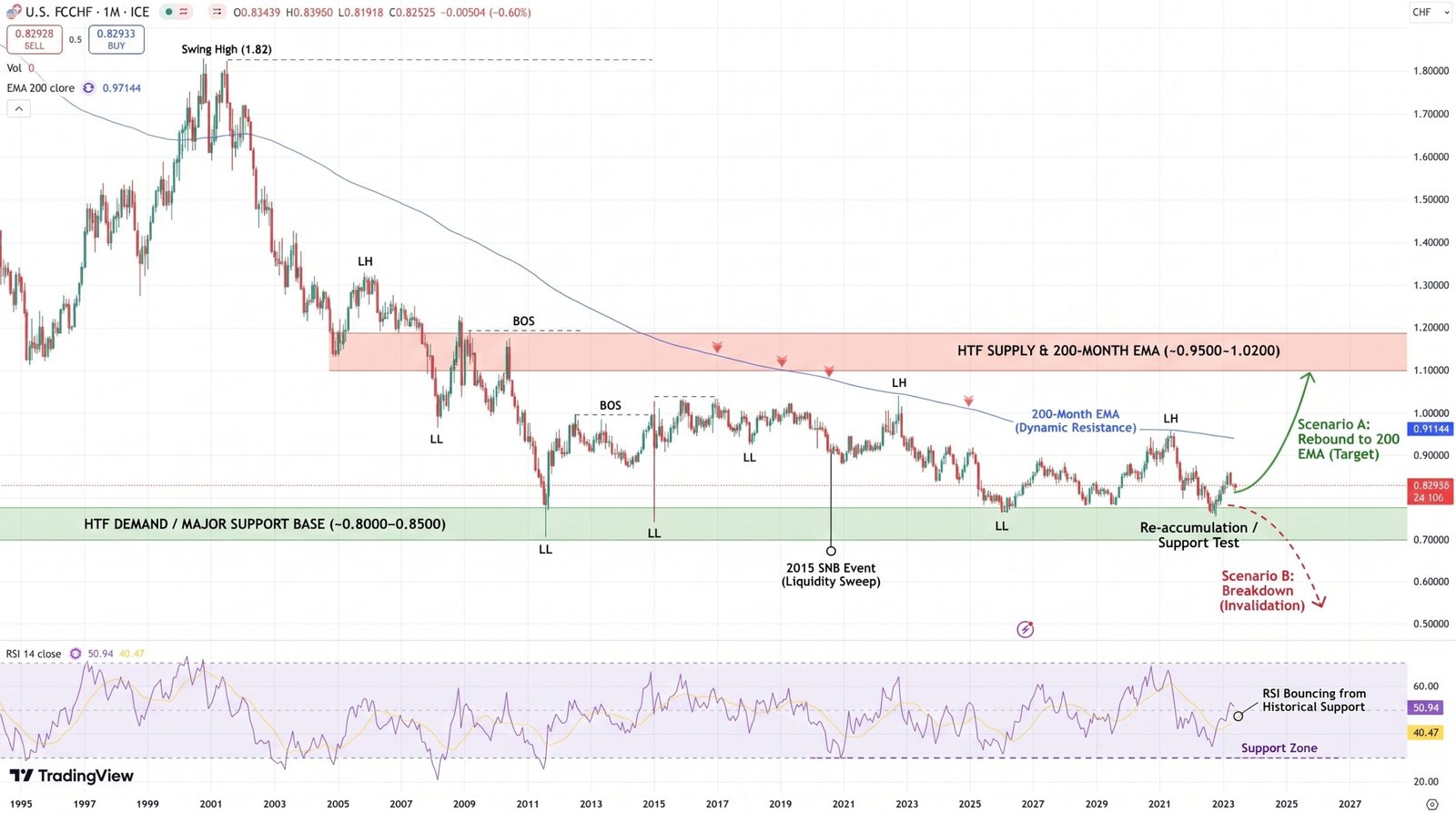
The supplied chart illustrates a long-term downtrend and alternative rebound or breakdown paths. Monthly candles help separate broad structure from daily noise. They cannot establish the exact timing of a reversal, and a trend can persist longer than a trader can finance a position.
Several annotations in this particular image conflict with the plotted axes, including some numerical zones and date markings. Its displayed prices and moving-average values should therefore not be copied into an order or treated as verified support and resistance. The image is retained as a conceptual illustration of the submitted analysis; exact levels require a clean, current data chart.
When reviewing a current chart, record the instrument, data feed, timeframe and observation date. Distinguish a completed monthly close from an unfinished candle. A test of a moving average is an observation, while a forecast that the test will hold is an interpretation. Keeping those separate makes the analysis easier to update and audit.
Three paths for the dollar–franc outlook
| Scenario | Conditions to watch | Evidence that weakens it |
|---|---|---|
| Higher USD/CHF | A more supportive US relative-rate outlook and less demand for francs | A sustained narrowing in expected US rate advantage or renewed franc demand |
| Range trading | Offsetting policy and capital-flow influences without a persistent directional change | A durable repricing of policy or a break in the underlying assumptions |
| Lower USD/CHF | Stronger franc demand and a less supportive dollar outlook | A reversal in relative expectations or flows that supports the dollar |
These are conditional paths, not assigned probabilities. Before adopting one, specify what new evidence would change the view. An outlook that cannot be revised in response to contrary evidence is difficult to distinguish from a fixed opinion.
What to check before the next annual review
- Policy: compare the latest Fed and SNB decisions and the reasoning behind them.
- Inflation and growth: separate one-off data surprises from sustained changes.
- Currency behaviour: compare USD/CHF with the EUR/USD outlook to help distinguish broad dollar moves from franc-specific developments.
- Technical evidence: refresh the chart and record completed monthly closes, rather than reusing snapshot quotes.
- Assumptions: retain, revise or retire the dated scenario ranges explicitly.
An annual review is a practical baseline for this long-term guide. A major policy change or a clear failure of the original assumptions warrants an earlier update. The next routine review should revisit the horizon labels as well as the numbers; a completed calendar year should become historical evaluation rather than remain presented as a future forecast.
Frequently asked questions
Will USD/CHF rise or fall by 2030?
No direction is certain. The September 2026 research range was 0.72–0.90 for 2030, conditional on assumptions that need periodic review. Relative policy expectations, inflation and demand for the two currencies could produce outcomes outside it.
Does a stronger Swiss franc mean USD/CHF rises?
No. With other factors unchanged, a stronger franc means fewer francs are needed to buy one dollar, so USD/CHF falls. Always check the quotation direction before interpreting a forecast.
Is the franc always a safe investment?
A safe-haven reputation does not eliminate exchange-rate risk. A holder can still lose value in another base currency, and a leveraged position adds financing and liquidation risks. The term describes a pattern of demand, not a guarantee of safety.
Can the SNB control USD/CHF?
The SNB can influence monetary conditions and may use exchange-rate measures, but its mandate does not promise a particular USD/CHF price. Market expectations and global demand remain relevant.
Can this forecast be used as a trade signal?
No. It is a long-term scenario framework. It provides no executable entry, stop or position size. Read the guide to leverage trading before evaluating how a currency move could affect a leveraged account.
Methodology, sources and review record
This guide combines the supplied September 2026 research scenarios with an evergreen explanation of their drivers. Primary SNB sources support the policy and currency background; they do not endorse AAFX’s numerical ranges. The October 28, 2026 revision removed stale spot-price and policy-rate claims, retained the submitted chart with its limitations identified, and clarified the difference between scenarios and live signals.
For related analysis, visit the forex forecasts hub and the broader price predictions library. Educational analysis is not personalised investment advice. Currency and leveraged trading involve risk, including losses that can occur faster than a long-term thesis changes.