The US Dollar Index (DXY) is holding near 100.35 at the start of the week as markets increase bets on another Federal Reserve rate hike before the end of 2026. DXY was recently around 100.37, up 0.15%, after reaching a seven-week high near 100.56 last week. The move comes after the Fed raised its policy rate by 25 basis points to 3.75%-4.00% on September 16, its first increase since 2023.
Fed tightening keeps dollar supported
The Fed’s latest decision has reinforced expectations that borrowing costs could remain elevated. The central bank said economic activity was expanding at a solid pace, domestic spending remained resilient and productivity growth was strong, while inflation was still elevated above its 2% objective.
Market pricing has also shifted toward another increase. The CME FedWatch measure cited in market coverage puts the probability of at least one additional hike this year at almost 88%. Separately, the Fed’s September projections showed that most policymakers expect another increase before year-end.
The dollar is also responding to renewed attention on US inflation. Minneapolis Fed President Neel Kashkari said Sunday that price pressures remain too high across the US economy and are not limited to higher oil prices. He backed last week’s rate increase and stressed the importance of returning inflation to the Fed’s 2% target.
Key factors for the dollar include:
- Fed policy: The benchmark rate now stands at 3.75%-4.00%.
- Inflation: Price pressures remain above the Fed’s 2% objective.
- Economic activity: Consumer spending and productivity remain resilient.
Goolsbee remarks put inflation in focus
Investors are closely monitoring Fed officials now that the policy-meeting blackout period has ended. Chicago Fed President Austan Goolsbee spoke in London at an Official Monetary and Financial Institutions Forum event on Monday, with markets watching for clues about the path of interest rates.
Goolsbee said stronger underlying demand could be contributing to persistent inflation and argued that the Fed may need to respond with higher rates if the economy is overheating. He also pointed to strong investment in artificial intelligence and continuing supply disruptions as factors complicating the inflation outlook. US inflation stood at 3.7% in July, according to the data cited in his remarks.
Those comments matter for the dollar because expectations for higher US interest rates can increase the relative return available from dollar-denominated assets. However, future policy will depend on incoming inflation, labor-market and growth data rather than speeches alone.
DXY technical outlook stays positive
On the daily chart, the US Dollar Index is trading around 100.35, above its 20-day exponential moving average at 99.63. The technical setup therefore remains constructive while DXY holds above that average.
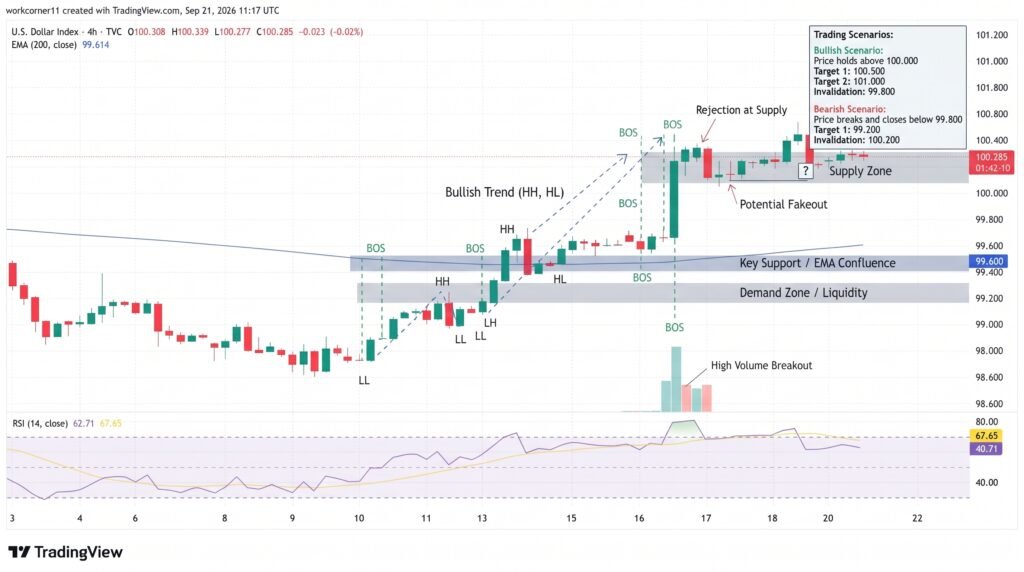
The Relative Strength Index (RSI) is at 63.15, showing positive momentum without reaching the traditional 70 threshold commonly associated with overbought conditions.
A sustained move above the 100.35 area would keep attention on last week’s high near 100.55. By contrast, a daily close below the 20-day EMA at 99.63 would weaken the immediate upside structure and indicate that momentum is losing strength.
Conclusion:
The US Dollar Index remains supported near 100.35 as markets price a higher probability of another Federal Reserve rate increase in 2026. Recent Fed communication has kept inflation at the center of the policy debate, while Goolsbee and Kashkari have highlighted persistent price pressures. Technically, DXY remains above its 20-day EMA at 99.63, with 100.55 representing the next notable upside reference. Future direction will depend heavily on incoming US economic data and further Fed guidance.
Sources & Methodology
Primary-source standard: Market-moving facts should link to original data releases, regulator notices, company filings or official project announcements whenever available. Secondary reporting is used for additional context, not as a substitute for original evidence.
Page last reviewed: