
EUR/USD is consolidating after last week’s decline, with the pair trading below the psychologically important 1.1500 level and close to its seven-week low around 1.1455. The Euro has received limited support from softer Oil prices as the Federal Reserve maintains a firmer policy stance and political uncertainty in Germany weighs on sentiment. The dollar also benefited last week after the Fed raised its target range by 25 basis points to 3.75%-4.00%.
Chicago Fed President Austan Goolsbee has reinforced the inflation focus, saying the US economy does not currently have an employment problem but does face an inflation problem. That message keeps attention on the possibility that US interest rates may remain restrictive for longer, supporting demand for the dollar.
Germany has added another source of pressure for the Euro. Chancellor Friedrich Merz’s CDU suffered major losses in regional elections, including failing to clear the 5% threshold in Mecklenburg-Western Pomerania, while the AfD recorded a strong result. Merz has said he intends to remain in office and continue his economic reform program.
Fed Policy and PMI in Focus
The next major catalyst is the release of preliminary Eurozone PMI and US PMI data on Wednesday. These surveys will provide an early reading on business activity, new orders and economic momentum across the two economies.
The euro-area economy has shown resilience despite energy and geopolitical shocks. The ECB’s September projections show real GDP increased 0.4% quarter-on-quarter in the second quarter of 2026, while the central bank expects full-year growth of 0.9%. However, the ECB also projects inflation at 3.0% for 2026, reflecting continued energy-related pressure.
Key developments for EUR/USD this week include:
- Wednesday’s preliminary Eurozone and US PMI releases.
- Further comments from Federal Reserve and ECB officials.
- Developments surrounding Germany’s government and reform agenda.
1.1450 Support Remains Critical
From a technical perspective, EUR/USD remains under pressure after failing to sustain levels above its longer-term moving averages. On the four-hour chart, the pair has traded below the 100- and 200-period simple moving averages, while a bearish trend line is developing around 1.1515.
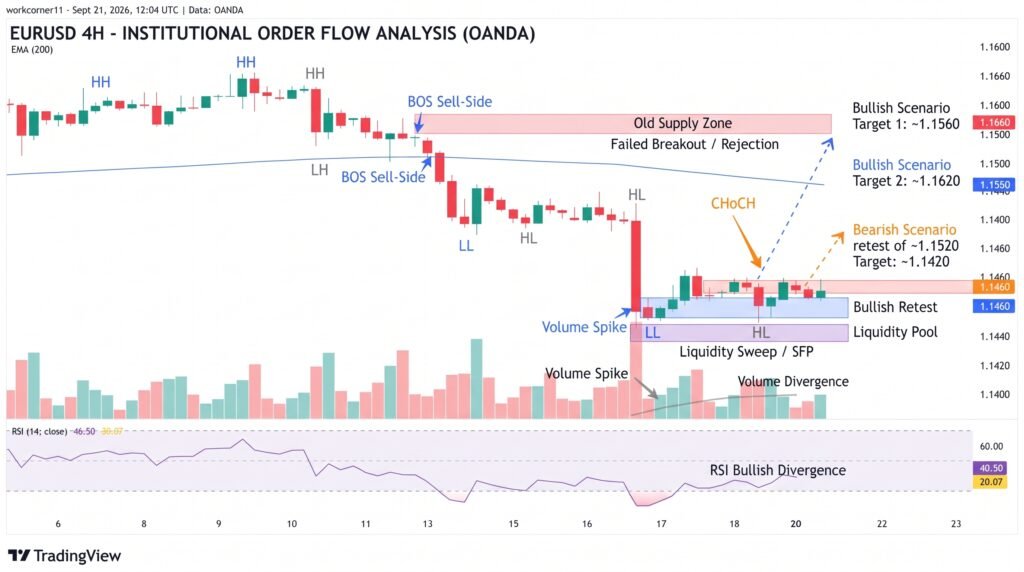
The first important downside reference is the recent 1.1455 low. A sustained break below that area would bring 1.1420 into focus, followed by the 1.1350 region. The broader chart also identifies the 78.6% Fibonacci retracement of the August recovery near 1.1410 as another technical level.
On the upside, a recovery above 1.1500 could shift attention toward 1.1515 and then the 1.1590 area, where the 100- and 200-period averages converge. Momentum remains fragile, with the Relative Strength Index near oversold territory and the Moving Average Convergence Divergence below zero.
Conclusion:
EUR/USD remains constrained below 1.1500 as monetary-policy expectations, German political uncertainty and upcoming PMI data shape the near-term outlook. The 1.1455-1.1450 area is the immediate technical zone to watch, while 1.1515 and 1.1590 represent successive recovery barriers. A decisive move through either side of these levels could provide clearer direction for the pair as traders assess the relative strength of the US and Eurozone economies.
Sources & Methodology
Primary-source standard: Market-moving facts should link to original data releases, regulator notices, company filings or official project announcements whenever available. Secondary reporting is used for additional context, not as a substitute for original evidence.
Page last reviewed: