
EUR/USD extends its decline for a third consecutive session, trading around 1.1380-1.1375 during Asian hours on Thursday after touching its lowest level since July 28. The pair remains below 1.1400 as traders reduce directional exposure ahead of the meeting between U.S. President Donald Trump and Chinese President Xi Jinping. Meanwhile, the U.S. Dollar has paused after reaching a nearly two-month high, limiting additional losses in the Euro. Still, expectations for further Federal Reserve tightening and political uncertainty in Europe continue to weigh on the pair.
Dollar Strength Keeps EUR/USD Lower
The dollar remains supported by expectations that the Federal Reserve may keep monetary policy restrictive for longer. The Fed raised its federal funds target range by 25 basis points on September 16 to 3.75%-4.00%, citing elevated inflation and resilient domestic spending. The central bank also said economic uncertainty remains high, partly because of geopolitical developments.
The September policy decision has kept interest-rate expectations central to the currency market. Investors are also monitoring incoming U.S. economic data for evidence that could influence the timing of the Fed’s next moves. The next scheduled FOMC meeting is October 27-28.
At the same time, the euro faces pressure from political uncertainty in Germany and broader concerns surrounding European fiscal conditions. Recent market reporting has also highlighted political and fiscal risks across major euro-area economies, creating an additional source of caution for euro buyers.
- EUR/USD: 1.1380-1.1375
- Immediate psychological resistance: 1.1400
- Fed target range: 3.75%-4.00%
Trump-Xi Summit Adds Market Risk
The meeting between Trump and Xi is a major near-term event for financial markets. The two leaders are scheduled to meet in Washington on September 24, with trade, technology and broader geopolitical issues expected to feature prominently in discussions. The summit follows efforts to maintain the U.S.-China trade truce established in 2025.
Any change in expectations surrounding U.S.-China trade relations could affect demand for the dollar and other major currencies. The Chinese yuan has recently strengthened, with the People’s Bank of China setting its daily midpoint at its strongest level since February 2023 ahead of the summit.
For EUR/USD, the immediate reaction may depend on whether the summit changes broader expectations for global trade, risk sentiment or U.S. monetary policy. Until then, traders may remain reluctant to extend short positions aggressively after the pair’s recent decline.
EUR/USD Technical Levels to Watch
The technical structure remains bearish, although momentum has reached an extreme. The daily Relative Strength Index (RSI) has fallen to 25.47, placing the indicator in oversold territory. This can increase the risk of a short-term rebound, but it does not by itself establish a lasting price bottom.
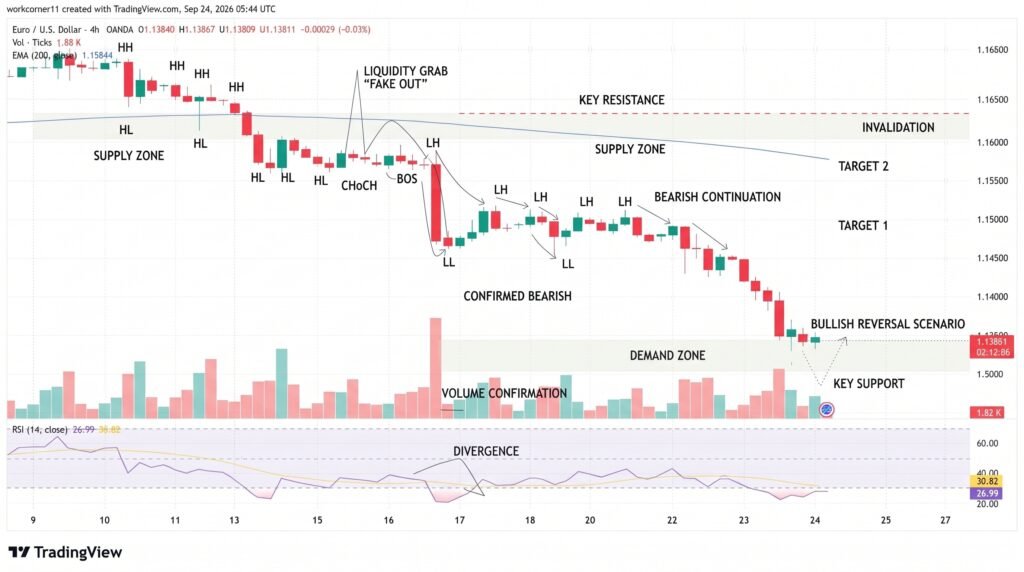
The MACD remains below zero near -0.0025, confirming that downside momentum is still dominant. A recovery could initially face resistance around 1.1400, followed by the 1.1420-1.1425 area, where sellers may reassess the strength of the decline.
On the downside, the June low near 1.1325 is the first significant support. A sustained break below that level would expose 1.1300, while a deeper decline could bring the 61.8% Fibonacci expansion at 1.1244 into focus.
Key levels:
- Resistance: 1.1400, 1.1420-1.1425
- Support: 1.1325, 1.1300, 1.1244
Conclusion
EUR/USD remains under pressure near 1.1380, with dollar strength, restrictive U.S. monetary policy expectations and European political uncertainty weighing on the pair. The oversold RSI leaves room for a corrective rebound, but the negative MACD keeps the broader technical structure tilted lower. A move below 1.1325 would put 1.1300 and 1.1244 on the radar, while a recovery above 1.1425 would provide the first indication that selling pressure is easing.
Sources & Methodology
Primary-source standard: Market-moving facts should link to original data releases, regulator notices, company filings or official project announcements whenever available. Secondary reporting is used for additional context, not as a substitute for original evidence.
Page last reviewed: