
USD/JPY consolidates near 158.30 on Thursday after extending its advance toward the key 200-day simple moving average (SMA) at 158.47. Strong US economic data and a sharp rise in US Treasury yields have strengthened the US Dollar, while the Japanese Yen remains under pressure. The latest US business survey showed activity accelerating at its fastest pace in more than five years, while rising energy costs added to inflation concerns. The combination has kept markets focused on the potential path of Federal Reserve policy and the risk of further yen weakness.
Strong US Data Supports the Dollar
The September S&P Global US PMI provided a fresh boost to the dollar. The preliminary Composite Output Index increased to 58.4 from 56.0 in August, marking the strongest expansion since July 2021. S&P Global said employment also increased sharply, with payroll growth reaching its highest rate in more than four years.
The survey also showed renewed cost pressure. Input-price growth accelerated to a near four-year high, partly reflecting higher energy costs and capacity constraints. That combination of stronger activity and persistent price pressure has reinforced the case for keeping US monetary policy restrictive.
The Federal Reserve raised its target federal funds range by 25 basis points to 3.75%-4.00% on September 16. The central bank said inflation remains elevated, while economic activity is expanding at a solid pace.
- US Composite PMI: 58.4
- Previous PMI: 56.0
- Fed target range: 3.75%-4.00%
Treasury Yields Add to USD/JPY Pressure
The dollar received another boost from the sharp rise in Treasury yields. The US 10-year yield moved back above 5% on Wednesday as strong economic data and weak demand at a five-year Treasury auction intensified the bond-market selloff. Reuters reported that the 10-year yield reached its highest level since 2007.
The higher-yield environment increases the relative return available on dollar assets and has helped maintain pressure on the yen. The move is particularly relevant for USD/JPY because the pair remains highly sensitive to changes in US-Japan interest-rate differentials.
Japan’s own economic data are also becoming important. S&P Global’s September flash PMI showed Japan’s private-sector activity remained strong, while inflation pressures stayed elevated. The data could keep expectations for additional Bank of Japan tightening in focus.
USD/JPY Technical Levels to Watch
The daily chart remains constructive for USD/JPY, with the pair trading around 158.30 and testing the 200-day SMA at 158.47. The Relative Strength Index (RSI) is rising above the 50 midpoint, while the MACD histogram is printing wider positive bars, indicating stronger upside momentum.
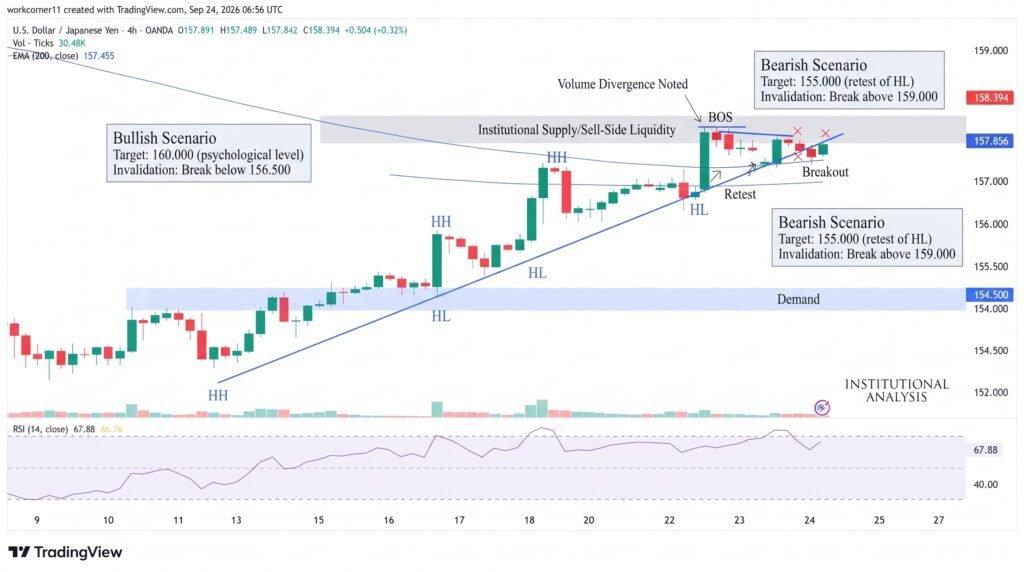
A sustained break above the 200-day SMA would place the late-August and early-September highs near 160.35 on the radar. That level represents the next major technical barrier if buyers maintain control.
On the downside, Wednesday’s low at 157.36 provides the first nearby support. A break below that level would expose the September 21 low near 156.60, followed by the September 17 low around 155.35.
Key levels:
- Resistance: 158.47 and 160.35
- Support: 157.36, 156.60 and 155.35
- 200-day SMA: 158.47
Conclusion
USD/JPY remains close to the 158.47 200-day SMA after strong US PMI data and higher Treasury yields strengthened the dollar. The latest US activity data point to resilient growth but also persistent cost pressures, keeping Federal Reserve policy expectations central to the pair’s outlook. Technically, a sustained break above 158.47 would expose 160.35, while a move below 157.36 could shift attention toward 156.60 and 155.35. Japan’s policy outlook and any official response to yen weakness remain additional factors for traders to monitor.
Sources & Methodology
Primary-source standard: Market-moving facts should link to original data releases, regulator notices, company filings or official project announcements whenever available. Secondary reporting is used for additional context, not as a substitute for original evidence.
Page last reviewed: