
GBP/USD trades around 1.3210 in early European trading Friday, with the British Pound remaining under pressure against the US Dollar. The decline comes as investors assess the UK’s deteriorating fiscal position ahead of the October 28 Budget and expectations for further Bank of England policy tightening. Official data showed that UK public-sector borrowing reached £18.3 billion in August, £3.5 billion above the Office for Budget Responsibility forecast. Financial-year borrowing through August reached £77.3 billion, £8.1 billion above the OBR projection.
UK Fiscal Risks Weigh on Sterling
The latest borrowing figures have increased attention on the government’s fiscal position ahead of the autumn Budget. The Office for National Statistics said August borrowing rose £2.9 billion from a year earlier, while the cumulative April-to-August figure remained £8.1 billion above the OBR forecast.
The figures do not necessarily mean UK finances have deteriorated across every measure. Borrowing during the first five months of the financial year was actually £2.2 billion lower than the same period last year. However, government spending has exceeded the OBR’s expectations, leaving policymakers with less room against existing fiscal plans.
UK public-sector net debt was provisionally estimated at £2.99 trillion at the end of August, equivalent to 93.8% of GDP.
- August borrowing: £18.3 billion
- April-August borrowing: £77.3 billion
- August borrowing above OBR forecast: £3.5 billion
- Net debt-to-GDP: 93.8%
BoE Rate Outlook Supports the Pound
Monetary policy presents a different dynamic for Sterling. The Bank of England held Bank Rate at 3.75% at its September meeting, although three of nine policymakers voted for a 25-basis-point increase. The central bank said UK CPI inflation had risen to 3.1% in August and warned that prolonged energy-price increases could generate additional inflation pressure.
The BoE’s next scheduled policy decision is November 5. Markets therefore remain focused on whether persistent energy costs and above-target inflation will encourage further tightening. That prospect can provide some support for Sterling, even as fiscal concerns limit its performance.
The policy picture is complicated by weaker domestic activity and restrictive financial conditions. The BoE said the eventual policy response will depend on the scale and duration of the energy shock and how strongly higher costs pass through to wages and prices.
GBP/USD Technical Levels in Focus
From a technical analysis perspective, GBP/USD remains below its 100-day simple moving average near 1.3425 and below the middle Bollinger Band around 1.3438. This keeps the short-term structure tilted lower.
The 14-period Relative Strength Index is near 24, placing momentum in oversold territory. Such a reading indicates heavy recent selling but does not, by itself, establish that a reversal is underway.
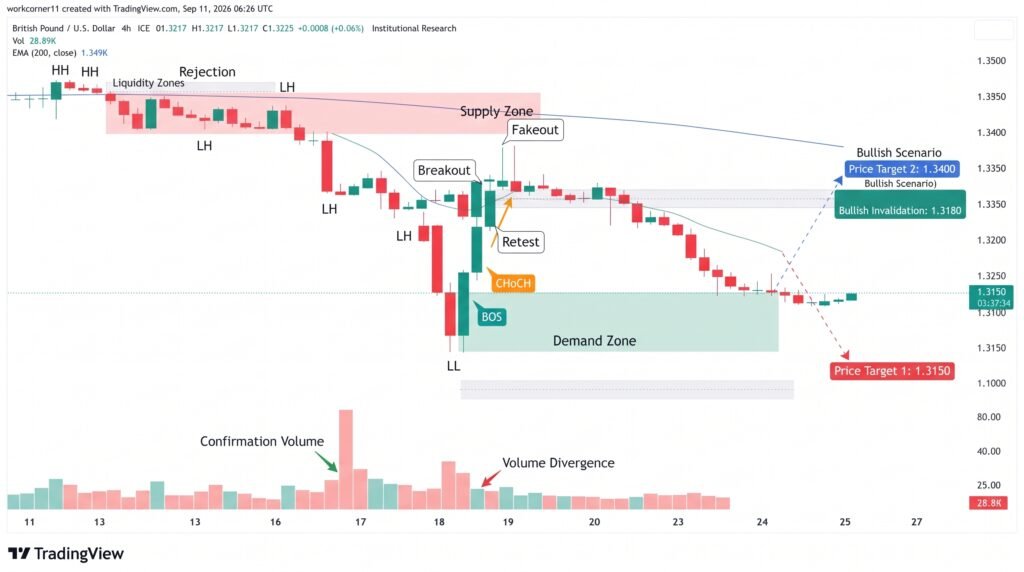
Near-term levels include:
- Initial resistance: 1.3215
- Next resistance: 1.3273
- 100-day SMA: 1.3425
- Key support: 1.3140
- Lower support: 1.3038
A sustained break below 1.3140 would bring the November 2025 lows near 1.3038 and 1.3010 into focus. Conversely, reclaiming 1.3273 would reduce immediate downside pressure, while a move above the 100-day SMA would materially change the current technical structure.
Conclusion
GBP/USD remains pressured near 1.3210 as UK fiscal concerns combine with a firm dollar backdrop. The government’s £77.3 billion financial-year borrowing figure is above the OBR’s forecast, while the BoE continues to balance 3.1% inflation against restrictive monetary conditions. For the currency pair, 1.3140 is the key downside reference, while 1.3425 remains an important technical barrier. Upcoming UK fiscal announcements, inflation data and BoE expectations should remain central to Sterling’s next move.
Sources & Methodology
Primary-source standard: Market-moving facts should link to original data releases, regulator notices, company filings or official project announcements whenever available. Secondary reporting is used for additional context, not as a substitute for original evidence.
Page last reviewed: