
Dogecoin (DOGE) traded near $0.085 on Friday after falling more than 11% during the week, as large holders reduced their positions and technical indicators weakened. Data from Santiment showed that wallets holding between 1 million and 100 million DOGE had collectively shed approximately 100 million tokens since Tuesday. Although derivatives data offered some signs of optimism, the meme coin remained close to a critical support area near $0.084. A decisive break below that level could expose DOGE to further losses, while recovering nearby moving averages would be necessary to ease bearish pressure.
Whale Selling Adds to DOGE Pressure
On-chain data points to growing distribution among some of Dogecoin’s largest holders. According to Santiment’s Supply Distribution metric, wallets holding 1 million–10 million DOGE and those holding 10 million–100 million DOGE reduced their combined balances by roughly 100 million tokens over the period covered by the report.
Large-wallet selling can increase available supply and weaken prices when demand fails to absorb the additional tokens. However, wallet-balance changes alone cannot establish whether investors are taking profits, reallocating holdings or transferring assets between addresses.
Data summarized by CryptoQuant also indicated that Dogecoin’s spot and futures markets were showing signs of overheating, with large orders in futures markets leaning toward sellers. This suggests that some market participants remain cautious despite the possibility of short-term rebounds.
The combination of whale distribution and weak price momentum leaves DOGE vulnerable if buyers fail to defend the current support zone.
Derivatives Offer a Bullish Counterpoint
Despite the decline, derivatives indicators suggest that some traders are positioning for a recovery. CoinGlass reported a DOGE long-to-short ratio of 1.18 on Friday, near its highest level in more than a month. A reading above one indicates that long positions outweigh short positions within the metric’s tracked accounts.
Dogecoin’s funding rate also remained positive at 0.0010%, following a shift into positive territory in September. In perpetual futures markets, positive funding generally means traders holding long positions pay those holding shorts, reflecting a premium for bullish exposure.
These figures do not guarantee a rebound. A market can maintain bullish derivatives positioning while spot prices continue falling, particularly when leveraged traders face liquidation or buyers lack sufficient demand to absorb selling.
DOGE Technical Outlook: $0.084 Matters
Dogecoin hovered near $0.085, just above the previously broken ascending trendline around $0.084. The price remained below several key exponential moving averages (EMAs), keeping the short-term outlook tilted to the downside.
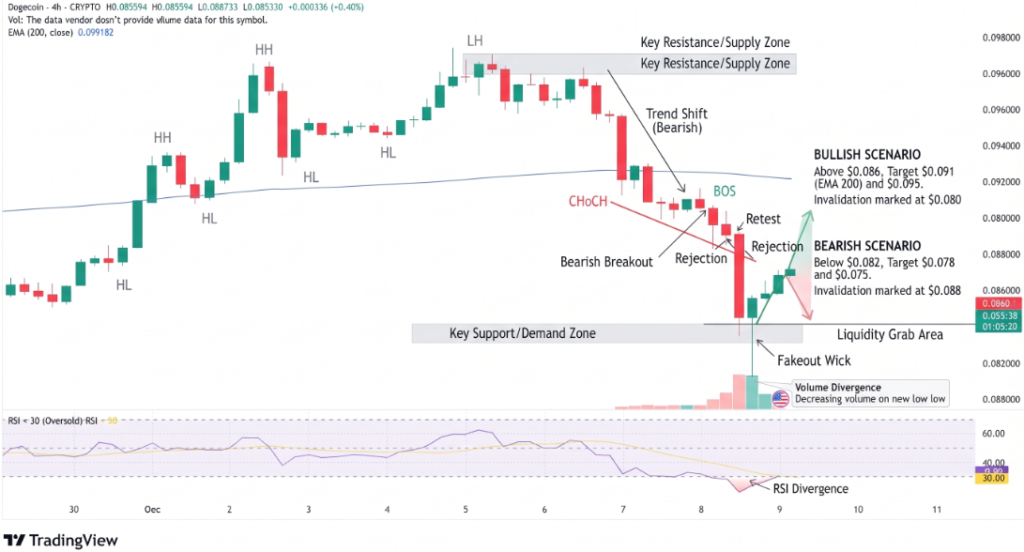
The Relative Strength Index (RSI) stood near 40, indicating subdued momentum. Meanwhile, the Moving Average Convergence Divergence (MACD) remained below zero and its signal line, suggesting that sellers retained control.
Key technical levels include:
- $0.084: Immediate trendline support.
- $0.078 and $0.070: Potential downside levels if support breaks.
- $0.086–$0.088: Initial resistance around the 100-day and 50-day EMAs.
- $0.093 and $0.102: Higher resistance levels that could become relevant if momentum improves.
A daily close below $0.084 would strengthen the bearish case, while a sustained recovery above $0.088 could provide an early indication that selling pressure is easing.
Conclusion
Dogecoin faces competing signals as large holders reduce exposure while derivatives traders maintain a modest bullish bias. The $0.084 support area is the immediate level to watch, with $0.078 and $0.070 in focus if selling intensifies. A recovery above $0.088 would improve the near-term picture, but stronger confirmation would require DOGE to reclaim the $0.093 resistance zone. Whale activity, spot demand and momentum indicators will remain central to the next move.
Sources & Methodology
Primary-source standard: Market-moving facts should link to original data releases, regulator notices, company filings or official project announcements whenever available. Secondary reporting is used for additional context, not as a substitute for original evidence.
Page last reviewed: