
AUD/USD traded near 0.6960 on Tuesday as a modest pullback in the US dollar offered temporary relief to the Australian currency. However, the pair’s broader technical picture remains bearish, with prices below the declining 20-day exponential moving average (EMA) at 0.7009. Investors are preparing for US inflation figures on Wednesday and Australian employment data on Thursday, both of which could influence the next move. Unless buyers reclaim 0.7009, the October low at 0.6904 remains a key downside target, followed by support near 0.6865.
US Inflation Keeps Dollar in Focus
The US dollar eased as Treasury yields retreated ahead of September’s Consumer Price Index (CPI) report. The US Dollar Index (DXY), which measures the greenback against six major currencies, slipped 0.16% to around 102.40, remaining close to Monday’s reported yearly high of 102.61. The 10-year US Treasury yield also edged lower, trading near 5.20%.
Economists expect headline US inflation to accelerate to 3.7% year over year from 3.4% in August. Core inflation, which excludes food and energy, is forecast at 2.5%, up from 2.4%. The figures will help investors assess whether price pressures are strengthening and how the Federal Reserve may respond.
A hotter reading could support the dollar by reinforcing expectations for tighter monetary policy. Softer inflation could pull yields lower and give AUD/USD room to recover. Markets broadly expect the Fed to leave interest rates unchanged at its next meeting, although incoming data could shift expectations.
Australian Data Could Test the Aussie
The Australian dollar also faces domestic and regional catalysts. Investors are watching China’s September inflation data, due Wednesday, for clues about consumer demand and pricing conditions in one of Australia’s most important trading partners.
Australia’s September employment report is scheduled for Thursday, October 15, according to the Australian Bureau of Statistics. Strong hiring could support the Australian dollar by reinforcing expectations for a resilient economy. Weaker employment figures could increase pressure on the currency, particularly if US inflation simultaneously strengthens the dollar.
The key developments to watch are:
- US CPI: Stronger inflation may support the greenback.
- China inflation: Weak demand could weigh on sentiment toward the Australian dollar.
- Australian jobs: Resilient employment could help limit AUD/USD losses.
AUD/USD Technical Levels to Watch
On the daily chart, AUD/USD remains below its 20-day EMA at 0.7009, indicating that short-term momentum favors sellers. The 14-day Relative Strength Index (RSI) stands at 37.6, below the neutral 50 mark but not yet in conventional oversold territory. This suggests bearish pressure persists without necessarily ruling out a temporary rebound.
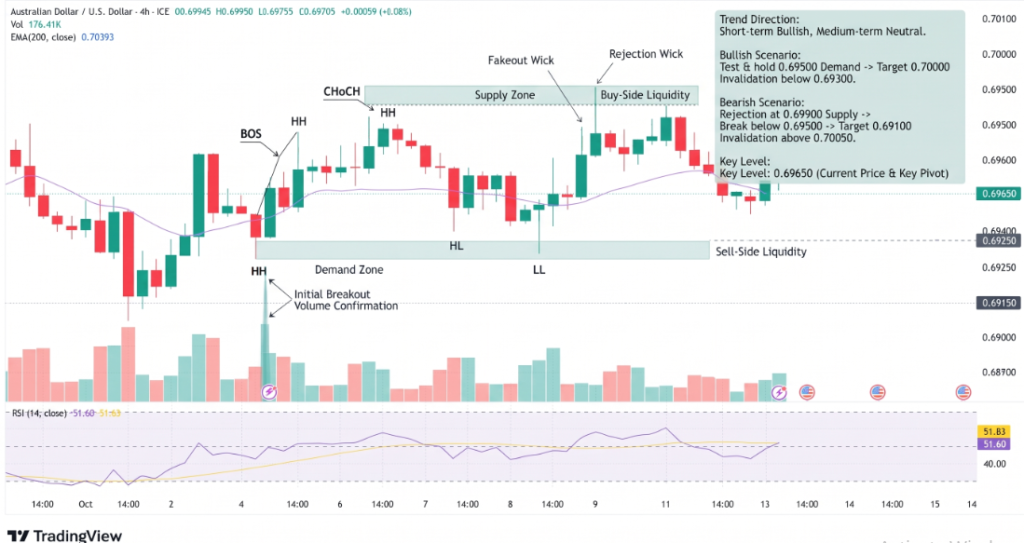
The main technical levels are:
- Resistance: 0.7009 at the 20-day EMA.
- Initial support: 0.6904, the October 1 low.
- Next downside level: 0.6865, the June low.
Conclusion
AUD/USD remains vulnerable while it trades beneath the declining 20-day EMA. A sustained break above 0.7009 would ease immediate bearish pressure, while a decisive move below 0.6904 could expose 0.6865. With US inflation, Chinese prices and Australian employment data approaching, traders should watch for confirmation rather than assume that Tuesday’s modest rebound marks a lasting reversal.
Sources & Methodology
Primary-source standard: Market-moving facts should link to original data releases, regulator notices, company filings or official project announcements whenever available. Secondary reporting is used for additional context, not as a substitute for original evidence.
Page last reviewed: