
The US Dollar Index (DXY) slipped 0.17% to around 102.38 on Tuesday but remained close to Monday’s yearly high of 102.61, as investors weighed softer US Treasury yields against expectations of tighter Federal Reserve policy. The index measures the dollar against six major currencies. With September’s US inflation reports approaching, traders are assessing whether resilient economic growth and persistent price pressures can support another advance toward 103.00. Technical indicators favor further gains, although elevated momentum raises the risk of a short-term pullback.
Fed Outlook Supports Dollar Strength
The dollar’s broader outlook remains supported by expectations that the Federal Reserve may need to keep monetary policy restrictive to contain inflation. Analysts at ING have highlighted the combination of resilient US growth, above-target inflation and the possibility of additional rate increases as factors supporting the greenback.
US Treasury markets reopened Tuesday after closing for Columbus Day on Monday. The 10-year Treasury yield was near 5.20%, down about 0.85% on the session, according to the supplied market figures. Lower yields can reduce the dollar’s near-term appeal, but they have not erased the broader bullish trend.
Cleveland Fed President Beth Hammack added to the hawkish policy narrative by warning that inflation could become entrenched if policymakers fail to respond decisively. Her remarks emphasize the central bank’s challenge: preventing persistent price increases from influencing household and business expectations.
The FXS Fed Sentiment Index reportedly rose 0.59 points to 138.92, while the FXS Speechtracker score for Hammack’s remarks reached 8.4 out of 10, above its historical average of 7.5. These proprietary measures suggest a hawkish tone, though they do not guarantee a rate increase.
US Inflation Data Is the Next Test
Investors are focusing on September’s Consumer Price Index (CPI) report, scheduled for Wednesday, October 14, followed by the Producer Price Index (PPI) on Thursday, October 15. Both releases could reshape expectations for the Fed’s next policy decisions.
The key factors to watch include:
- Headline CPI: Higher inflation could strengthen expectations for restrictive policy.
- Core inflation: Price pressures excluding food and energy may offer a clearer view of underlying trends.
- Producer prices: Rising business costs could signal further pressure on consumer prices.
A stronger-than-expected inflation report could support the dollar and Treasury yields. Cooler figures could temper rate expectations and slow the index’s advance. Investors can follow the release schedule through the US Bureau of Labor Statistics.
DXY Technical Levels and Price Outlook
On the daily chart, DXY trades near 102.38, above its 20-day exponential moving average (EMA) at 101.48. This positioning supports a bullish near-term bias. However, the 14-day Relative Strength Index (RSI) is around 69, approaching the commonly watched overbought threshold of 70. Strong momentum remains evident, but the risk of consolidation is increasing.
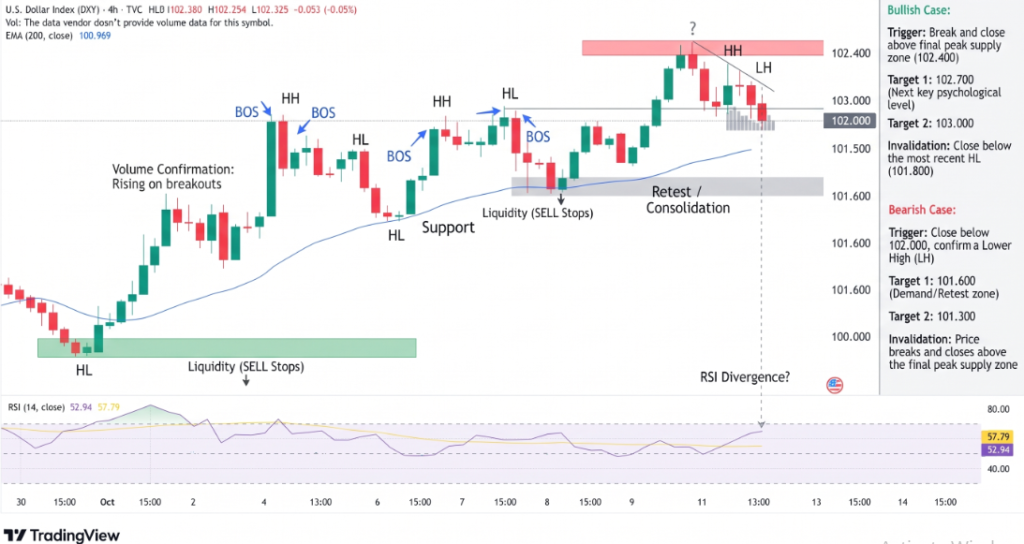
The important levels are:
- Resistance: 102.61, the recent high; a decisive break could open the way toward 103.00.
- Support: 101.48, where the 20-day EMA may attract buyers during a pullback.
Conclusion
The US Dollar Index retains an upward bias as hawkish Fed expectations and persistent inflation concerns support demand for the greenback. A sustained break above 102.61 would strengthen the case for a move toward 103.00. However, an overbought RSI and upcoming inflation releases leave room for volatility. A decline toward 101.48 would test whether buyers remain willing to defend the broader uptrend.
Sources & Methodology
Primary-source standard: Market-moving facts should link to original data releases, regulator notices, company filings or official project announcements whenever available. Secondary reporting is used for additional context, not as a substitute for original evidence.
Page last reviewed: