
EUR/USD traded near 1.1230 during Monday’s European session as political unrest and fiscal concerns in France weakened demand for the euro. The currency pair remained under pressure despite fading expectations for another Federal Reserve interest-rate increase. Markets increasingly anticipate the Fed will keep borrowing costs unchanged at its October meeting, limiting potential dollar gains. However, the euro faces its own challenges, while technical indicators suggest that sellers retain control below key moving averages. Investors are also monitoring European Central Bank commentary for fresh clues about the region’s monetary policy outlook.
French Unrest Weighs on Euro Outlook
The euro faced selling pressure as demonstrations over living costs and public services spread across France, Belgium, Italy and Portugal. France’s political uncertainty and concerns about government finances have raised questions about the region’s economic stability, weighing on sentiment toward the shared currency.
According to Reuters, the euro slipped approximately 0.1% to $1.1225 during early Asian trading on Monday, while the U.S. Dollar Index held near 101.83. The figures highlight the euro’s vulnerability as investors assess European political risks.
Meanwhile, Federal Reserve Chair Kevin Warsh offered no firm commitment on the direction of US interest rates. Markets assigned an 83.9% probability to the Fed holding rates steady at its October meeting, compared with 49% a month earlier, according to the supplied report.
Scotiabank estimated EUR/USD fair value at 1.1285, suggesting potential room for recovery if market conditions improve. However, French fiscal concerns could complicate the European Central Bank’s policy decisions, particularly if financial-market stress intensifies.
Fed Outlook and ECB Signals in Focus
Warsh’s cautious approach to forward guidance has left currency traders sensitive to incoming economic data. While easing expectations for a US rate increase may reduce support for the dollar, persistent inflation could still encourage the Fed to maintain a restrictive policy stance.
ECB Executive Board member Frank Elderson was scheduled to speak on Monday, offering investors another opportunity to assess the central bank’s outlook.
Key factors influencing the pair include:
- Federal Reserve: Markets expect rates to remain unchanged in October.
- French fiscal risks: Political uncertainty could increase pressure on the euro.
- ECB policy: Officials’ comments may influence expectations for future rate decisions.
- Economic data: Inflation and growth figures could shift interest-rate expectations on both sides of the Atlantic.
EUR/USD Forecast: Support at 1.1151
The technical outlook remains cautious as EUR/USD trades below its 100-day Simple Moving Average (SMA) and the middle line of its 20-day Bollinger Bands. The Relative Strength Index (RSI) stands near 40, indicating weak momentum without yet reaching conventional oversold territory.
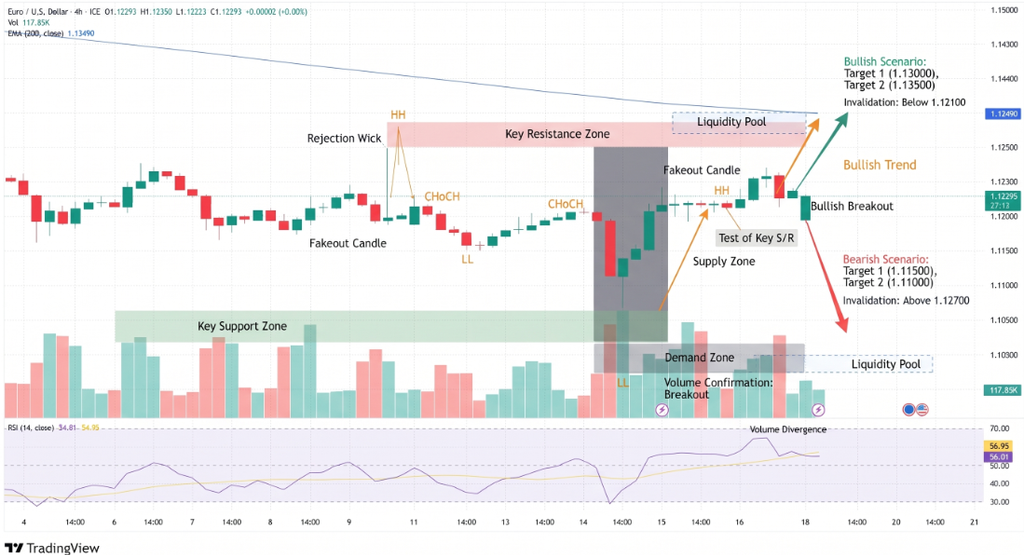
Initial support sits at 1.1151, the October 15 low. A decisive break could expose the lower Bollinger Band near 1.1105, followed by the May 2025 low at 1.1050.
On the upside, resistance stands at 1.1270, followed by 1.1353 and the broader resistance zone around 1.1440–1.1465, where the upper Bollinger Band and 100-day SMA provide additional technical barriers.
Conclusion
EUR/USD remains vulnerable while French political risks persist and prices stay below key moving averages. A break under 1.1151 would strengthen the bearish outlook, while a sustained move above 1.1270 could signal improving recovery momentum. Traders should watch ECB commentary, U.S. economic releases, and developments in France before assessing the next directional move.
Sources & Methodology
Primary-source standard: Market-moving facts should link to original data releases, regulator notices, company filings or official project announcements whenever available. Secondary reporting is used for additional context, not as a substitute for original evidence.
Page last reviewed: