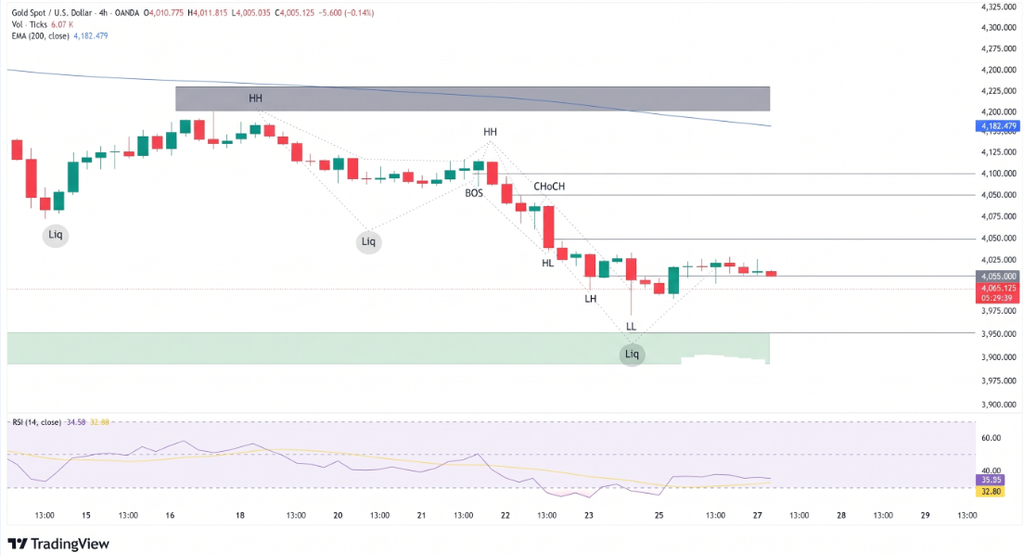
Gold prices edged lower on Tuesday as investors positioned for the Federal Reserve’s October 27–28 policy decision and assessed diplomatic efforts to ease tensions between the United States and Iran. Spot gold fell 0.2% to $4,010.39 an ounce, while US gold futures declined 0.4% to $4,023.57. A slightly stronger dollar added pressure, with the US Dollar Index rising 0.1% to 102.04. Lower oil prices offered some relief from inflation concerns, but uncertainty over future interest rates continued to limit demand for bullion.
Gold Prices React to Fed Rate Outlook
The Federal Reserve is the main near-term catalyst for gold. Markets broadly expect policymakers to hold the benchmark federal funds rate at 3.75%–4.00% at Wednesday’s meeting, although investors are looking for signals about whether borrowing costs could rise again before year-end. A Reuters poll published October 20 found that economists overwhelmingly expected an October pause, with a further increase anticipated in December. Reuters’ Fed outlook highlights the tension between persistent inflation and the risk of tightening policy too aggressively.
Gold does not pay interest, making it less attractive when interest rates and bond yields rise. Conversely, expectations of lower rates can support bullion by reducing the opportunity cost of holding the metal. Traders are therefore watching the Fed’s statement and Chair Kevin Warsh’s remarks for clues about the policy path.
Recent US inflation data have complicated that outlook. Elevated energy costs risk feeding into transport, production and consumer prices, potentially forcing policymakers to maintain restrictive conditions for longer. The CME FedWatch Tool tracks market-implied rate expectations as traders reassess the likelihood of future policy moves.
Iran Diplomacy Eases Oil and Inflation Risks
Crude oil prices declined for a second consecutive session as diplomatic efforts raised hopes of preventing a further escalation in the US-Iran conflict. Lower energy prices can ease inflation pressure, potentially reducing the need for additional monetary tightening and improving the outlook for gold.
However, the improvement remains fragile. Any renewed disruption to Middle Eastern energy supplies could push oil prices higher, revive inflation concerns and strengthen expectations for tighter monetary policy.
Other precious metals traded mixed on Tuesday:
- Silver: Down 0.03% to $53.9605 an ounce.
- Platinum: Lower 0.08% to $1,529.27.
- Palladium: Spot prices rose 0.07% to $1,046.65, while futures fell 0.9% to $1,043.25.
Gold had advanced 0.5% in the previous session before retreating, illustrating how quickly sentiment can shift as traders balance geopolitical developments against interest-rate risks.
Gold Outlook: Key Events Ahead
Investors will focus on Wednesday’s Fed decision and any change in guidance about inflation and future rate increases. Thursday’s US economic releases, including third-quarter GDP and September personal consumption expenditures inflation data, could provide further direction. Recent Reuters reporting also noted that gold had recovered from a Friday low of $3,975 an ounce as softer oil prices eased inflation fears.
Conclusion
Gold remains near $4,010 as traders weigh the prospect of a Fed pause against the risk of further tightening later this year. Easing US-Iran tensions and lower oil prices could support bullion, but persistent inflation and a firmer dollar may restrict gains. The Fed’s guidance will be central to gold’s next move.
Sources & Methodology
Primary-source standard: Market-moving facts should link to original data releases, regulator notices, company filings or official project announcements whenever available. Secondary reporting is used for additional context, not as a substitute for original evidence.
Page last reviewed: