Gold traded near a three-month low on Monday after losing 4.1% last week, with prices remaining below the psychologically important $4,000 an ounce threshold. Investors weighed elevated oil prices, persistent inflation risks and the outlook for U.S. interest rates ahead of the Federal Reserve’s October 27–28 policy meeting. Spot gold was little changed at $3,995.42 an ounce, while U.S. gold futures held near $4,007.45. The combination of higher energy costs and elevated bond yields has made the near-term outlook more challenging for bullion.
Oil Prices Keep Gold Under Pressure
The latest decline reflects concern that expensive energy could keep inflation elevated and discourage central banks from cutting interest rates. Brent crude oil gained 6.2% last week, reaching its highest weekly close since mid-2022 before easing on Monday as diplomatic efforts raised hopes of reduced tensions in the Middle East.
Higher oil prices can raise transportation, manufacturing and household energy costs. If these increases spread across the economy, inflation may prove harder to control, potentially keeping borrowing costs higher for longer.
Gold traditionally attracts investors during periods of geopolitical uncertainty and as a potential store of value when purchasing power declines. However, the metal does not pay interest. When yields on government bonds rise, investors may prefer assets that provide regular income, increasing the opportunity cost of holding gold.
The recent sell-off highlights the competing forces shaping bullion:
- Inflation risk: Expensive energy could keep consumer prices elevated.
- Interest-rate pressure: Tighter monetary policy may support yields and weigh on gold.
- Safe-haven demand: Continued Middle East uncertainty could limit further losses.
Fed Meeting and Inflation Data in Focus
The Federal Reserve’s upcoming decision is likely to shape gold’s direction through its policy statement and guidance on future rates. Markets broadly expect policymakers to leave rates unchanged at the October meeting, but traders are watching for signals about December. The supplied market data put the probability of a December rate hike at around 78%, according to the CME FedWatch Tool.
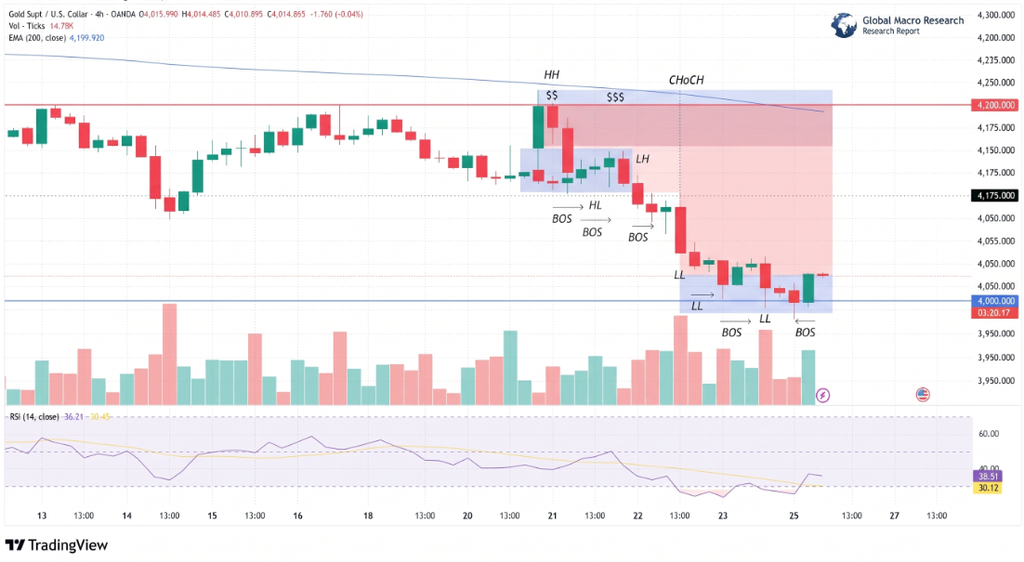
Recent U.S. consumer and producer inflation readings have reportedly exceeded expectations, adding to concerns that price pressures remain persistent. The next major data point is the Personal Consumption Expenditures price index, the Fed’s preferred inflation gauge, scheduled for October 29. The latest published report showed that annual PCE inflation reached 3.4% in August, while core inflation, which excludes food and energy, stood at 3.0%. The September report will offer a fresher assessment of price pressures.
The 10-year U.S. Treasury yield was near 5% in the supplied market snapshot, a level that can make non-yielding gold less attractive.
Conclusion
Gold’s ability to recover above $4,000 will depend partly on the Fed’s guidance, incoming inflation data and movements in oil and Treasury yields. A more hawkish message or stronger inflation reading could intensify selling pressure, while easing geopolitical risks or falling yields could provide relief. Other precious metals were mixed, with silver near $53.94 an ounce and platinum down 0.5% at $1,544.97. For gold traders, the next policy and inflation signals may determine whether the recent decline extends or stabilizes.
Sources & Methodology
Primary-source standard: Market-moving facts should link to original data releases, regulator notices, company filings or official project announcements whenever available. Secondary reporting is used for additional context, not as a substitute for original evidence.
Page last reviewed: