
The AUD/USD exchange rate traded near 0.7030 on Wednesday after Australian inflation pushed the currency pair to a one-month high during Asian trading. Annual consumer inflation accelerated to 4.3% in September from 4.0% in August, strengthening expectations of a possible November interest-rate increase by the Reserve Bank of Australia (RBA). However, a stronger US dollar limited further gains as investors awaited the Federal Reserve’s policy decision. The outlook remains cautiously positive, with technical resistance likely to determine whether the Australian dollar can extend its recovery.
Australian Inflation Raises Rate Hike Bets
The Australian Bureau of Statistics reported that annual consumer inflation reached 4.3% in September, up from 4.0% in August. The trimmed-mean inflation measure, which reduces the impact of unusually large price changes, also remained above the RBA’s 2%–3% target range.
Persistent inflation can encourage a central bank to raise interest rates to restrain demand and slow price increases. Higher Australian interest rates may attract investors seeking stronger returns, potentially supporting the Australian dollar against the US dollar. Markets consequently increased their expectations of another RBA rate increase in November, although the final decision will depend on incoming economic data and policymakers’ assessment.
The US dollar provided a counterweight. The US Dollar Index (DXY), which measures the greenback against six major currencies, strengthened amid expectations that the Fed could maintain a restrictive policy stance. Geopolitical uncertainty and elevated energy prices also supported demand for the dollar as a perceived safe-haven asset.
AUD/USD Technical Outlook: Key Levels
AUD/USD remained above 0.7000 but struggled to extend gains after reaching a fresh monthly high. The pair’s technical indicators suggest improving momentum, although its failure to establish a sustained break above the 100-day exponential moving average (EMA) leaves room for further volatility.
The Moving Average Convergence Divergence (MACD) indicator turned positive and moved above its signal line, while its expanding histogram indicated strengthening upward momentum. The Relative Strength Index (RSI) stood at 53.7, suggesting modest buying pressure without an overbought reading.
The main price levels to watch are:
- 0.7025: Initial support at the 38.2% Fibonacci retracement.
- 0.6975: Secondary support at the 23.6% retracement.
- 0.7066: Resistance at the 50% retracement.
- 0.7106: Further resistance at the 61.8% retracement.
A sustained move above 0.7066 could expose 0.7106, followed by resistance at 0.7164 and the previous swing high of 0.7238. A decline below 0.7025 would weaken the recovery and bring 0.6975 into focus. A deeper correction could expose support near 0.6893.
Fed Decision Could Set the Next Direction
The Federal Reserve’s October 27–28 meeting is the immediate catalyst for currency markets. Investors are assessing the interest-rate decision and policymakers’ guidance on inflation, economic growth and the possibility of further tightening. A hawkish message could lift the dollar and limit AUD/USD gains, even as Australian inflation supports expectations of tighter RBA policy.
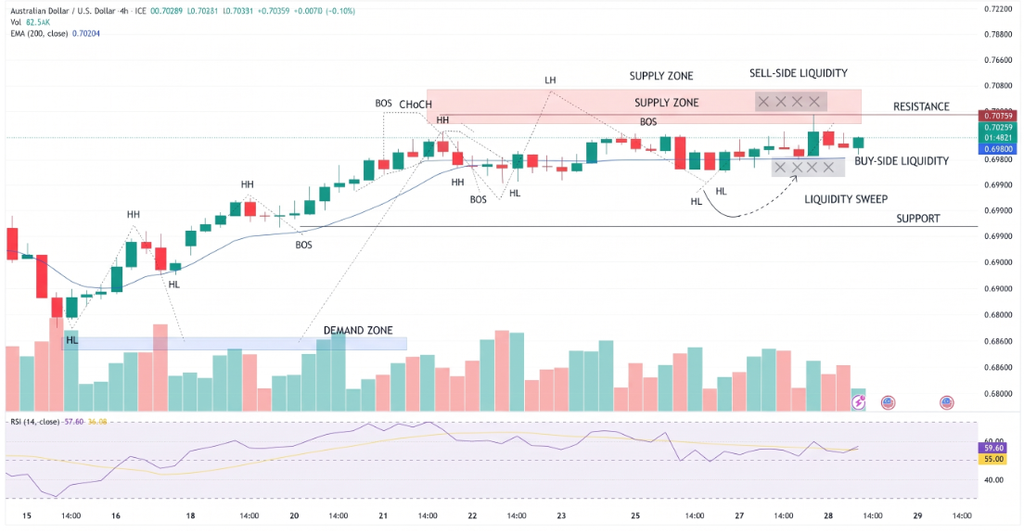
The geopolitical backdrop adds another source of uncertainty. Higher energy prices can increase inflation pressures while weakening economic activity, complicating central banks’ decisions. This leaves the currency pair sensitive to both policy announcements and changes in global risk appetite.
Conclusion
Australia’s 4.3% inflation rate has strengthened expectations of further monetary tightening, providing support for the Australian dollar. However, the Fed’s policy outlook and resistance above the current price remain important obstacles. A sustained break above 0.7066 would strengthen the recovery case, while a fall below 0.7025 could expose further losses. Traders should watch both central bank guidance and price confirmation before drawing conclusions about the next major move.
Sources & Methodology
Primary-source standard: Market-moving facts should link to original data releases, regulator notices, company filings or official project announcements whenever available. Secondary reporting is used for additional context, not as a substitute for original evidence.
Page last reviewed: