The US Dollar Index (DXY) traded near 102.25 on Thursday, October 29, holding above the psychologically important 102.00 level after the Federal Reserve kept interest rates unchanged. Investors are now focused on September’s Personal Consumption Expenditures (PCE) inflation report, due Friday, for clues about the next policy move. Although two Fed officials favored an immediate rate increase, Chair Kevin Warsh offered limited guidance on December’s decision. The dollar’s near-term direction will depend on inflation data, interest-rate expectations and whether the index can maintain its recent technical strength.
Fed Decision Keeps December Hike in Focus
The Federal Open Market Committee voted 10-2 on October 28 to maintain the federal funds rate at 3.75%-4.00%. Governor Lisa Cook and Cleveland Fed President Beth Hammack dissented, preferring a quarter-percentage-point increase. The official statement described economic activity as strong and inflation as elevated, leaving further policy tightening possible.
Markets interpreted the decision alongside Warsh’s comments, which provided little clarity about the December meeting. A firm anti-inflation stance can support the dollar when investors expect US interest rates to remain higher for longer, although the absence of explicit forward guidance can limit immediate gains.
According to the supplied market report, futures pricing implied an 83.3% probability of a December rate increase. Other estimates published around the meeting differed, highlighting how quickly market expectations can change.
The upcoming PCE price index is therefore critical. Stronger-than-expected inflation could reinforce expectations for another hike, while softer readings could reduce the appeal of dollar-denominated assets.
Inflation Outlook Supports Dollar Sentiment
The Fed’s central objective is to return inflation to 2% while supporting employment. Warsh reiterated the importance of price stability, but his limited guidance left traders dependent on incoming economic data.
Analysts at MUFG have emphasized the significance of the Fed’s decision to pause despite two calls for an increase. This division suggests policymakers remain concerned about inflation, even as they assess whether existing monetary restrictions are sufficient.
The dollar’s performance against major currencies will also depend on how other central banks respond. Differences in interest-rate expectations can influence capital flows, making the euro and yen particularly important counterparts in broader currency-market movements.
DXY Technical Forecast and Key Levels
On the daily chart, DXY maintains a constructive bias while trading above its 100-day simple moving average (SMA) and the middle line of its Bollinger Bands. The Relative Strength Index (RSI) stood near 60, indicating positive momentum without reaching the commonly used overbought threshold of 70.
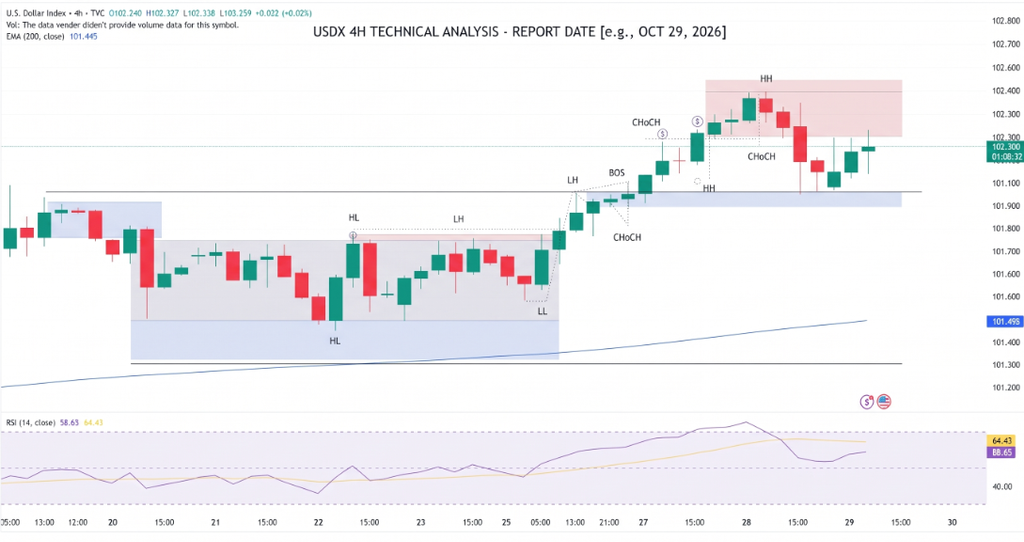
Key levels from the supplied technical analysis include:
- Immediate support: 102.05, near the Bollinger middle band.
- Initial resistance: 102.60, near the upper Bollinger Band.
- Next resistance: 102.94, the October 14 high.
- Higher target: 104.71, the March 27, 2025, high.
- Lower support: 101.50, followed by the 100-day SMA at 100.65.
Conclusion
The Dollar Index remains supported above 102.00, but a sustained advance will depend on incoming inflation data and the probability of another Fed rate increase. A break above 102.60 could open the way toward 102.94, while a decline below 102.05 would weaken the near-term bullish setup. Traders should watch the PCE report for evidence that could reshape expectations for December’s policy decision.
Sources & Methodology
Primary-source standard: Market-moving facts should link to original data releases, regulator notices, company filings or official project announcements whenever available. Secondary reporting is used for additional context, not as a substitute for original evidence.
Page last reviewed: