
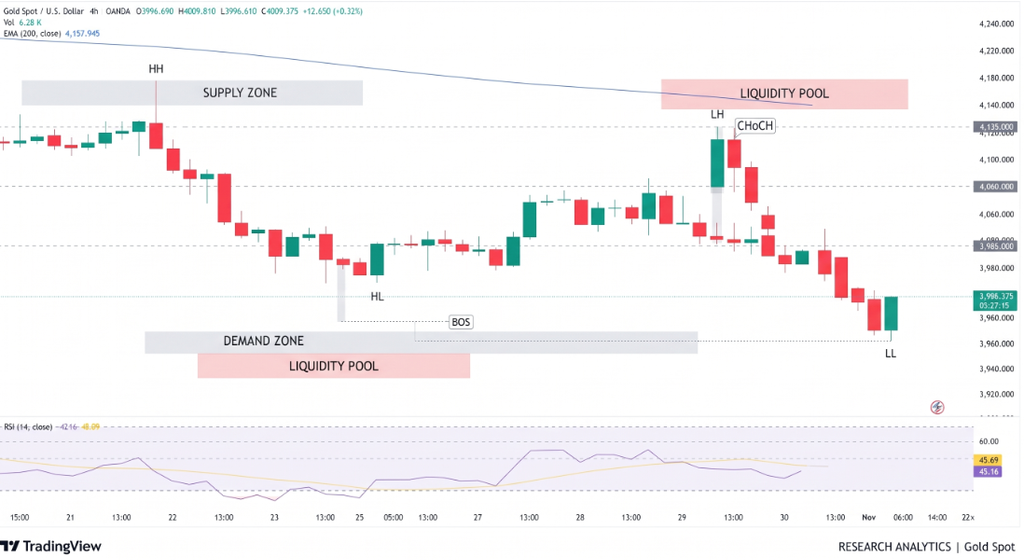
Gold prices dropped below $4,000 an ounce on Friday as accelerating U.S. inflation and renewed Middle East tensions strengthened expectations of further Federal Reserve tightening. Bullion fell to $3,992.46, extending its October decline and putting the precious metal on track for a second consecutive monthly loss. Rising energy costs, uncertainty surrounding artificial intelligence investments and expectations of higher borrowing costs have weakened investor demand, although buying interest from China has provided some support near the psychologically important $4,000 level.
Gold Prices Extend October Decline
Spot gold (XAU/USD) declined 0.7% to $3,992.46 an ounce at 23:50 ET (03:50 GMT), while U.S. gold futures dropped 0.8% to $4,002.22.
Other precious metals also recorded losses:
- Silver: Fell 1.7% to $51.29 an ounce.
- Platinum: Declined 1.8% to $1,460.79.
- Palladium: Dropped 1.7% to $989.46, while futures lost 2% to $984.75.
- U.S. Dollar Index: Slipped 0.3% to 101.79.
Gold has lost more than 3% during October, reflecting persistent inflation concerns and rising geopolitical risks. Renewed fighting in the Middle East has kept energy prices elevated, increasing concerns that higher oil costs could make inflation more difficult to control.
Oil prices have also advanced amid reports that Washington could consider resuming military strikes against Iran after next week’s U.S. midterm elections. Continued geopolitical uncertainty has complicated the outlook for financial markets and commodity prices.
Inflation Revives Federal Reserve Fears
Fresh U.S. economic figures have added pressure to gold by strengthening expectations that the Federal Reserve could raise interest rates again before the end of the year.
The Personal Consumption Expenditures (PCE) Price Index, the central bank’s preferred inflation measure, increased 0.5% in September. This represented its largest monthly advance since March. Annual headline inflation accelerated to 3.6%, compared with 3.4% in August, while core PCE inflation reached 3.1%.
The Federal Reserve kept its benchmark interest rate unchanged at 3.75%-4.00% during its latest meeting. However, policymakers maintained a cautious approach as inflation remained above their 2% target.
According to Reuters, financial markets increased expectations of a December rate increase following the inflation report.
Higher interest rates generally create difficulties for gold because the metal does not generate interest or dividend income. Consequently, investors may prefer interest-bearing assets when borrowing costs and bond yields rise.
AI Selloff Adds Pressure to Metals
Gold is also facing pressure from broader financial-market volatility. According to ANZ, investors reassessing substantial artificial intelligence investments have increased the risk of further equity-market liquidations.
Technology shares declined for a second consecutive session following disappointing corporate earnings, with Alphabet leading the latest selloff. Concerns about whether enormous AI infrastructure investments will deliver sufficient returns have weakened investor confidence.
During last week’s technology-led market decline, investors sold gold to cover losses elsewhere in their portfolios. Bullion subsequently recovered some ground but continued trading around $4,000.
Chinese households and longer-term investors have provided support by purchasing gold during price declines.
The technology selloff has also affected industrial metals, particularly copper, as investors reassess future demand from data centres. Nevertheless, physical demand in China remains relatively strong.
The Yangshan copper import premium, an indicator of Chinese demand for imported metal, climbed to a record $200 per tonne as buyers sought to secure supplies amid tightening market conditions.
Conclusion
Gold’s immediate outlook remains closely tied to U.S. inflation, Federal Reserve policy and developments in the Middle East. A potential December rate increase could maintain pressure on bullion, while geopolitical uncertainty and Chinese buying may provide support. With prices hovering around $4,000, investors will closely monitor upcoming economic data and central bank signals for direction.
Sources & Methodology
Primary-source standard: Market-moving facts should link to original data releases, regulator notices, company filings or official project announcements whenever available. Secondary reporting is used for additional context, not as a substitute for original evidence.
Page last reviewed: