Gold prices hovered around $3,930 an ounce on Tuesday as investors weighed diplomatic developments in the US-Iran conflict against uncertainty surrounding the US midterm elections. Spot bullion slipped slightly after gaining nearly 2% in the previous session, while oil-price swings continued to complicate the inflation outlook. The market was also assessing whether changing political and economic conditions could influence Federal Reserve policy and demand for precious metals.
Gold steadies as metals trade mixed
Spot gold declined marginally to $3,927.87 an ounce at 19:54 ET on Tuesday, equivalent to 00:54 GMT on Wednesday. US gold futures fell 0.1% to $3,936.50. The broader precious-metals market showed mixed performance, while the US dollar index weakened.
The latest prices showed:
- Silver: Down 0.4% to $49.5750 an ounce.
- Platinum: Up 0.2% to $1,421.51.
- Palladium spot: Up 0.1% to $937.60.
- Palladium futures: Little changed at $930.50.
- US Dollar Index: Down 0.2% to 101.70.
The modest decline followed bullion’s advance of almost 2% on Monday. The contrasting movements in precious metals indicate that investors remain cautious rather than uniformly shifting into or out of the sector.
Iran negotiations keep oil and inflation in focus
Developments in the Middle East remain a major influence on gold through their effect on energy prices and inflation expectations. Washington and Tehran are reviewing proposals from regional mediators intended to prevent a return to full-scale conflict. However, diplomatic progress remains uncertain.
The situation became more complicated after US forces carried out limited strikes on targets on Iran’s Qeshm Island, near the strategically important Strait of Hormuz, on Monday. US officials described the operation as defensive and said it was not a resumption of major combat operations.
Oil prices fluctuated sharply as markets assessed the competing signals from military activity and negotiations. This matters for gold because higher crude prices can increase inflationary pressure, potentially encouraging central banks to maintain restrictive interest rates.
Unlike interest-bearing assets, bullion does not generate income. Consequently, expectations of higher interest rates can make gold less attractive by increasing the opportunity cost of holding it.
US midterms add uncertainty to gold outlook
Investors are also watching the US midterm elections, which will determine control of the House of Representatives and Senate. The outcome could influence government spending, budget deficits and future economic policy.
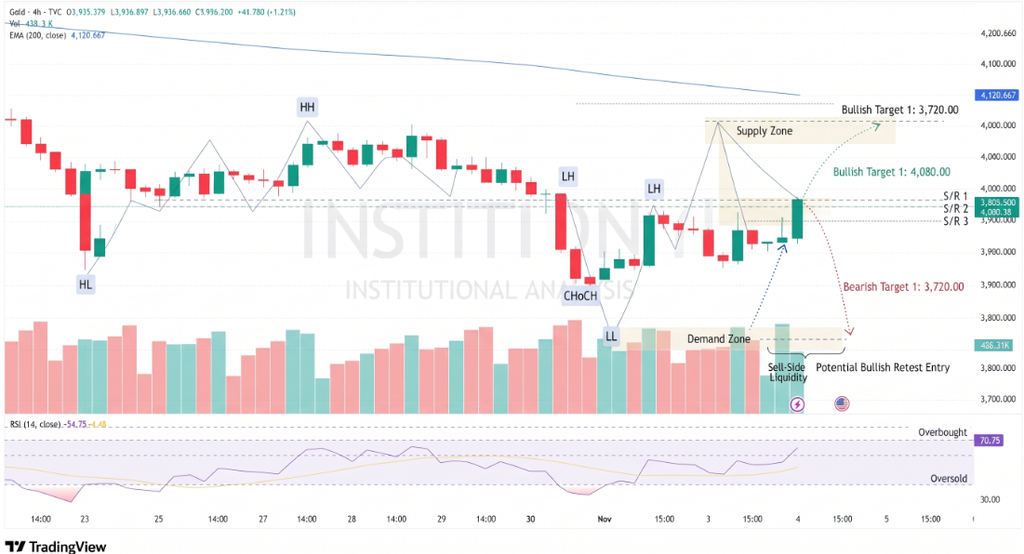
The World Gold Council has noted that gold historically responds more consistently to the economic and monetary policies that follow elections than to election results themselves. In the current geopolitical environment, however, policy uncertainty could amplify market reactions.
Gold has faced substantial pressure in recent months. Bullion lost nearly 7% in October, falling below $4,000 an ounce late in the month. It has also declined approximately 25% since the US-Iran conflict began in late February, according to the supplied market report.
Conclusion
Gold’s ability to hold near $3,930 reflects a market balancing geopolitical risk against inflation and interest-rate concerns. Progress in US-Iran negotiations could ease energy-price pressure, while renewed escalation may revive demand for defensive assets. The midterm results could influence fiscal expectations, but the longer-term direction for bullion will depend heavily on inflation, Federal Reserve policy and developments in the Middle East.
Sources & Methodology
Primary-source standard: Market-moving facts should link to original data releases, regulator notices, company filings or official project announcements whenever available. Secondary reporting is used for additional context, not as a substitute for original evidence.
Page last reviewed: