
EUR/USD traded around 1.1160 during early European trading on Monday, November 9, as expectations of tighter European Central Bank (ECB) policy provided modest support to the Euro. However, stronger-than-expected U.S. employment data continued to underpin the Dollar, limiting the pair’s recovery. Investors are assessing the contrasting monetary policy outlooks of the ECB and Federal Reserve (Fed), with December emerging as a crucial month for potential interest rate adjustments. Despite Monday’s gains, EUR/USD retains a bearish technical structure while trading below its key moving averages.
ECB Rate Outlook Supports the Euro
The Euro gained some support after ECB President Christine Lagarde indicated that policymakers would assess incoming economic indicators before deciding whether another interest rate increase is necessary in December.
The ECB maintained its deposit rate at 2.50% at its latest policy meeting. However, Lagarde emphasized that economic data released before the December meeting would help determine whether additional monetary tightening is justified.
She also highlighted the difficulty of separating supply-driven inflation from demand pressures, particularly as elevated energy costs weigh on economic growth while increasing consumer prices.
Meanwhile, the U.S. Bureau of Labor Statistics reported that American employers added 165,000 jobs in October, significantly exceeding economists’ expectations of approximately 65,000. September employment growth was revised upward to 60,000, while the unemployment rate declined to 4.1%.
The stronger figures reinforced expectations that the Federal Reserve could maintain restrictive monetary policy or consider another interest rate increase in December, supporting demand for the U.S. Dollar.
Dollar Demand Limits EUR/USD Recovery
Despite the ECB’s relatively hawkish stance, the Euro has struggled to attract sustained buying interest against the Greenback.
Analysts at ING described the Euro’s recent performance as disappointing, noting that even a substantial sell-off in U.S. technology stocks had failed to generate meaningful EUR/USD demand.
According to ING, European investors continue holding relatively high levels of Dollar cash rather than shifting capital toward the single currency. This reflects a preference for Dollar liquidity amid financial-market uncertainty.
The renewed demand for U.S. Treasury bonds as safe-haven assets has also supported the Greenback. When investors become cautious, Treasury demand can reinforce Dollar strength and limit gains in EUR/USD.
ING expects the currency pair to consolidate near 1.12, while markets continue pricing approximately 18 basis points of potential ECB rate increases in December.
EUR/USD Forecast: Technical Levels to Watch
The daily technical outlook remains bearish despite Monday’s recovery. EUR/USD is trading below its 20-day Bollinger moving average and 100-day Simple Moving Average (SMA), indicating that the broader trend remains under pressure.
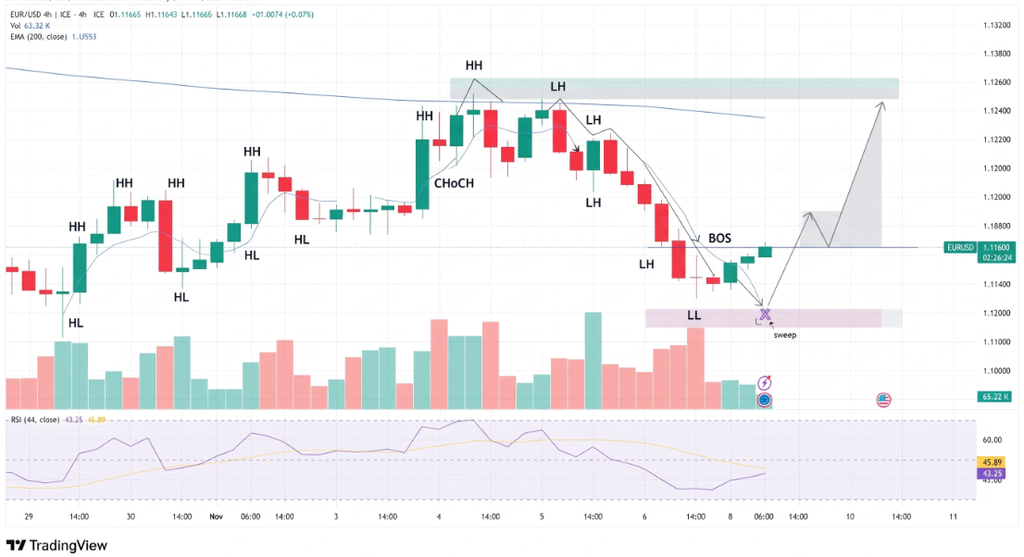
The Relative Strength Index (RSI) stands near 41, reflecting negative momentum without reaching oversold territory. This suggests that sellers retain an advantage, although the indicator does not yet signal an extreme bearish condition.
Important technical levels include:
- 1.1190: Initial resistance at the 20-day Bollinger average.
- 1.1260: Upper Bollinger Band resistance.
- 1.1325: June 24 swing-low resistance.
- 1.1412: 100-day SMA resistance.
- 1.1125: Immediate downside support.
- 1.1100: Psychological support.
- 1.0951: May 12, 2025 low.
Conclusion
EUR/USD faces competing monetary policy expectations as the ECB considers further tightening while resilient U.S. employment supports the Dollar. A sustained move above 1.1190 could improve the recovery outlook, with 1.1260 emerging as the next resistance. Conversely, a decisive break below 1.1125 could expose 1.1100 and subsequently 1.0951. Until the pair reclaims its major moving averages, the broader technical outlook remains bearish.
Sources & Methodology
Primary-source standard: Market-moving facts should link to original data releases, regulator notices, company filings or official project announcements whenever available. Secondary reporting is used for additional context, not as a substitute for original evidence.
Page last reviewed: