
Dogecoin (DOGE) recovered modestly to around $0.068 on Wednesday, following a decline to a new yearly low of $0.066 in the previous session. The rebound has done little to change the cryptocurrency’s bearish outlook, as large holders continue reducing their positions and on-chain indicators point to weak demand. According to Santiment, whale wallets have shed approximately 750 million DOGE since November 3, adding to selling pressure. Technical indicators also suggest that the token remains vulnerable to further losses.
Whales Sell 750 Million DOGE Tokens
Santiment’s Supply Distribution data shows that several large-holder groups have reduced their Dogecoin balances since November 3. The affected wallets hold between 100,000 and 1 million DOGE, 1 million and 10 million DOGE, and 10 million and 100 million DOGE.
Combined, these groups have shed around 750 million tokens, indicating a reduction in exposure among substantial holders. Whale distribution can weigh on prices because large transfers to exchanges or increased selling activity may add supply to the market. However, wallet-balance changes alone do not establish where tokens were transferred or whether every reduction represents a direct market sale.
The continued decline in large-holder balances is nevertheless an important signal for traders monitoring Dogecoin’s recovery prospects. Without stronger accumulation or renewed buying demand, the token could struggle to establish a sustained price floor.
On-Chain Indicators Signal Weak Demand
Data from CryptoQuant also points to cautious trading conditions across Dogecoin’s spot and futures markets. Its summary indicators show large whale orders, elevated market activity and selling dominance, suggesting that sellers currently have greater influence over price direction.
The combination of whale distribution and sell-side pressure indicates that traders remain reluctant to increase exposure. This is particularly relevant for Dogecoin, whose price can be sensitive to shifts in speculative demand and broader cryptocurrency sentiment.
The latest readings do not guarantee another decline, but they suggest that a short-lived rebound may not be enough to reverse the prevailing trend. Investors will likely look for stronger spot demand and a sustained improvement in large-holder activity before treating the recovery as a meaningful change in market direction.
DOGE Technical Outlook Points to $0.065
Dogecoin remains below its 50-day, 100-day and 200-day Exponential Moving Averages (EMAs), positioned between approximately $0.079 and $0.088. Trading below all three averages reinforces the bearish structure, with each level potentially acting as resistance during a recovery.
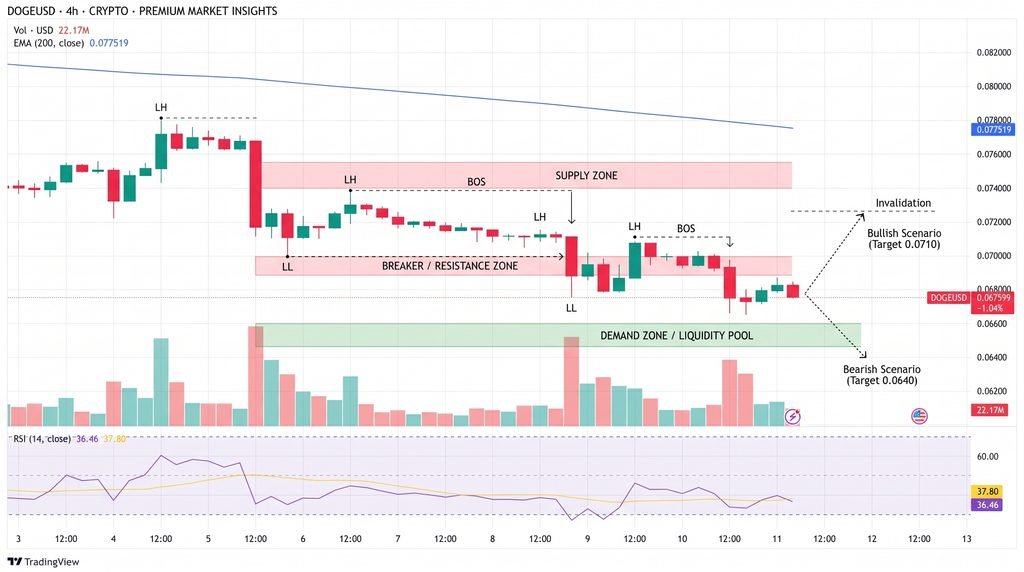
The daily Relative Strength Index (RSI) has slipped toward the low-30s, approaching oversold territory. Meanwhile, the Moving Average Convergence Divergence (MACD) remains slightly below zero, indicating that downside momentum persists.
Key levels to monitor include:
- Immediate support: $0.065.
- Initial resistance: $0.068 and $0.077.
- Moving-average resistance: $0.079, $0.081 and $0.088.
- Higher resistance: $0.102.
Conclusion
Dogecoin’s modest recovery near $0.068 has not yet changed its bearish outlook. Continued whale distribution, weak on-chain readings and negative momentum leave the $0.065 support level exposed. A decisive break below that threshold could extend losses, while a sustained move above $0.077 would offer an early indication that buying interest is returning. Until DOGE reclaims its key moving averages, sellers are likely to retain control of the near-term trend.
Sources & Methodology
Primary-source standard: Market-moving facts should link to original data releases, regulator notices, company filings or official project announcements whenever available. Secondary reporting is used for additional context, not as a substitute for original evidence.
Page last reviewed: