EUR/GBP extended its decline for a fourth consecutive session on Monday, November 16, slipping below 0.8350 as renewed Middle East tensions weighed on risk appetite and supported oil prices. The pair retreated from last week’s high above 0.8370, with the British Pound drawing additional support from stronger-than-expected UK economic growth. Traders are now watching the 0.8320–0.8315 support area, while upcoming UK employment and inflation reports could influence expectations for the Bank of England’s next interest-rate decision.
Geopolitical Risks Weigh on the Euro
Renewed tensions between the United States and Iran have added to market uncertainty. Iran’s Islamic Revolutionary Guard Corps claimed it launched drones at a US military facility in Bahrain on Sunday. Bahrain said its air defences intercepted Iranian aerial attacks, although the claimed strike on the US facility was not independently confirmed.
The arrival of the USS Theodore Roosevelt in the Middle East, joining two other US aircraft carriers in the region, has heightened concerns about a further escalation. Higher oil prices can also complicate the Eurozone’s economic outlook because the bloc relies heavily on imported energy.
Eurozone industrial production provided little support for the single currency. According to Eurostat, output increased by 0.2% in September, recovering from August’s 0.5% contraction but falling short of the 0.3% market forecast. Production was also down 1.5% from a year earlier.
UK Data Keeps Sterling Supported
The Pound has benefited from the latest UK growth figures. The Office for National Statistics reported that the economy expanded by 0.7% in the third quarter of 2026, following 0.5% growth in the previous quarter. September monthly GDP also increased by 0.2%.
The data has reinforced expectations that the Bank of England may maintain a relatively firm policy stance. However, investors need further evidence on wages, employment and inflation before assessing the likelihood of additional rate increases.
The next releases are particularly important:
- November 17: UK labour-market statistics.
- November 18: UK October consumer price inflation.
Stronger wage growth or persistent inflation could strengthen the case for tighter monetary policy and provide further support to sterling. Weaker figures could instead reduce expectations for additional BoE action.
EUR/GBP Technical Outlook and Key Levels
EUR/GBP was trading around 0.8340 in the latest technical assessment. The pair’s rejection above 0.8370 and retreat beneath 0.8350 indicate that sellers retain near-term control.
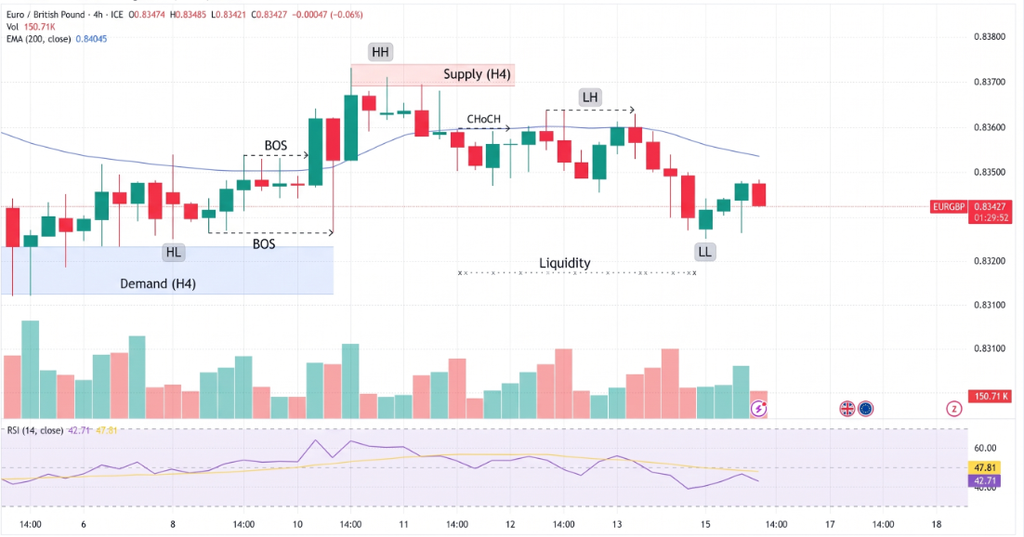
EUR/GBP Price Chart – Source: Tradingview
The Relative Strength Index (RSI) stood at 40.1, below the neutral 50 threshold, while the Moving Average Convergence Divergence (MACD) remained marginally bearish.
The immediate downside levels are:
- 0.8322: Late-October and early-November support.
- 0.8315: March 2025 low and a key technical floor.
- 0.8300: Next psychological downside target.
- 0.8240: Area of the 2025 lows.
On the upside, a break above 0.8372 could open the way toward 0.8380 and then 0.8400.
Conclusion
EUR/GBP remains vulnerable while it trades below 0.8372. A sustained break beneath 0.8315 would strengthen the bearish outlook, whereas stronger UK data could keep sterling supported. The upcoming employment and inflation releases are likely to shape the pair’s next move.
Sources & Methodology
Primary-source standard: Market-moving facts should link to original data releases, regulator notices, company filings or official project announcements whenever available. Secondary reporting is used for additional context, not as a substitute for original evidence.
Page last reviewed: