
The US Dollar Index (DXY) edged lower during Friday’s Asian trading session, retreating from recent gains while remaining below the 104.00 psychological resistance level. Despite the modest pullback, the broader outlook remains bullish as expectations of Federal Reserve interest-rate increases and escalating geopolitical tensions continue to support demand for the Greenback. The index is heading toward a fourth consecutive weekly gain, reflecting persistent inflation concerns and renewed safe-haven buying. Traders are now awaiting US consumer sentiment data and inflation expectations for fresh clues about the Federal Reserve’s monetary-policy direction.
Fed Rate Bets Support Dollar Momentum
The US Dollar Index has strengthened significantly over the past two weeks, approaching levels last recorded in April 2025. The rally has been driven primarily by expectations of tighter monetary policy following stronger-than-expected US inflation data and hawkish signals from Federal Reserve officials.
Minutes from the October Federal Open Market Committee (FOMC) meeting, released Wednesday, revealed that nearly all policymakers considered additional interest-rate increases necessary to bring inflation back toward the central bank’s 2% target.
According to the CME FedWatch Tool, markets are assigning an overwhelmingly high probability to a 25-basis-point rate increase in December. Investors are also anticipating further tightening in early 2027, potentially extending the period of restrictive monetary policy.
Higher interest rates generally support the Dollar by increasing the returns available on US assets relative to those in other economies. This policy outlook has helped the DXY maintain its upward trajectory despite Friday’s modest decline.
Geopolitical Risks Strengthen Safe-Haven Demand
Geopolitical uncertainty has provided additional support to the Greenback, with investors monitoring escalating tensions between Washington and Tehran.
Reports that US President Donald Trump was considering additional military strikes against Iran have heightened concerns about regional instability. The ongoing dispute over Iran’s nuclear program and strategic shipping routes, including the Strait of Hormuz, has increased demand for traditional safe-haven currencies.
The Dollar has benefited from its defensive appeal as investors reassess exposure to riskier assets amid concerns about global economic stability.
Market participants are watching several developments that could influence near-term DXY movements:
- Middle East tensions: Further escalation could strengthen safe-haven demand.
- Fed policy expectations: Additional hawkish signals may support Dollar buying.
- US economic data: Consumer sentiment and inflation expectations could influence rate forecasts.
The combination of monetary-policy expectations and geopolitical uncertainty continues to favor the Dollar, limiting the potential for a deeper correction.
DXY Technical Outlook: 104.00 in Focus
The technical outlook for the Dollar Index remains constructive following a series of higher closes from the 101.50–102.00 region. The Relative Strength Index (RSI) stands at 69.86, approaching the overbought threshold of 70 and signaling strong but potentially stretched bullish momentum.
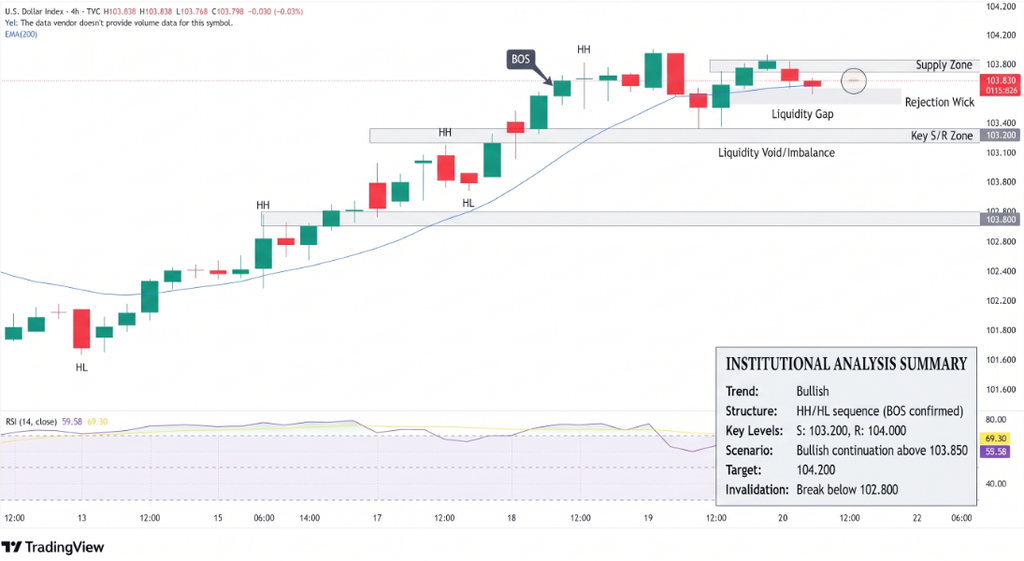
The Moving Average Convergence Divergence (MACD) indicator remains in positive territory, with the MACD line above its signal line, reinforcing the upward bias.
Immediate support is located at 103.55. A sustained hold above this level would keep the bullish structure intact and strengthen the case for a move toward 104.00.
However, the elevated RSI suggests the index could experience consolidation or a temporary pullback if buying momentum weakens.
Conclusion
The Dollar Index remains supported by expectations of further Fed tightening and geopolitical uncertainty. While 104.00 represents a significant near-term hurdle, the broader technical and fundamental outlook favors additional gains. A break below 103.55 would signal weakening momentum and increase the risk of a corrective decline.
Sources & Methodology
Primary-source standard: Market-moving facts should link to original data releases, regulator notices, company filings or official project announcements whenever available. Secondary reporting is used for additional context, not as a substitute for original evidence.
Page last reviewed: