
The Australian Dollar (AUD) remained under pressure against the US Dollar (USD) on Friday, trading near 0.6645 after approaching an 11-month low. A hawkish Federal Reserve outlook has strengthened the Greenback, while weakening Australian employment figures have reduced expectations of further Reserve Bank of Australia (RBA) interest-rate increases. The combination has left AUD/USD vulnerable to additional losses. Traders are now watching the 0.6604 Fibonacci support level, which could determine whether the pair stabilizes or extends its decline toward 0.6420.
Fed Hawkish Outlook Supports US Dollar
The US Dollar continues to outperform the Australian Dollar as investors prepare for additional Federal Reserve monetary tightening. The US Dollar Index, which measures the Greenback against six major currencies, traded near 103.80 on Friday after approaching 104.00, its highest level in approximately 19 months.
Minutes from the October 27–28 Federal Open Market Committee (FOMC) meeting revealed that almost all policymakers considered further interest-rate increases appropriate under their baseline economic outlook.
The Fed maintained its benchmark interest-rate range at 3.75%–4.00% following a 25-basis-point increase in September. The decision received a 10–2 vote, but subsequent comments from policymakers reinforced expectations of additional tightening.
Fed Governor Christopher Waller has advocated considering a larger 50-basis-point increase in December, citing persistent inflation and evidence that price pressures are spreading beyond energy.
According to economists at UOB Group, the Fed could deliver two additional 25-basis-point increases, one in December 2026 and another in the first quarter of 2027. However, persistent inflation could increase the possibility of a larger move.
Higher US interest rates generally support the Dollar by improving the relative returns available on American financial assets.
Weak Australian Jobs Weigh on Aussie
The Australian Dollar faces additional pressure as recent employment figures have weakened expectations of further RBA tightening.
According to analysts at Rabobank, Australia’s unemployment rate increased from 4.7% to 4.9%, while employment declined by 43,500 positions. Economists had expected an increase of approximately 25,000 jobs.
The deterioration in the labor market suggests that previous interest-rate increases may be slowing economic activity, reducing the urgency for the RBA to tighten monetary policy further.
However, the outlook remains uncertain ahead of Australia’s October Consumer Price Index (CPI) release. A stronger-than-expected inflation reading could revive expectations of additional rate increases and provide temporary support to the Australian Dollar.
Key developments influencing AUD/USD include:
- US monetary policy: Further Fed tightening supports the Greenback.
- Australian employment: A 43,500 decline in jobs weakens the Aussie outlook.
- Australian inflation: The upcoming CPI report could influence RBA expectations.
The widening difference between the two central banks’ policy outlooks remains a significant headwind for AUD/USD.
AUD/USD Technical Outlook: 0.6604 Support
The technical outlook remains bearish, with AUD/USD trading below its 20-day Exponential Moving Average (EMA) at 0.6838. The Relative Strength Index (RSI) stands near 24, indicating deeply oversold conditions but providing no confirmed reversal signal.
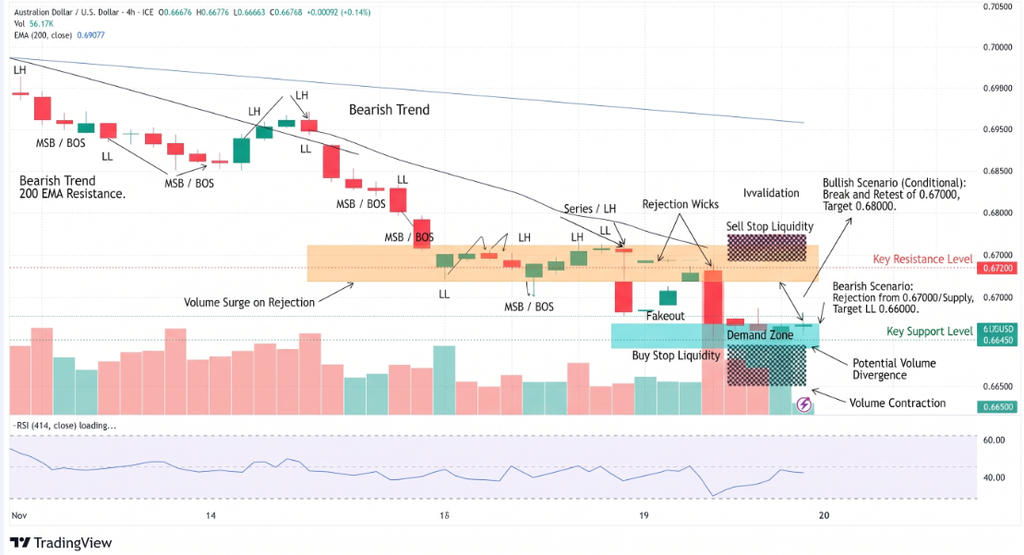
Immediate support lies at the 78.6% Fibonacci retracement near 0.6604. A decisive break below this level could expose the next downside target around 0.6420.
On the upside, initial resistance stands at the 61.8% Fibonacci level at 0.6748. Further barriers include:
- 0.6838: 20-day EMA.
- 0.6850: 50% Fibonacci retracement.
- 0.6952: 38.2% Fibonacci retracement.
- 0.7077: Higher resistance level.
Conclusion
AUD/USD remains exposed to further losses as hawkish Fed expectations and weakening Australian employment data favor the US Dollar. A break below 0.6604 could extend the decline toward 0.6420, while a sustained recovery above 0.6748 would provide the first indication of improving bullish momentum.
Sources & Methodology
Primary-source standard: Market-moving facts should link to original data releases, regulator notices, company filings or official project announcements whenever available. Secondary reporting is used for additional context, not as a substitute for original evidence.
Page last reviewed: