
Zcash (ZEC) remained under pressure on Wednesday, trading near $728 after another decline pushed the privacy-focused cryptocurrency toward the important $700 support level. The weakness comes as Gemini introduces deposits to shielded Zcash addresses, allowing customers to move tokens into the exchange without exposing transaction details on the public blockchain. While the development strengthens Zcash’s privacy infrastructure, it has yet to reverse the market’s bearish price momentum. Traders are watching whether buyers can defend the $700 area or whether ZEC will extend its correction toward lower support levels.
Gemini Expands Shielded ZEC Support
Gemini announced on November 24 that customers can now deposit ZEC directly to shielded receiving addresses. The update complements the exchange’s existing support for shielded withdrawals to Zcash’s Ironwood pool, introduced earlier this year.
The development allows ZEC to move into and out of Gemini through shielded addresses, reducing the transaction information visible on Zcash’s transparent blockchain. Shielded transactions use zero-knowledge cryptography to conceal details such as the sender, recipient and transferred amount while still allowing the network to verify transactions.
Gemini’s new deposit feature is significant because it extends privacy beyond withdrawals. Previously, users could withdraw ZEC into the shielded pool, but deposits could expose transaction details when funds reached the exchange’s transparent address.
According to the Zkp.baby dashboard, approximately 4.93 million ZEC were held in shielded pools in the supplied market snapshot, representing 28.94% of the cryptocurrency’s total supply.
The announcement strengthens exchange infrastructure for privacy-focused transactions, although it does not guarantee immediate demand for ZEC. Deposits can also make it easier for holders to transfer tokens to an exchange, where they may be sold.
ZEC Price Forecast: $700 Support
ZEC traded around $728 on Wednesday, extending a steep correction from its annual high of $1,698. The latest price snapshot places the token roughly 57% below that peak, reflecting sustained selling pressure across the market.
The supplied technical chart places the 200-day Exponential Moving Average at $870 and the 50-day EMA at $1,046. ZEC trades below both averages, indicating that buyers have yet to regain control of the broader trend.
However, the 50-day EMA remains above the 200-day EMA. This is a bullish moving-average alignment, not a Death Cross, although price weakness beneath both indicators remains a negative signal.
The immediate downside levels are:
- $700: Major psychological support.
- $690: Nearby horizontal support.
- $486: Deeper structural support if selling accelerates.
A sustained break below $690 could expose ZEC to further losses, while a recovery above $700 would help stabilize the near-term outlook.
Oversold Momentum Limits Recovery
Momentum indicators continue to reflect selling pressure. The Moving Average Convergence Divergence (MACD) remains negative and below its signal line, suggesting bearish momentum is still dominant.
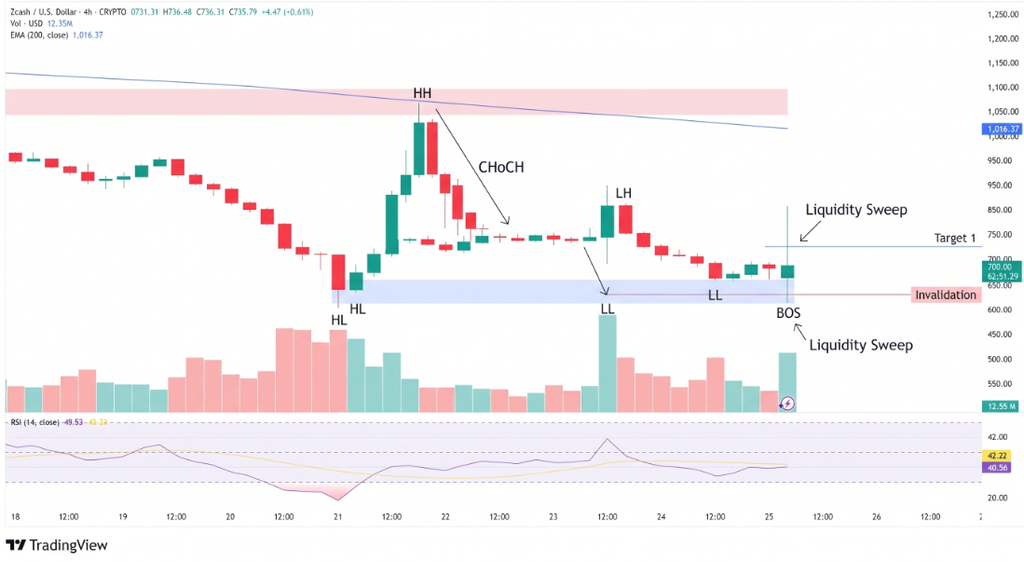
The Relative Strength Index (RSI) was near 29 in the supplied chart, placing it in oversold territory. Such readings can precede short-term rebounds, but they do not independently confirm a trend reversal.
On the upside, resistance stands at $870, followed by the $1,000 psychological level and the 50-day EMA near $1,046.
Conclusion
Gemini’s shielded-deposit support is a meaningful infrastructure development for Zcash, but its immediate effect on price remains uncertain. ZEC’s ability to hold $700 and $690 will be crucial. A decisive breakdown could expose $486, while a sustained recovery above $870 would provide stronger evidence that selling pressure is easing.
Sources & Methodology
Primary-source standard: Market-moving facts should link to original data releases, regulator notices, company filings or official project announcements whenever available. Secondary reporting is used for additional context, not as a substitute for original evidence.
Page last reviewed: