
Pi Network (PI) is attempting to extend its recovery on Thursday as buying interest returns to the cryptocurrency market. The token has gained around 2%, building on the previous session’s modest advance after falling sharply earlier in November. However, the rebound remains technically fragile. PI is still trading below important moving averages and a descending trendline, leaving $0.0584 as the first major barrier bulls must overcome to establish a more convincing recovery.
Crypto recovery lifts PI sentiment
The broader cryptocurrency market showed signs of stabilisation on Thursday. Bitcoin recovered above $60,000, while several major altcoins posted gains as investors reassessed the impact of recent US inflation data.
PI’s advance reflects this improvement in risk appetite. Historical market data showed the token trading around $0.0561 on November 26, up approximately 1.8% on the day. That follows a recovery from its November 20 low near $0.0473, although the token remains well below its mid-November levels.
Social activity may be providing another source of support. Data attributed to Santiment in the supplied market analysis showed PI’s social dominance rising to 0.20% from 0.06% in one day. Social dominance measures the share of cryptocurrency-related online discussion devoted to a particular asset.
The increase suggests that PI is attracting more attention, but higher discussion levels do not necessarily translate into sustained buying. Traders will need to see stronger market demand and a break above technical resistance before treating the improvement in sentiment as evidence of a lasting trend change.
The macroeconomic backdrop also remains important. October US PCE inflation increased 3.8% annually, while core inflation reached 3.3%. Although monthly increases were in line with forecasts, the annual core reading exceeded the 3.2% consensus cited in market reports, keeping expectations of tighter Federal Reserve policy elevated.
PI faces resistance at $0.0584
PI’s daily chart continues to reflect a broader bearish structure. The token remains below its 50-day exponential moving average (EMA) near $0.0697 and a descending trendline around $0.0671. These levels could limit the recovery if buyers fail to build momentum.
The immediate technical hurdle is the $0.0584 Fibonacci extension level. This represents the 127.2% extension measured from the decline between $0.1394 and $0.0704. A sustained move above this barrier would improve the short-term outlook and put the $0.0671–$0.0697 resistance zone in focus.
Momentum indicators show some improvement. The Relative Strength Index (RSI), near 37, remains below the neutral 50 threshold, indicating that buyers have not yet regained control. Meanwhile, the Moving Average Convergence Divergence (MACD) line is approaching a bullish crossover above its signal line, while the negative histogram is shrinking.
$0.0461 remains critical support
The downside remains exposed if the recovery loses momentum. The 161.8% Fibonacci extension near $0.0461 represents an important support reference below the recent low.
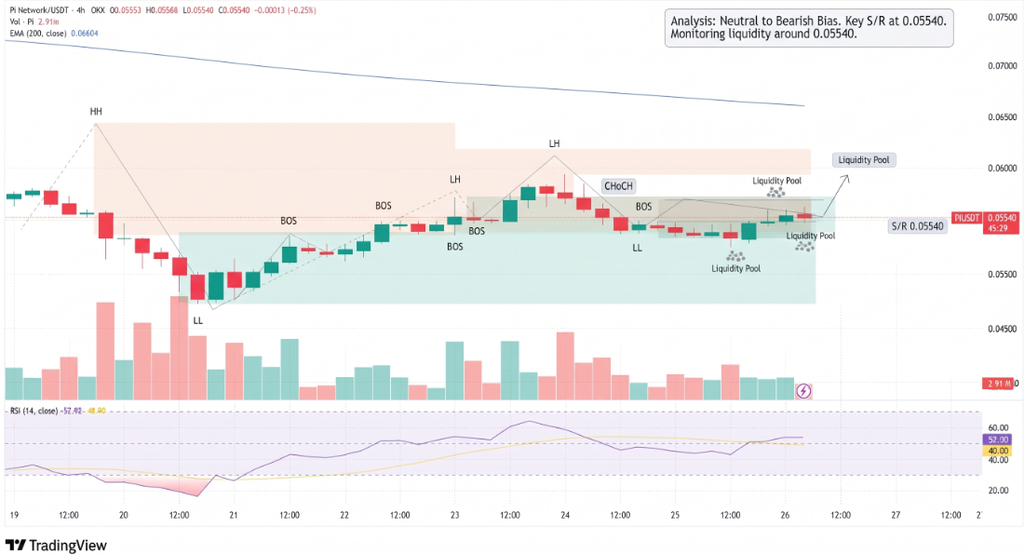
Key levels to monitor include:
- Immediate resistance: $0.0584.
- Higher resistance: $0.0671–$0.0697.
- Major support: $0.0461.
- Momentum signals: RSI near 37 and a potential MACD bullish crossover.
A confirmed break below $0.0461 could expose PI to further losses and extend its existing downtrend. Conversely, a sustained close above $0.0584 would provide an initial technical signal that buyers are gaining strength.
Conclusion
Pi Network’s latest rebound and improving social attention suggest selling pressure may be easing, but a bullish reversal is not yet confirmed. The $0.0584 level is the immediate test for buyers, while $0.0461 remains a critical downside reference. Until PI reclaims resistance and moves above its declining trendline, the recovery remains vulnerable to renewed selling.
Sources & Methodology
Primary-source standard: Market-moving facts should link to original data releases, regulator notices, company filings or official project announcements whenever available. Secondary reporting is used for additional context, not as a substitute for original evidence.
Page last reviewed: