
Zcash developers are urging holders to move approximately $300 million in cryptocurrency out of the network’s older Sapling privacy pool, warning that future advances in mathematics and computing could undermine the cryptography protecting private transactions. The proposal, led by the Zakura development team, would stop new deposits into Sapling while allowing existing funds to move into Ironwood, the network’s newer privacy system. The recommendation is precautionary: developers say a practical attack against the technology remains highly speculative.
Zcash targets $300M Sapling migration
Zakura, whose maintainers include Zcash co-founder Sean Bowe and developer Dev Ojha, called on the community Thursday to accelerate Sapling’s retirement.
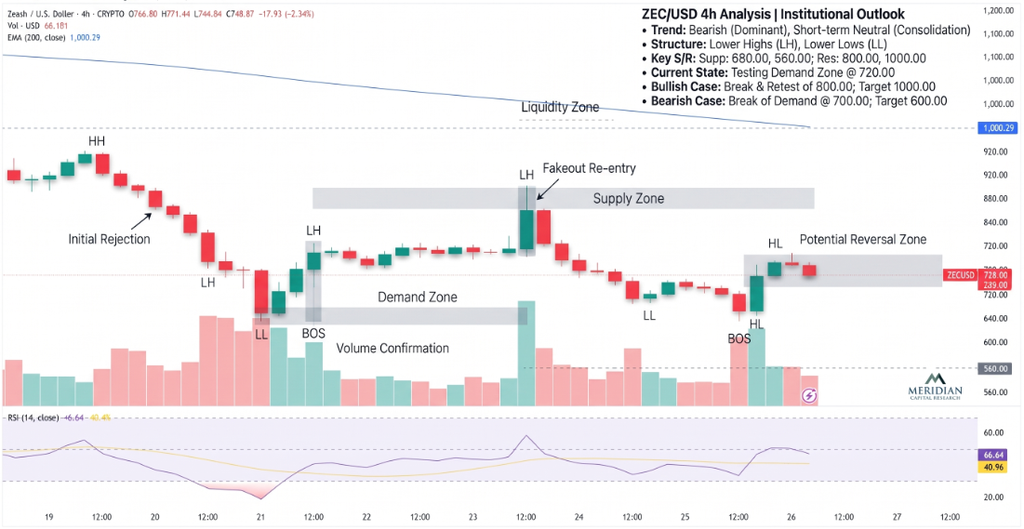
The team estimates that roughly 400,000 ZEC remains in the pool. At the approximately $755 price cited in the original report, those holdings represent close to $300 million. Current tracking data places Sapling’s balance nearer 378,000 ZEC, illustrating that the figure changes as users transfer funds.
The proposed measure would require a network upgrade to disable incoming Sapling payments. Existing holders would retain a route to withdraw their coins and transfer them into Ironwood. Developers also want a recovery mechanism for users who fail to migrate before any future security incident.
Zakura stressed that the threat is not immediate. It described a practical break of pairing-based cryptography as highly speculative, but argued that moving funds while the system remains secure would reduce potential exposure.
Why Sapling’s cryptography concerns devs
Launched in 2018, Sapling allows Zcash users to conceal transaction amounts and the identities of senders and recipients. It relies on zero-knowledge proofs, mathematical evidence that a transaction follows network rules without revealing its private details.
Sapling verifies those proofs using cryptographic pairings. These mathematical operations allow the network to check transactions efficiently, but their security depends on certain computational problems remaining difficult to solve.
A successful attack could let someone forge a proof and make an invalid transaction appear legitimate. In the worst case, counterfeit ZEC could enter the shielded pool without being immediately visible because transaction amounts are concealed.
The concern is not evidence that Sapling has been compromised. Rather, developers want to reduce reliance on cryptographic assumptions that could weaken as computing and mathematical techniques advance.
Ironwood offers a different security model
Zcash’s newer Ironwood privacy pool uses Halo 2, a proof system that does not rely on the same pairing-based construction as Sapling. This means a breakthrough targeting pairings would not automatically undermine Ironwood.
The migration also follows earlier changes to Zcash’s privacy infrastructure. The network activated Ironwood in July 2026 and sealed the older Orchard pool against new deposits after developers disclosed a separate proof-system vulnerability.
Key points behind the proposed Sapling transition include:
- Estimated balance: About 400,000 ZEC, with recent tracking closer to 378,000.
- Proposed change: Stop new deposits while preserving withdrawals.
- Destination: Ironwood, which uses Halo 2 proofs.
- Security objective: Reduce exposure to potential future cryptographic breakthroughs.
Conclusion
Zakura’s recommendation is a preventive security measure, not a declaration that Sapling has been breached. The proposed migration would give Zcash users a path toward newer cryptography while limiting the risk that an eventual breakthrough could threaten funds protected by its older privacy system.
Sources & Methodology
Primary-source standard: Market-moving facts should link to original data releases, regulator notices, company filings or official project announcements whenever available. Secondary reporting is used for additional context, not as a substitute for original evidence.
Page last reviewed: