
AUD/USD rebounded on Monday after falling toward 0.6600 last week, its lowest level since December 2025. A weaker US Dollar (USD), driven by declining oil prices, easing inflation concerns and falling Treasury yields, supported the Australian Dollar (AUD). However, the recovery remains limited near 0.6650, with technical indicators signaling persistent bearish momentum. Traders remain cautious as expectations of further Federal Reserve (Fed) rate increases, geopolitical uncertainty and a more dovish Reserve Bank of Australia (RBA) outlook continue to weigh on the currency pair.
US Dollar weakness supports AUD/USD rebound
The Australian Dollar gained ground against the US Dollar as financial markets adjusted their expectations for further monetary tightening by the Federal Reserve. Declining oil prices helped ease inflation concerns, reducing the likelihood of more aggressive interest-rate increases.
Meanwhile, a broad selloff in global equity markets prompted investors to seek safer assets, contributing to lower US Treasury yields and weakening demand for the Greenback. This combination offered temporary relief to AUD/USD following Friday’s steep decline.
However, the US Dollar’s downside could remain limited. Markets continue to anticipate a potential 25-basis-point rate hike in December, followed by another increase in early 2027. Higher interest rates generally support a currency by improving the relative returns available on its assets.
The Australian Dollar faces additional pressure from the Reserve Bank of Australia’s monetary policy outlook, with a more dovish stance reducing the currency’s yield advantage. Geopolitical risks and continued uncertainty surrounding global economic growth could also restrict the pair’s recovery.
Technical outlook: Bearish momentum persists
The technical structure remains negative despite Monday’s rebound. The Relative Strength Index (RSI) sits near 25, indicating deeply oversold conditions. This suggests that selling pressure has become intense, potentially allowing a short-term recovery, although oversold readings alone do not confirm a trend reversal.
The Moving Average Convergence Divergence (MACD) histogram remains below zero, reinforcing the bearish momentum.
AUD/USD has also broken below the 38.2% Fibonacci retracement level at 0.6751, measured across the April 2025-May 2026 upswing. The breakdown strengthens the downside bias and suggests that rallies could attract renewed selling.
Key technical levels include:
- 0.6751: Initial resistance at the 38.2% Fibonacci retracement.
- 0.6949: Resistance at the 23.6% retracement.
- 0.7041: The 200-day Simple Moving Average (SMA).
- 0.7271: The previous cycle high.
0.6590 support remains critical
On the downside, the 50% Fibonacci retracement level at 0.6590 represents the first significant support zone. A decisive break below this level could expose the 61.8% retracement at 0.6429, followed by broader support near 0.6200.
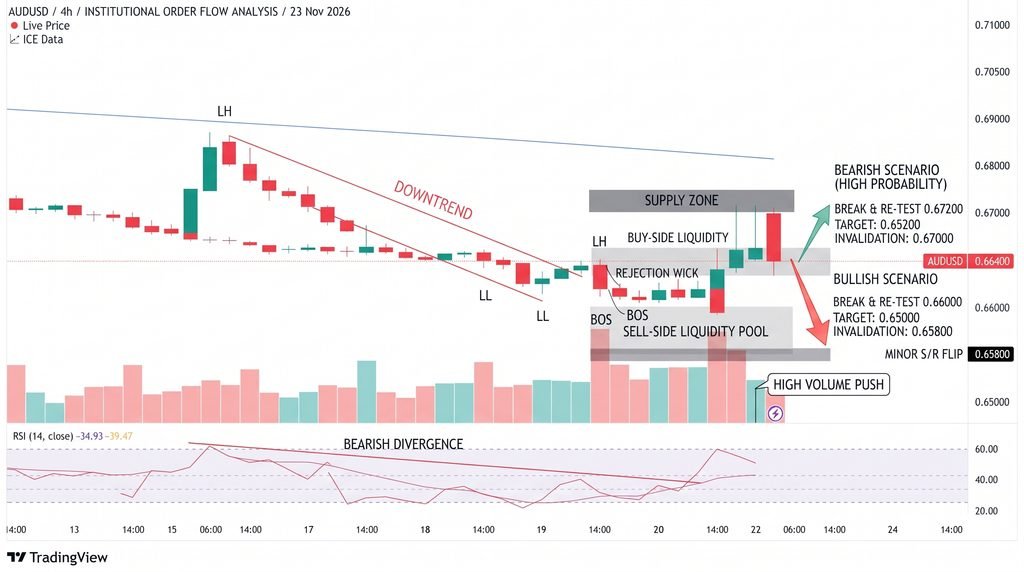
The pair’s ability to hold above 0.6590 could determine whether the current rebound develops into a more meaningful recovery or remains a temporary correction within the broader downtrend.
Conclusion
AUD/USD remains under bearish pressure despite Monday’s recovery, as weakening technical momentum and expectations of further Fed tightening limit upside potential. While oversold conditions may encourage short-term buying, a sustained move above 0.6751 would be required to improve the outlook. Until then, a break below 0.6590 could expose 0.6429 and deepen the pair’s correction.
Sources & Methodology
Primary-source standard: Market-moving facts should link to original data releases, regulator notices, company filings or official project announcements whenever available. Secondary reporting is used for additional context, not as a substitute for original evidence.
Page last reviewed: