
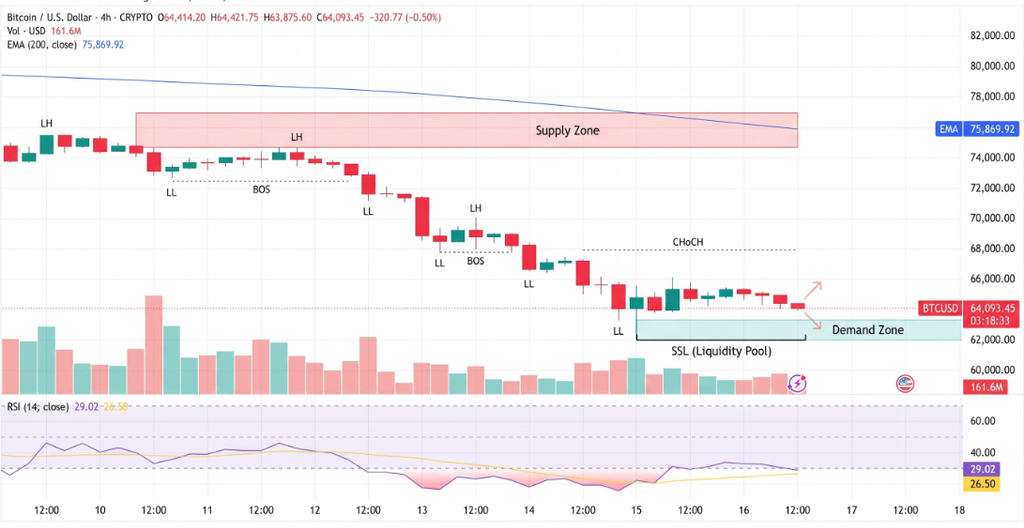
Bitcoin extended its decline on Monday, November 16, trading near $64,353 as persistent institutional withdrawals, higher US interest-rate expectations and regulatory uncertainty weighed on cryptocurrency markets. The largest digital asset fell approximately 2% by 05:05 ET, remaining close to its lowest levels in several months. Although some altcoins showed limited relief, investors remained cautious ahead of Nvidia’s earnings report and fresh signals from the Federal Reserve. Continued ETF redemptions have added another source of pressure to an already fragile market.
Fed Rate Fears Pressure Bitcoin
Expectations of tighter US monetary policy have become a major concern for cryptocurrency investors. Recent inflation data strengthened market expectations of a possible Federal Reserve rate increase in December, with some traders also considering a larger 50-basis-point move.
Higher interest rates can reduce demand for speculative investments by making cash and interest-bearing assets more attractive. Bitcoin has experienced substantial pressure during previous tightening cycles, particularly in 2022 and 2023, when rising borrowing costs and reduced liquidity contributed to a broad decline across risk assets.
Political uncertainty has also affected sentiment. Democrats’ gains in the November midterm elections have raised questions about the future direction of US cryptocurrency regulation. Investors are assessing whether a Democrat-led Congress could slow the progress of legislation intended to establish clearer rules for digital-asset businesses.
Another concern comes from index provider MSCI, which plans to remove Strategy and certain other companies from its global indexes effective December 1. Strategy, formerly known as MicroStrategy, holds a substantial Bitcoin treasury and relies partly on capital markets to finance its accumulation strategy.
The removal could reduce demand for Strategy shares from passive investment funds. Reuters reported that the company warned the decision could trigger significant stock sales, while analysts have raised concerns about the potential effect on its financing options.
Bitcoin ETFs Lose $1.07 Billion
Institutional demand has weakened considerably. US spot Bitcoin exchange-traded funds recorded approximately $1.07 billion in net outflows during the week ended November 13, according to SoSoValue data analysed by The Block.
This marked the second consecutive week of withdrawals exceeding $1 billion. The previous week recorded approximately $1.28 billion in outflows, bringing the combined two-week total to $2.35 billion.
The latest figures also show:
- Weekly withdrawals: $1.07 billion.
- Previous week’s withdrawals: $1.28 billion.
- Two-week total: $2.35 billion.
- Daily outflow streak: Seven consecutive trading sessions.
Persistent redemptions suggest that investors are reducing exposure through regulated Bitcoin investment products, weakening an important source of institutional demand.
Altcoins Follow Bitcoin Lower
The broader cryptocurrency market also remained under pressure. Ethereum declined nearly 2% to $1,796.23, while XRP dropped 2.1%. Cardano lost 2.1%, Solana slipped 1.8% and BNB fell 1.5%.
Memecoins recorded further losses. Dogecoin declined 1.6%, while Official Trump fell 2.8%, moving below $1 for the first time since its 2025 launch.
Nvidia’s earnings report, scheduled for November 17, could influence broader risk appetite because technology stocks and cryptocurrencies have both faced pressure amid concerns about market valuations and economic conditions.
Conclusion
Bitcoin faces several overlapping challenges, including ETF withdrawals, interest-rate uncertainty and concerns about regulatory policy. Until institutional demand improves and monetary-policy expectations become clearer, the cryptocurrency market could remain vulnerable to further volatility.
Sources & Methodology
Primary-source standard: Market-moving facts should link to original data releases, regulator notices, company filings or official project announcements whenever available. Secondary reporting is used for additional context, not as a substitute for original evidence.
Page last reviewed: