
Bitcoin’s futures market increasingly resembles a crowded club with a narrow exit, a structural mismatch that traders and analysts warn could set off outsized price swings if a large number of positions try to close at once. Total futures open interest currently stands at $48 billion, while 24-hour trading volume in the same market registers just $25 billion, according to Coinglass data. That gap has widened to levels not seen since September of last year, a sharp reversal from 2019 and 2020, when trading volume routinely outpaced open interest by two to three times.
Why the Open Interest-to-Volume Gap Matters
Open interest measures the total dollar value of futures positions still active in the market, rising or falling only when positions genuinely open or close rather than simply change hands. If a long position and its matching short both exit simultaneously, open interest drops; but if a closing long is immediately replaced by a fresh short entering the market, open interest holds steady even though the underlying trade has fully turned over. It functions like headcount at an exclusive club: if one person leaves just as another walks in, the total number inside doesn’t change.
Trading volume works differently, measuring simply how many contracts changed hands during a given period regardless of who ultimately holds the position. It’s the equivalent of counting how many times a club’s front door opened and closed, capturing the churn or liquidity available to manage positions rather than the size of positions themselves. When open interest towers over volume, as it does now, the market has accumulated a large stock of active bets without the daily trading activity needed to absorb a rapid unwind.
Thinning Bids Raise Downside Risk
Blockchain analytics firm Glassnode described the current setup in stark terms: when open interest dwarfs daily volume, liquidations meet little resting flow to absorb them, and adverse price moves can extend further than they otherwise would. The firm noted that traders have added substantial risk into the market, most of it concentrated in long positions, without a corresponding increase in matching demand to support an orderly exit.
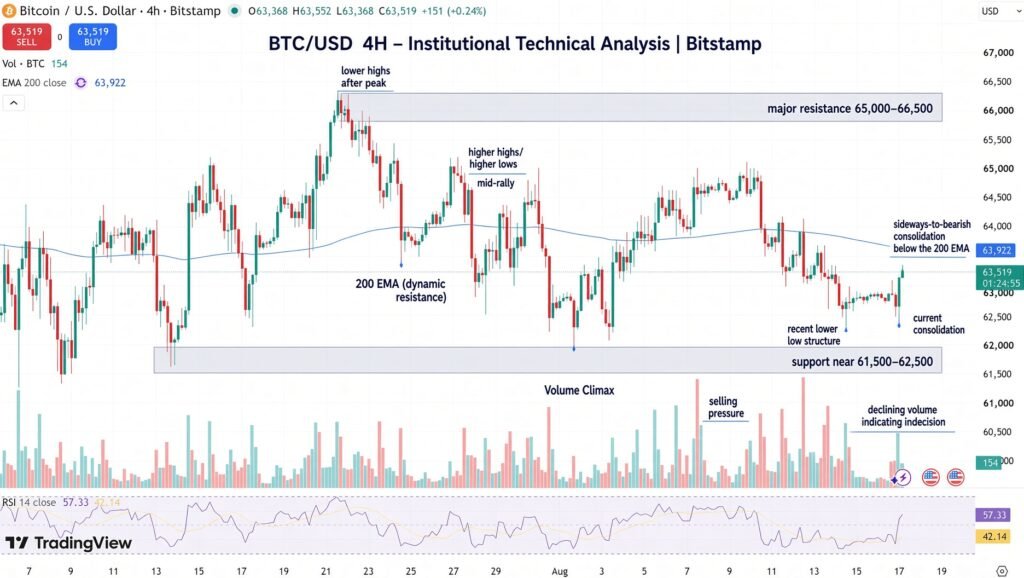
The risk of an exaggerated move skews to the downside specifically because of thinning buy-side support. Glassnode found that the band of resting bids framing the summer trading range peaked at the start of July and has thinned by roughly a third since, leaving considerably less support beneath current prices than existed during the last test of the lows. In practical terms, a retest of June’s low near $58,000 would likely find far fewer buyers waiting to step in than during prior tests of that level, raising the risk of a steeper decline if leveraged long positions begin liquidating into that thin order book.
- Total futures open interest: $48 billion versus $25 billion in 24-hour futures volume
- Spot market volume registers just $12.55 billion over 24 hours, less than half of futures volume, deepening the market’s overall liquidity thinness
Conclusion
The imbalance between bitcoin’s futures positioning and its available trading liquidity is structural rather than a one-day anomaly, and the risk it poses is mechanical: a market this heavily positioned has less capacity to absorb a wave of forced liquidations without the price moving further than the underlying selling would otherwise justify. Bitcoin remains calm for now, trading near $63,500, up roughly 1% since midnight UTC, according to CoinDesk. But with resting bid support already thinned by a third since early July and spot volume running even lighter than futures, the market’s underlying vulnerability to a sharp, self-reinforcing selloff has grown even while price action stays quiet on the surface.
Sources & Methodology
Primary-source standard: Market-moving facts should link to original data releases, regulator notices, company filings or official project announcements whenever available. Secondary reporting is used for additional context, not as a substitute for original evidence.
Page last reviewed: