
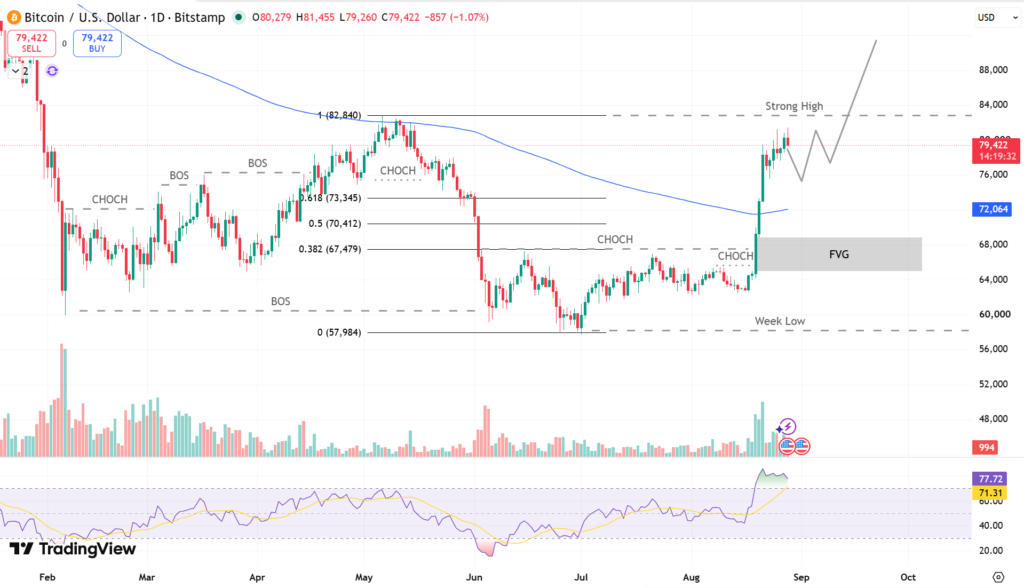
Bitcoin has traded in a narrow band around $80,000 for much of this week, and according to Arthur Hayes, that pause alone is enough to break Strategy’s decade-old playbook. The BitMEX co-founder argues Michael Saylor is now boxed into three uncomfortable choices, each carrying a real cost. For years, Strategy Inc. (Nasdaq: MSTR) traded like a leveraged bitcoin bet, often commanding double or triple the value of the coins on its balance sheet. That premium is what let the company sell shares, buy more bitcoin, and repeat the cycle.
A Premium That Ran Out of Room
In a recent appearance on Laura Shin’s Unchained Podcast, Hayes said the cycle is running out of road now that bitcoin’s price growth has slowed rather than reversed — the coin does not need to fall for the model to break, it just has to stop accelerating. Bitcoin briefly topped $81,000 on August 25 before easing back toward the high $70,000s, a sideways grind Hayes says directly punishes Strategy’s structure. With the stock’s enterprise market value to net asset value (mNAV) compressed to roughly 1.01x, and basic and diluted measures near 0.73x and 0.74x as of August 27, Strategy now trades close to the raw value of the 840,447 BTC on its books, leaving almost no premium to fund another buying cycle.
Three Costly Choices for Saylor
Hayes laid out the levers left available, and none come free:
- Issue new shares — without a healthy premium, this dilutes existing holders instead of rewarding them
- Sell bitcoin outright — cutting against the “never sell” identity that built the stock’s following
- Trim preferred dividends — risking confidence among income-focused investors who bought for yield, not bitcoin exposure
That tension is grounded in real numbers. Bitcoin.com News reported in May that Strategy held 818,334 BTC at an average cost of $75,537 each, against roughly $1.5 billion a year in combined obligations on two preferred-stock instruments: STRK, paying 8%, and STRC, paying between 10% and 11.5%. At that pace, the company had about 18 months of dividend coverage before needing a new funding source. Saylor said at the time the company would “probably sell some bitcoin to pay a dividend just to inoculate the market” — a line Hayes has since mocked, accusing Saylor of playing “Jedi mind tricks” over how far those sales might eventually go.
Conclusion: Why the Grind Matters
Hayes isn’t predicting an overnight collapse. His argument is narrower: Strategy’s original reason for existing — letting investors pay extra for equity-funded bitcoin exposure — stops making sense once bitcoin grinds sideways instead of compounding higher. He has told investors that anyone seeking plain bitcoin exposure through a brokerage account can simply buy a spot ETF instead, without paying for Strategy’s leverage or carrying its dividend overhang. As long as bitcoin holds near $80,000 without a fresh breakout, that premium-dependent model stays under pressure.
Sources & Methodology
Primary-source standard: Market-moving facts should link to original data releases, regulator notices, company filings or official project announcements whenever available. Secondary reporting is used for additional context, not as a substitute for original evidence.
Page last reviewed: