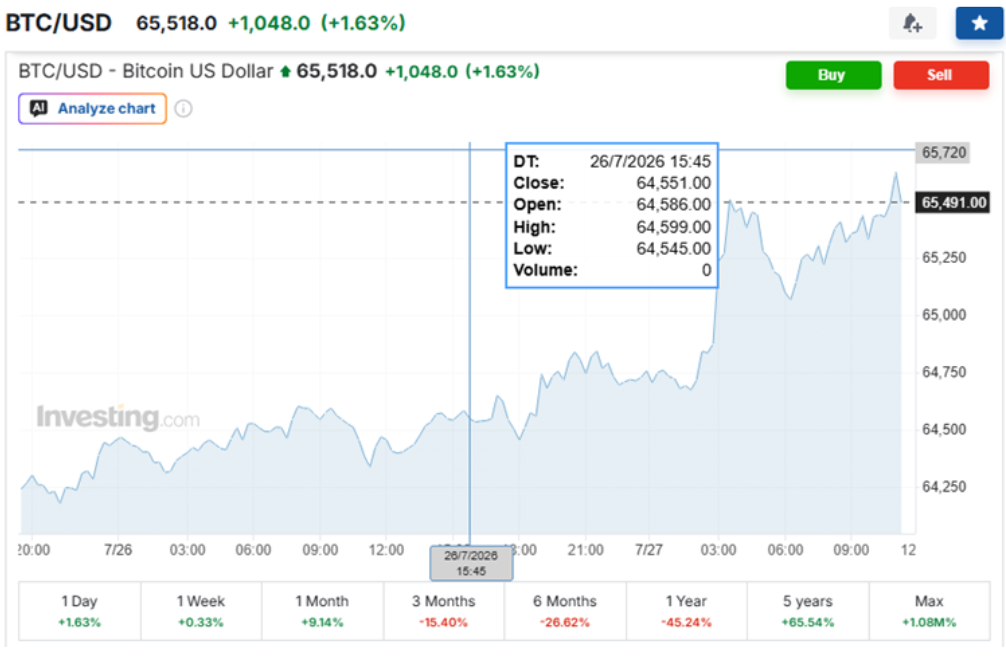
Bitcoin climbed above $65,000 on Monday after a pause in military actions between the United States and Iran eased geopolitical tensions, sending oil prices sharply lower and improving investor sentiment. As reported by Investing.com, the world’s largest cryptocurrency recovered alongside broader risk assets, as traders positioned ahead of this week’s U.S. Federal Reserve policy meeting.
Key Developments
- Bitcoin rose above $65,000, trading around $65,405 after recovering from last week’s volatile trading, according to Investing.com.
- A two-day pause in hostilities between the United States and Iran reduced fears of a broader Middle East conflict.
- Brent crude oil fell by more than 5% (around 6% according to ME News), easing concerns over energy-driven inflation.
- Market participants are now focused on the Federal Reserve’s interest rate decision scheduled for Wednesday.
- According to ME News, markets are pricing in roughly a 37% probability of a Federal Reserve rate hike, while the latest PCE inflation data is also due this week.
- ME News also reported that approximately $90 million in crypto positions were liquidated over the past 24 hours as Bitcoin crossed the $65,000 level.
- In separate industry developments reported by ME News, Singapore-based crypto payment firm Triple-A suffered an estimated $12 million hot wallet exploit, while South Korea’s WEMIX project experienced a contract ownership compromise that resulted in the unauthorized issuance of more than 5.22 million tokens.
- ME News further reported that Iran’s Oil Ministry claimed it used Bitcoin (BTC) and Tether (USDT) to help facilitate more than $11 billion in oil sales during the current fiscal year despite international sanctions.
Why Markets Reacted
Bitcoin and broader risk assets rallied after the United States and Iran signalled a temporary pause in hostilities, easing fears of a prolonged disruption to Middle East oil supplies. Brent crude fell more than 5% to around $91–92 a barrel, while WTI dropped to roughly $84–85, reducing concerns that higher energy costs would reignite global inflation. The retreat in oil also pushed U.S. Treasury yields lower and weakened the U.S. dollar, improving demand for risk-sensitive assets including cryptocurrencies.
As reported by Investing.com, Bitcoin climbed back above $65,000, recovering from last week’s volatile trading as investors rotated into higher-risk assets. Futures markets also reflected improving sentiment, with Nasdaq 100 futures rising about 1.3% and S&P 500 futures gaining around 0.8%, underscoring a broad recovery across technology and digital assets.
Attention has now shifted to the Federal Reserve. While policymakers are widely expected to leave interest rates unchanged, investors are looking for guidance on whether easing inflation and softer energy prices could reduce the likelihood of additional tightening later this year. Current market pricing implies roughly a one-in-three probability of a 25-basis-point rate increase, down from levels seen during last week’s oil-driven sell-off.
Background and Context
Bitcoin has increasingly traded alongside technology stocks and other risk assets throughout 2026, making macroeconomic developments and geopolitical events key drivers of short-term price action.
This week’s market focus extends beyond the Federal Reserve. Investors are also awaiting major earnings reports from leading technology companies, including Microsoft, Meta Platforms, Apple, and Amazon, with expectations that updates on artificial intelligence investments could influence broader market sentiment.
Meanwhile, the cryptocurrency industry continues to face operational risks despite improving market sentiment. Security incidents involving crypto payment provider Triple-A, where more than US$9.7 million was reportedly drained from hot wallets, and an ongoing investigation into a potential WEMIX$ smart contract security issue highlight that cybersecurity remains a key challenge for digital asset markets.
What’s Next
Investors will closely watch Wednesday’s Federal Reserve policy decision and Chair Kevin Warsh’s comments for indications on the future interest-rate path. Markets will also monitor the release of U.S. PCE inflation data, additional developments surrounding U.S.-Iran relations, and corporate earnings from major technology firms.
For Bitcoin, the combination of easing geopolitical tensions, lower oil prices and a softer U.S. dollar has improved the near-term backdrop. However, any renewed escalation in the Middle East, an upside surprise in inflation, or a more hawkish Federal Reserve could quickly reverse sentiment and trigger renewed volatility across both cryptocurrency and traditional financial markets.
Sources & Methodology
Primary-source standard: Market-moving facts should link to original data releases, regulator notices, company filings or official project announcements whenever available. Secondary reporting is used for additional context, not as a substitute for original evidence.
Page last reviewed: