
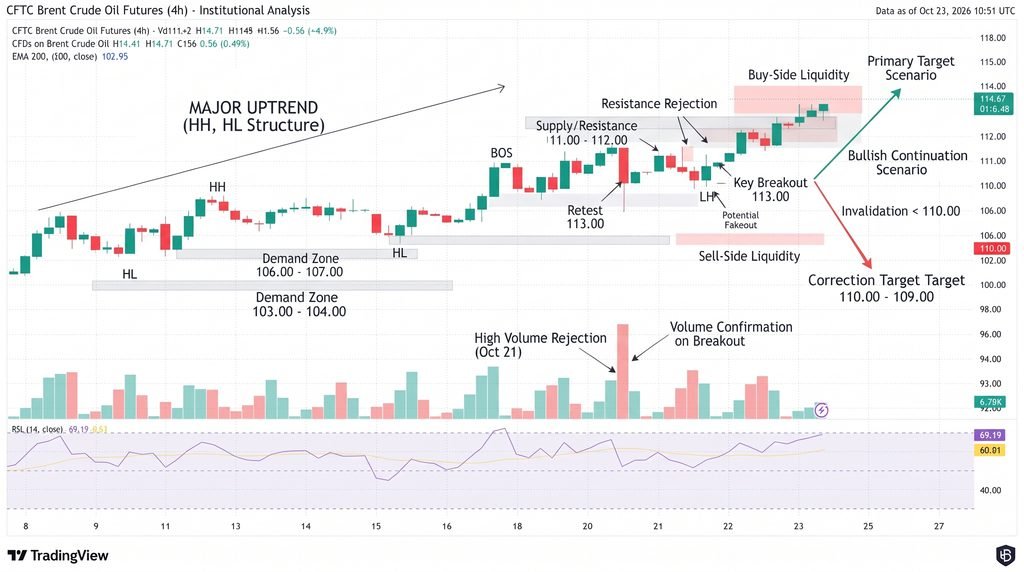
Oil prices climbed on Friday as escalating attacks involving Yemen’s Houthi movement and Saudi Arabia raised concerns about renewed disruptions to Middle Eastern energy supplies. Brent crude futures reached $114.72 a barrel, their highest level since May 4, while US West Texas Intermediate (WTI) crude advanced above $101. The rally reflects growing uncertainty over shipping routes, production facilities and the availability of crude and refined fuels. Additional concerns include a Libyan pipeline shutdown and an oil spill off the United Arab Emirates, reinforcing the market’s sensitivity to supply disruptions.
Brent Oil Rallies on Middle East Risks
Brent futures rose $1.14, or 1%, to $114.31 a barrel by 1006 GMT on Friday. WTI gained $1.65, or 1.7%, to $101.12. Brent was on course for a third consecutive weekly advance of approximately 4%, although WTI remained set for a weekly decline of around 0.3%.
The immediate catalyst was intensifying conflict involving Saudi Arabia and Yemen-based Houthis, who are aligned with Iran. Saudi Aramco reportedly ordered the evacuation of its headquarters in Dhahran on Thursday as fighting escalated.
The conflict has heightened concerns about the Bab el-Mandeb Strait, a strategic passage connecting the Red Sea with the Gulf of Aden. Disruptions there could delay shipments, increase insurance and freight costs, and complicate deliveries to international buyers.
UBS analyst Giovanni Staunovo said volatile oil flows and elevated freight rates had left the market undersupplied. The duration and scale of any actual disruption will determine whether prices maintain their geopolitical risk premium.
Libya and UAE Add to Supply Concerns
Supply uncertainty extends beyond Saudi Arabia. Libya’s National Oil Corporation reported that a pipeline valve connecting the Hamada and Tahara oilfields to Zawiya port had been shut, reducing production from both fields.
Separately, the UAE’s Ministry of Climate Change and Environment confirmed an oil spill from a tanker affecting coastal areas near Umm Al Quwain. Authorities began containment and environmental assessments, temporarily closing beaches and coastal areas while the extent of the impact was evaluated.
Key developments for oil traders include:
- Brent crude: $114.72 intraday high, the strongest level since May 4.
- WTI crude: $101.12, up 1.7% in Friday trading.
- Libya: Pipeline disruption has reduced production at two oilfields.
- UAE: Tanker-related oil pollution has triggered containment operations.
These incidents do not automatically translate into sustained global shortages, but simultaneous disruptions can tighten available supply and amplify price volatility.
Russian Diesel Offers Potential Relief
A countervailing development is the return of Russian diesel to the US market. Shipping data from LSEG showed that a Malta-flagged tanker carrying 40,000 metric tons of ultra-low-sulfur diesel was heading toward New York, with arrival expected on November 7.
Russia began easing its self-imposed diesel export restrictions following an agreement involving US President Donald Trump and Russian President Vladimir Putin. Additional shipments could improve fuel availability, although one cargo is too small to offset major disruptions to global oil flows.
Conclusion
Brent crude’s advance to $114.72 reflects mounting concerns over Middle Eastern security, shipping risks and interrupted production. If attacks persist and deliveries are delayed, prices could remain elevated. However, restored supply, additional fuel exports or easing geopolitical tensions could reduce the premium. Traders will focus on actual shipment losses and the duration of disruptions to determine whether the rally can continue.
Sources & Methodology
Primary-source standard: Market-moving facts should link to original data releases, regulator notices, company filings or official project announcements whenever available. Secondary reporting is used for additional context, not as a substitute for original evidence.
Page last reviewed: