
Cardano (ADA) traded near $0.250 on Monday after declining 2.85% over the previous week, with improving derivatives indicators supporting a potential recovery. The token is holding above its 50-day, 100-day and 200-day exponential moving averages (EMAs), suggesting that its short-term structure remains constructive. However, mixed signals from market analytics platforms indicate that selling pressure has not disappeared. Traders are watching $0.245 as immediate support and $0.299 as the next major resistance, with momentum indicators offering a cautiously positive outlook.
ADA Derivatives Signal Improving Sentiment
Data from CoinGlass shows Cardano’s long-to-short ratio at 1.01 on Monday. A reading above one indicates that long positions marginally outnumber short positions within the metric’s measured accounts or positions. This suggests a slight bullish tilt, although it does not guarantee that ADA’s price will rise.
The token’s funding rate also turned positive on Sunday, reaching 0.0061% on Monday. In perpetual futures markets, positive funding generally means traders holding long positions pay those holding shorts. The rate reflects positioning and the relationship between futures and spot prices, rather than providing definitive evidence of future price direction.
Despite these encouraging developments, CryptoQuant data points to potential risks. Its market indicators reportedly show selling pressure across Cardano’s spot and futures markets, alongside large whale orders in futures trading. Large transactions can amplify volatility, particularly when liquidity is limited.
The combination of positive funding and potential sell-side dominance presents a mixed picture. Traders may be positioning for a rebound, but concentrated selling or crowded long positions could undermine the recovery.
Cardano Price Holds Above Key EMAs
ADA is trading above its 50-day EMA at $0.230, 100-day EMA at $0.219 and 200-day EMA at $0.241. These moving averages track recent price trends and can help traders identify potential support zones. Their position below the current price supports a constructive near-term outlook, although it does not confirm a sustained uptrend.
The Relative Strength Index (RSI) stands near 54, indicating modest positive momentum without reaching the conventional overbought threshold of 70. Meanwhile, the Moving Average Convergence Divergence (MACD) remains slightly below zero, suggesting that bullish momentum has yet to establish a stronger foothold.
On the downside, $0.245 is the first support level, followed by the 200-day EMA near $0.241 and another price floor at $0.236. A break below these levels could expose the 50-day EMA at $0.230 and the 100-day EMA at $0.219.
ADA Price Forecast: $0.299 in Focus
Cardano’s next move will depend on whether buyers can defend immediate support and generate enough momentum to challenge overhead resistance. The $0.299 level is the next notable barrier if the recovery extends.
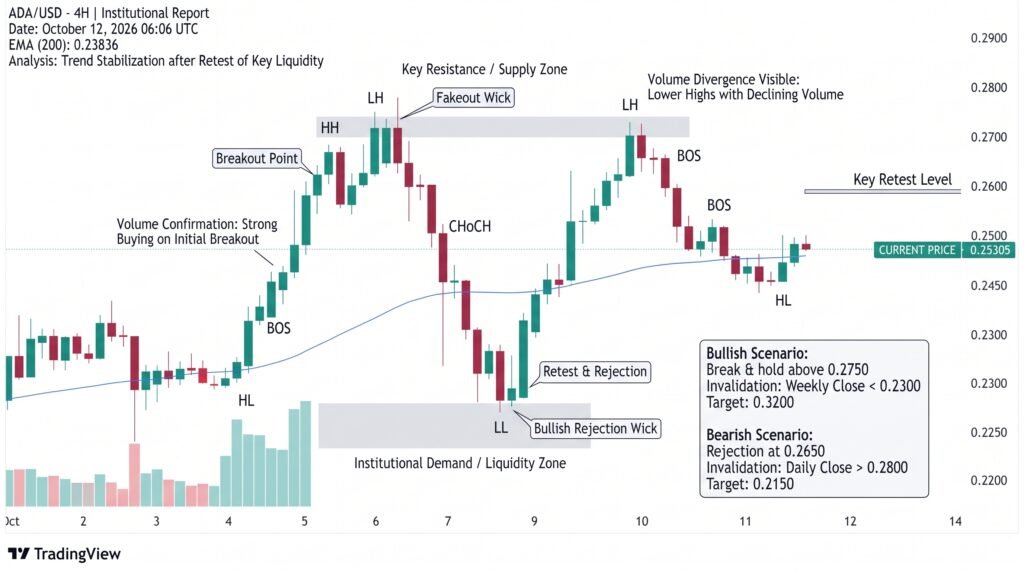
Key levels to monitor include:
- $0.245: Immediate support for the current recovery.
- $0.241: 200-day EMA support.
- $0.230–$0.219: Deeper support zone around the 50-day and 100-day EMAs.
- $0.206: Rising trendline support.
- $0.299: Major upside resistance and potential profit-taking zone.
A sustained move above $0.250 would help reinforce the recovery, while a decisive break below $0.236 would weaken the bullish setup.
Conclusion
Cardano is showing early signs of stabilization near $0.250, supported by positive funding, a slightly bullish long-to-short ratio and trading above its major EMAs. However, the MACD remains below zero, and reported selling pressure warrants caution. Holding $0.245 could preserve the recovery attempt, while a sustained break above $0.299 would provide stronger evidence of renewed bullish momentum. Until then, ADA’s outlook remains cautiously positive rather than decisively bullish.
Sources & Methodology
Primary-source standard: Market-moving facts should link to original data releases, regulator notices, company filings or official project announcements whenever available. Secondary reporting is used for additional context, not as a substitute for original evidence.
Page last reviewed: