
The US Dollar Index (DXY) is consolidating above 103.00 after climbing to its highest level since April 2025, supported by stronger inflation data, rising Treasury yields and expectations of further Federal Reserve tightening. The dollar’s advance has also received support from renewed geopolitical tensions involving Iran, which have increased demand for traditional safe-haven assets. With markets reassessing the Fed’s interest-rate outlook, investors are watching US producer-price data and central bank commentary for clues about whether the rally can continue.
Fed rate expectations support the dollar
The dollar’s latest advance reflects a shift in expectations for US monetary policy. October’s Consumer Price Index (CPI) increased 0.4% month over month, exceeding economists’ 0.3% forecast. Core CPI, which excludes food and energy, rose 0.3%, against expectations of 0.2%. The stronger figures reinforced concerns that inflation remains persistent and could require additional action from the Federal Reserve.
Market pricing has adjusted accordingly. Reuters reported on Friday that traders assigned a 14.5% probability to a 50-basis-point December rate increase. A basis point equals 0.01 percentage point, making a 50-basis-point move equivalent to half a percentage point. Expectations of higher US interest rates can support the dollar by making dollar-denominated investments more attractive relative to currencies with lower yields.
Treasury markets have reflected the repricing. The 10-year US government bond yield moved above 5%, while the two-year yield climbed sharply as investors assessed the possibility of a more restrictive Fed policy.
RBC economists have also highlighted persistent core-inflation pressures, strong economic growth and a tight labour market as arguments for further tightening. However, the final policy decision will depend on incoming economic data rather than market expectations alone.
Iran tensions add safe-haven demand
Geopolitical developments have provided another source of support for the greenback. Renewed tensions involving Washington and Tehran, alongside concerns about attacks on energy infrastructure and commercial shipping, have increased uncertainty surrounding Middle Eastern energy supplies.
The Strait of Hormuz is particularly important because a substantial share of globally traded oil passes through the waterway. Any disruption could push energy prices higher, potentially adding to inflation concerns and reinforcing expectations that the Fed may need to maintain restrictive policy.
The dollar can benefit from this environment because investors often seek liquid, widely traded assets during periods of geopolitical uncertainty. Nevertheless, higher oil prices could also weigh on economic growth, creating competing influences for currency markets.
Key developments for traders include:
- US October Producer Price Index (PPI) figures.
- Further comments from Federal Open Market Committee officials.
- Changes in crude oil prices and Middle East security risks.
DXY technical outlook: 103.00 matters
The DXY remains above the psychologically important 103.00 threshold, maintaining a constructive near-term technical structure. Its position above the 200-day Simple Moving Average (SMA), according to the supplied chart analysis, also supports the broader bullish bias.
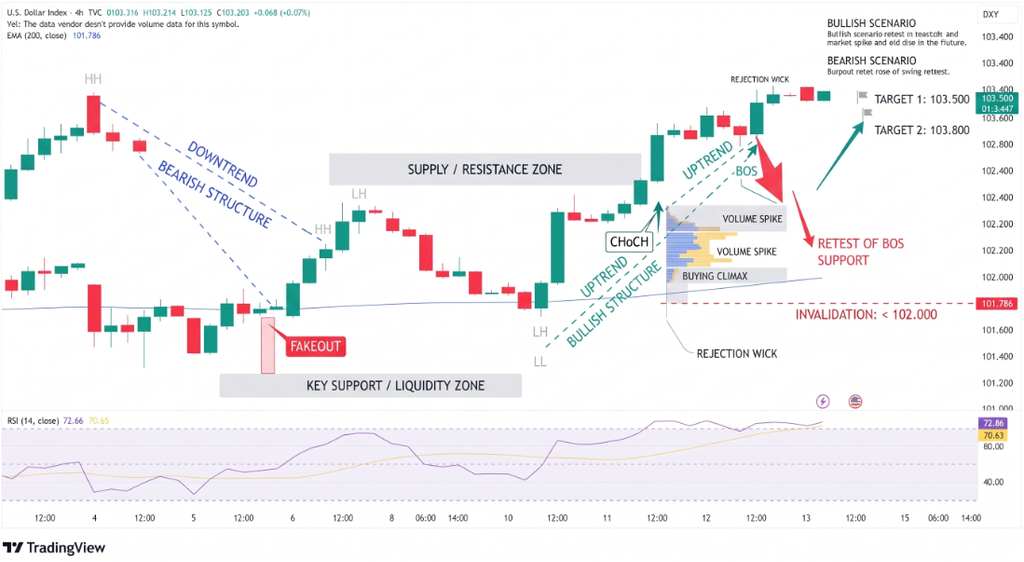
A sustained move below 103.00 could bring the 102.60–102.50 region into focus. This former resistance area is now viewed as potential support. Holding above it would help preserve the recovery structure, while a decisive break lower could signal that bullish momentum is weakening.
Conclusion
The dollar’s outlook remains positive as higher inflation, rising Treasury yields and geopolitical uncertainty support demand. However, much of the expected Fed tightening may already be reflected in market prices. A stronger-than-expected PPI reading could extend the rally, while softer inflation or less hawkish Fed commentary could encourage profit-taking.
Sources & Methodology
Primary-source standard: Market-moving facts should link to original data releases, regulator notices, company filings or official project announcements whenever available. Secondary reporting is used for additional context, not as a substitute for original evidence.
Page last reviewed: