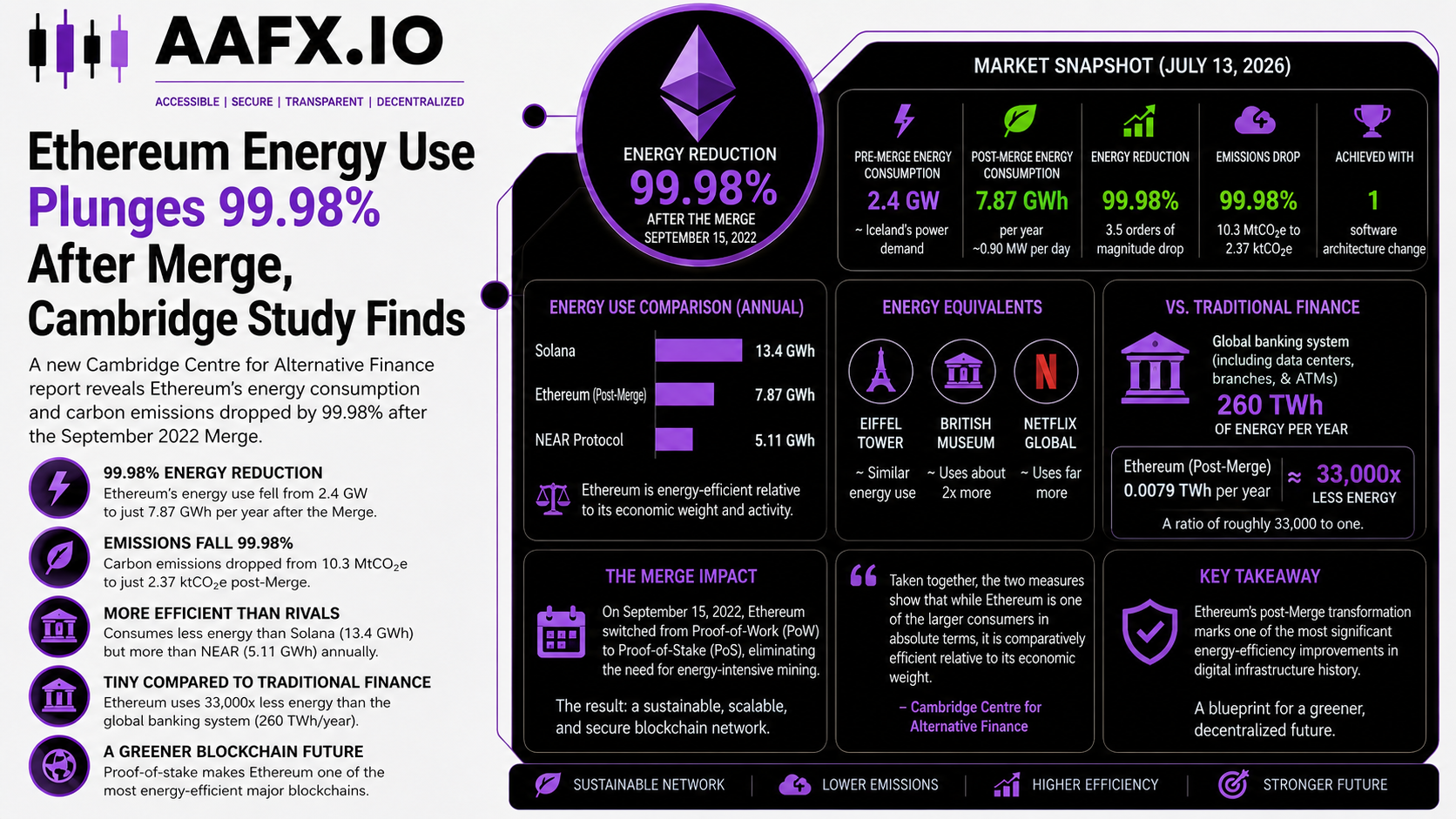
Cambridge research shows Ethereum cut energy consumption and emissions by 99.98% after the Merge, reshaping blockchain sustainability metrics.
Ethereum’s Post-Merge Shift Redefines Blockchain Energy Efficiency
Ethereum’s transition from proof-of-work to proof-of-stake continues to draw attention nearly four years after the historic network upgrade. A new report from the Cambridge Centre for Alternative Finance (CCAF) provides one of the most comprehensive assessments yet of how the September 2022 Merge transformed Ethereum’s energy profile, operational structure, and environmental footprint.
Published in June, the report titled Ethereum After the Merge: A Change in Power examines the long-term consequences of replacing energy-intensive mining with a validator-based consensus system. The findings reveal a dramatic reduction in electricity consumption and carbon emissions, positioning Ethereum as one of the most efficient major blockchain networks relative to its economic scale.
Cambridge Measures Massive Drop
Before the Merge, Ethereum relied on proof-of-work mining, a process requiring significant computing power to secure the network. According to Cambridge researchers, Ethereum’s electricity demand peaked at approximately 2.4 gigawatts, comparable to the energy requirements of a small nation such as Iceland.
The shift to proof-of-stake fundamentally changed that equation. The report estimates Ethereum’s annual energy consumption now stands at just 7.87 gigawatt-hours, representing a reduction of roughly 99.98%.
Researchers calculated these figures using a network-weighted average of 105 watts per node. The result is a blockchain that operates with only a fraction of its previous energy requirements while continuing to process billions of dollars in transactions and support thousands of decentralized applications.
The study argues that Ethereum’s transformation demonstrates how software architecture changes can significantly alter the environmental impact of large digital networks without compromising functionality.
Ethereum Versus Blockchain Rivals
The report also compared Ethereum’s energy footprint with other leading blockchain ecosystems.
Key findings include:
- Ethereum consumes approximately 7.87 GWh annually.
- Solana’s estimated annual consumption exceeds 13.4 GWh.
- NEAR Protocol records roughly 5.11 GWh per year.
- Ethereum’s energy use is comparable to that of the Eiffel Tower.
- Its consumption is about half that of the British Museum.
While Ethereum remains one of the larger blockchain networks by absolute energy usage, Cambridge researchers concluded that it performs efficiently when measured against its economic activity, market value, and network utilization.
The findings challenge long-standing criticisms that blockchain technology must inherently consume vast amounts of electricity to remain secure and decentralized.
Emissions Fall Alongside Energy Use
Perhaps the most striking conclusion involves Ethereum’s carbon footprint. The report estimates emissions dropped from 10.3 million metric tons of carbon dioxide equivalent before the Merge to just 2.37 thousand metric tons afterward.
That reduction mirrors the network’s decline in energy consumption and highlights the environmental significance of the transition.
Cambridge also compared Ethereum with traditional financial infrastructure. Researchers estimated that global banking systems—including branches, ATMs, and data centers—consume approximately 260 terawatt-hours of electricity annually.
Against that benchmark, Ethereum’s current footprint of 0.0079 terawatt-hours is roughly 33,000 times smaller. The report concludes that the Merge represents one of the most significant energy-efficiency improvements ever achieved through a single software-driven infrastructure upgrade, offering a new model for sustainable digital networks.
Sources & Methodology
Primary-source standard: Market-moving facts should link to original data releases, regulator notices, company filings or official project announcements whenever available. Secondary reporting is used for additional context, not as a substitute for original evidence.
Page last reviewed: