
The Euro slipped against the dollar on Tuesday, extending its pullback from a four-day high of 1.1711 to near 1.1655, as the US Dollar Index climbed 0.1% to 99.07. The move reflects caution ahead of two events: July’s Personal Consumption Expenditure inflation data and the Jackson Hole Symposium. Beneath the pullback, the broader case for the euro remains intact, anchored by growing bets on a September rate hike from the European Central Bank.
Dollar Rebound Looks Tactical, Not Structural
Scotiabank strategists describe this week’s event calendar as carrying significant risk, and expect that backdrop to support modest near-term dollar gains as traders trim positions ahead of the data. They’re careful to separate that from a trend change, though: technical signals still point lower for the dollar, and while momentum oscillators show some slowing in the decline, no reversal has shown up yet.
That distinction matters. The greenback’s bounce this week looks more like traders squaring positions into uncertainty than a shift in the dollar’s underlying trajectory, which has been weighed down for weeks by concerns over U.S. fiscal policy and expanded Treasury bond buybacks.
ECB Rate Path Keeps Euro Underpinned
Nomura analysts continue to expect the ECB to raise rates in September, arguing that recent activity data should ease the concerns of more dovish policymakers wary of tightening beyond what’s necessary. A hike would lift the deposit rate to 2.5%, with markets currently pricing a 25% chance of a further move to 3% by March 2027, rising to 60% by next September.
The ECB’s own Consumer Expectations Survey supports the case for continued tightening. Despite the July escalation of the Iran conflict, three-year-ahead median inflation expectations eased 0.1 percentage point to 2.7%, while five-year expectations held steady at 2.4%, signaling that price pressures remain anchored even amid geopolitical stress.
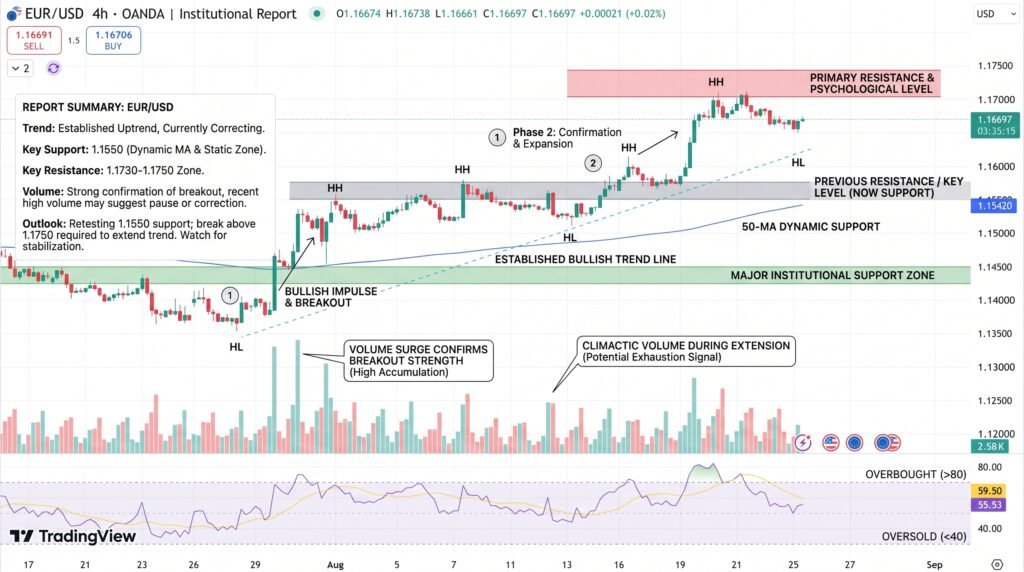
Key technical levels on the EUR/USD chart:
- Support: June 15 high at 1.1622, then the 20-day EMA at 1.1577
- Resistance: August high at 1.1711, followed by the May high near 1.1800
- Momentum: RSI(14) near 67, firm but not yet extreme
EUR/USD trades around 1.1654, holding above its 20-day Exponential Moving Average, a level that has kept buyers in control of the near-term trend. The pair needs a decisive close above 1.1711 to resume its broader uptrend toward 1.1800.
Conclusion
The euro’s dip is a pause within an uptrend, not the start of a reversal. With the ECB positioned to hike in September and U.S. fiscal concerns still weighing on the dollar’s longer-term trajectory, EUR/USD’s next directional move likely hinges on Friday’s PCE print and the tone Federal Reserve officials strike at Jackson Hole.
Sources & Methodology
Primary-source standard: Market-moving facts should link to original data releases, regulator notices, company filings or official project announcements whenever available. Secondary reporting is used for additional context, not as a substitute for original evidence.
Page last reviewed: