
EUR/USD has slipped to around 1.1665 in Wednesday’s European session, pressured by a rebound in the U.S. Dollar ahead of the July Personal Consumption Expenditures report. Markets are also positioning ahead of Federal Reserve Chair Kevin Warsh’s first Jackson Hole address on Friday, his opening keynote since taking office in May. The pair’s broader trend remains constructive, but the Relative Strength Index is approaching overbought territory, a sign upside momentum is starting to stretch.
Dollar Rebound Pressures the Euro
Economists expect Core PCE, which excludes food and energy, to rise 3.3% year-over-year in July, with sticky inflation partly attributed to energy risk tied to the Middle East conflict. A hotter-than-expected reading would strengthen the case for a Fed rate hike in September and support the dollar against the euro. Rate-hike odds have already shifted: the CME FedWatch tool now prices a 38.4% probability of a 25-basis-point increase next month, down sharply from 67% earlier in August.
The euro’s underlying support comes from the other side of the Atlantic. The European Central Bank held its three key rates steady at its July 23 meeting, keeping the deposit facility rate at 2.25% and declining to commit to a future path, while citing volatile energy prices. Euro-area annual inflation ran at 2.9% in July, giving the ECB less pressure to act than the Fed currently faces.
Momentum Builds Toward Resistance
Analysts at UOB Group say the pair has broken out of a tight range that had defined recent sessions, after an earlier call for continued consolidation proved wrong. EUR/USD dipped toward 1.1650 before recovering to settle near 1.1674, a move UOB frames as early-stage upward momentum. The group sees scope for a test of 1.1695 in the near term, while flagging that resistance at 1.1710 is unlikely to give way just yet.
- Support: 1.1665, then 1.1655
- Near-term resistance: 1.1695, with a firmer ceiling at 1.1710
Overbought Signal Caps the Upside
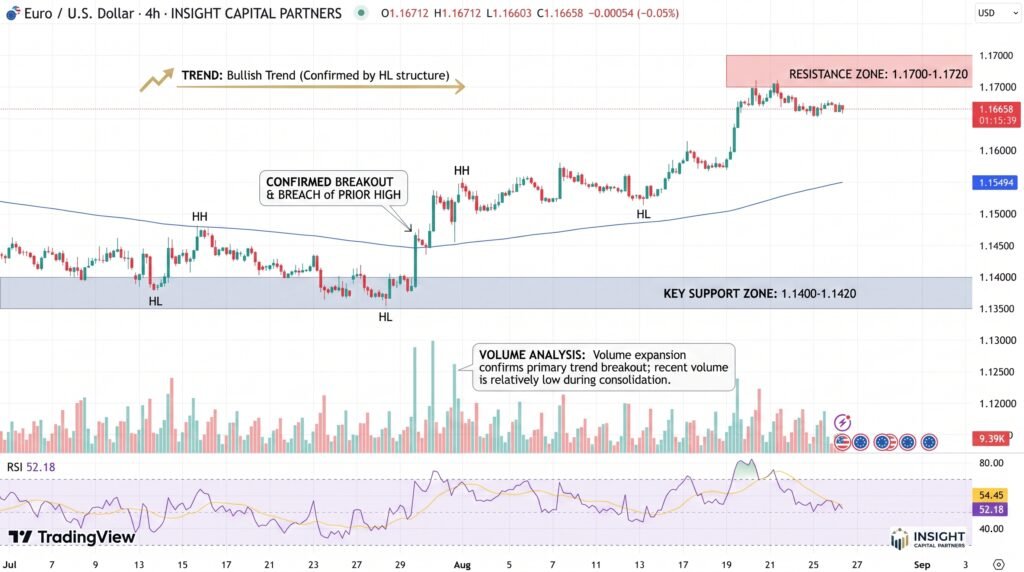
On the daily chart, EUR/USD holds a constructive bias, trading above both the 100-day simple moving average and the 20-day Bollinger middle band. The 14-day RSI at 67.27 is approaching overbought territory, a signal that upside momentum remains firm but increasingly stretched.
Immediate resistance sits at the 20-day Bollinger upper band near 1.1705, a level where profit-taking often emerges. A confirmed break above it would open the path toward the May 8 high of 1.1788, and beyond that, the April 16 high of 1.1824. On the downside, the 1.1580–1.1575 zone — where the Bollinger middle band and 100-day SMA converge — is the key support level. A break below it would weaken the bullish structure and expose the lower Bollinger band near 1.1460.
The setup leaves EUR/USD in a narrow band between conflicting forces: a dollar rebound tied to Fed rate-hike odds, and a euro that retains structural support from the ECB’s steady policy stance. Wednesday’s PCE data and Friday’s Jackson Hole speech from Warsh are the two catalysts most likely to resolve that tension, and traders should expect the RSI’s approach to overbought levels to limit gains until one of those events provides clearer direction.
Sources & Methodology
Primary-source standard: Market-moving facts should link to original data releases, regulator notices, company filings or official project announcements whenever available. Secondary reporting is used for additional context, not as a substitute for original evidence.
Page last reviewed: