
EUR/USD extended its decline toward 1.0950 on Thursday as stronger US inflation reinforced expectations of further Federal Reserve tightening. The euro remains under pressure despite expectations that the European Central Bank could raise interest rates in December. A stronger dollar, supported by defensive demand and concerns over technology stocks, has kept buyers cautious. With the pair trading below its 100-day simple moving average (SMA), attention is turning to support at 1.0896 and the possibility of a deeper correction toward 1.0733.
US inflation strengthens dollar outlook
The latest US inflation figures have reinforced the case for restrictive monetary policy. The Bureau of Economic Analysis reported that headline Personal Consumption Expenditures (PCE) inflation increased to 3.8% annually in October, from 3.7% in September. Core PCE, which excludes food and energy, accelerated to 3.3% from 3.1%.
Both measures increased 0.3% month over month, indicating that underlying price pressures remain persistent. The figures have strengthened expectations that the Federal Reserve could raise interest rates at its December 8–9 meeting.
Market pricing has reflected growing confidence in another quarter-point increase, although interest-rate futures represent changing expectations rather than a confirmed policy decision. Fed Governor Christopher Waller has also discussed the possibility of a larger increase, highlighting the debate over how aggressively policymakers should respond to inflation.
The dollar has received additional support from defensive positioning as investors reassess the outlook for US technology shares and the artificial-intelligence trade. Reuters reported that the euro slipped to approximately $1.096 on Thursday, while the dollar index remained near its 2026 highs.
ECB rate expectations offer limited support
The euro has struggled to benefit from expectations of tighter European monetary policy. Scotiabank’s latest outlook points to a possible 25-basis-point ECB increase in December, followed by another increase during the first half of 2027.
However, expectations of higher eurozone interest rates have not been sufficient to offset demand for the US dollar. Investors are weighing the relative economic and policy outlooks of both regions, leaving EUR/USD vulnerable to changes in US rate expectations.
German economic growth has also offered limited encouragement. Third-quarter GDP was revised to 0.1% quarter over quarter, a tenth of a percentage point below the preliminary estimate. The modest downgrade adds to concerns about the strength of the eurozone recovery.
Scotiabank estimated the euro’s fair value at approximately 1.1069, suggesting the currency could be undervalued relative to its fundamental indicators. However, fair-value estimates do not guarantee an immediate price recovery.
EUR/USD technical outlook remains bearish
The daily chart shows EUR/USD trading below its 100-day SMA and the middle line of its Bollinger Bands, maintaining a negative near-term structure. The 14-day Relative Strength Index (RSI), near 35, indicates weak momentum but has not yet reached the conventional oversold threshold of 30.
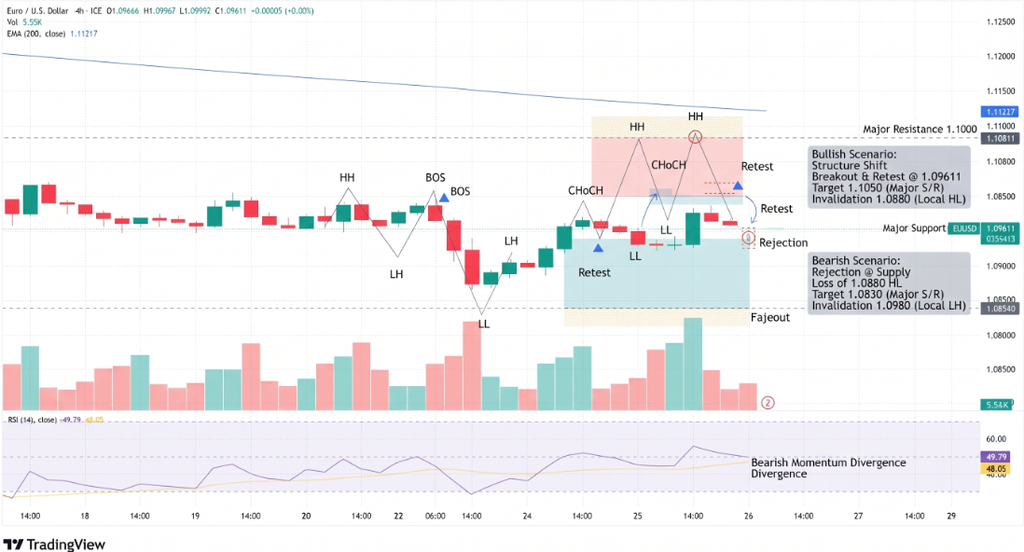
Key technical levels include:
- Immediate support: 1.0896, the November 24 low.
- Further support: 1.0860, followed by 1.0733.
- Initial resistance: 1.1000 and 1.1070.
- Major resistance: 1.1282 and the 100-day SMA near 1.1360.
A sustained break below 1.0896 could expose the 1.0860 Bollinger Band support, with 1.0733 becoming the next major downside reference. On the upside, reclaiming 1.1000 would provide initial relief, while a move above 1.1070 would improve the recovery outlook.
Conclusion
EUR/USD remains vulnerable as elevated US inflation supports expectations of further Fed tightening and defensive dollar demand. Although ECB rate expectations and the euro’s estimated fair value offer some underlying support, the technical picture remains negative below 1.1070. A break under 1.0896 would strengthen the case for a deeper decline toward 1.0733.
Sources & Methodology
Primary-source standard: Market-moving facts should link to original data releases, regulator notices, company filings or official project announcements whenever available. Secondary reporting is used for additional context, not as a substitute for original evidence.
Page last reviewed: