
EUR/USD extended its decline for a fifth consecutive session on Monday, November 16, briefly approaching 1.1015 during Asian trading and reaching its weakest level since May 2025. A firmer US Dollar, supported by rising Federal Reserve rate-hike expectations and elevated Treasury yields, has kept the euro under pressure. Despite the European Central Bank’s hawkish policy signals, buyers have struggled to defend the single currency. The 1.1000 psychological level is now the key downside threshold for traders watching whether the latest sell-off will accelerate.
Fed Expectations Strengthen the Dollar
The latest US inflation data and hawkish remarks from Federal Reserve policymakers have encouraged markets to price in tighter monetary policy. Expectations of a potential December rate increase have supported US bond yields, improving the dollar’s appeal relative to currencies such as the euro.
The dollar has also benefited from demand for traditional safe-haven assets amid geopolitical uncertainty. The US Dollar Index climbed to a 19-month high last week, while the euro weakened to levels last seen in April 2025. Reuters reported that markets were pricing in nearly an 85% probability of a December Fed rate increase on November 12.
The euro has received limited support from the ECB’s increasingly hawkish tone. However, expectations that the central bank could approach the end of its tightening cycle have restricted the currency’s ability to recover against the dollar.
EUR/USD Technical Outlook Turns Bearish
The technical picture also favours sellers. On the four-hour chart, EUR/USD has repeatedly failed to reclaim its 200-period Exponential Moving Average (EMA), reinforcing the broader downward trend. The pair has also broken below the 1.1115–1.1110 support zone, which now acts as an initial resistance area.
Momentum indicators underline the selling pressure:
- RSI: Near 25, indicating deeply oversold conditions.
- MACD: Below the zero line, reflecting negative momentum.
- Price structure: A sequence of lower levels supports the short-term bearish trend.
The oversold RSI leaves room for a temporary rebound as some traders close profitable short positions. However, an oversold reading alone does not confirm that a lasting recovery has begun.
1.1000 Becomes the Critical Support
The immediate focus is whether sellers can push EUR/USD below the 1.1000 psychological threshold and keep it there. A sustained break could attract additional selling and extend the pair’s decline, although the next downside targets would depend on subsequent price action.
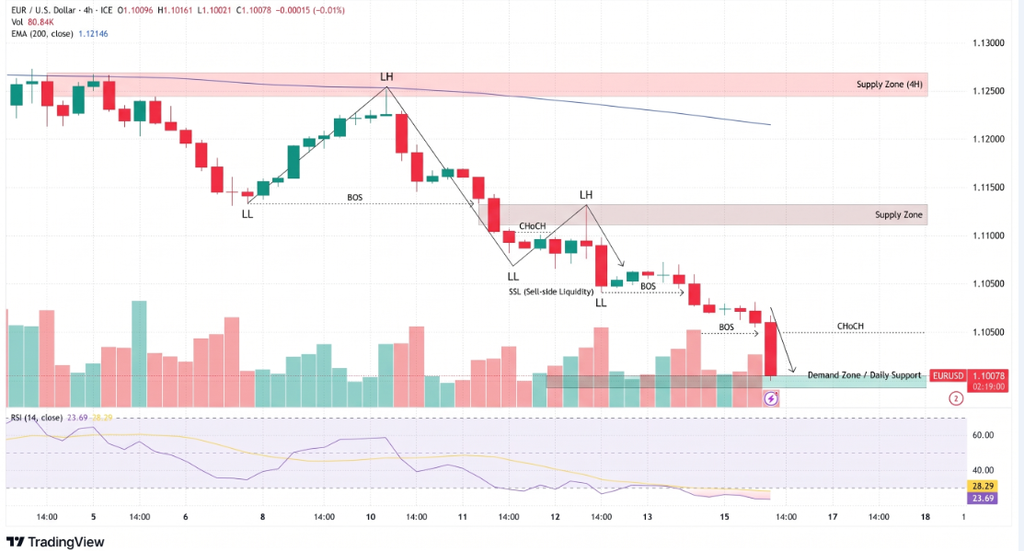
EUR/USD Price Chart – Source: Tradingview
On the upside, the former support band between 1.1110 and 1.1115 represents the first significant recovery hurdle. A move above this area could open the way toward the four-hour 200-period EMA near 1.1217.
A sustained recovery above 1.1217 would weaken the immediate bearish structure and suggest that sellers are losing control. Until then, rallies may encounter selling interest.
Conclusion
EUR/USD remains vulnerable as dollar strength and expectations of further Fed tightening outweigh support from the ECB. The 1.1000 level is the immediate test for bears. A decisive break would reinforce downside risks, while a recovery above 1.1115 would offer the first indication that selling pressure is easing.
Sources & Methodology
Primary-source standard: Market-moving facts should link to original data releases, regulator notices, company filings or official project announcements whenever available. Secondary reporting is used for additional context, not as a substitute for original evidence.
Page last reviewed: