
The EUR/USD pair edged higher to around 1.1208 on Monday, October 12, as hopes for a Russia-Ukraine energy ceasefire offered temporary relief to the euro. The announcement helped pull oil prices lower, easing some immediate inflation concerns. However, persistent French fiscal uncertainty continues to weigh on the euro, while traders await September U.S. inflation data for fresh clues on Federal Reserve policy. The U.S. Dollar Index (DXY) hovered near 102.20, keeping the dollar relatively firm and limiting the currency pair’s recovery.
Energy Truce Offers Limited Euro Relief
U.S. President Donald Trump announced an immediate energy ceasefire between Russia and Ukraine, raising hopes of reduced attacks on energy infrastructure and improved fuel supply conditions. Oil prices came under pressure following the announcement, providing some relief to economies exposed to higher energy costs. However, the agreement’s scope and implementation remain uncertain, as Ukrainian President Volodymyr Zelenskyy reported continued Russian attacks after the announcement.
Lower energy prices can support the euro by reducing imported inflation and easing pressure on European consumers and businesses. Yet the currency faces another challenge in France, where rising government borrowing costs and political uncertainty have heightened concerns about public finances.
Recent market pressure on French government bonds has reinforced investor concerns about debt sustainability and the government’s ability to control its budget deficit. These risks could weaken confidence in euro-denominated assets and restrict EUR/USD gains, even if energy prices retreat.
US CPI Puts Dollar Direction in Focus
The next major catalyst is the September U.S. Consumer Price Index (CPI), scheduled for Wednesday, October 14. The report measures changes in consumer prices and will help investors assess whether inflation is cooling or remaining persistent.
The latest available figures showed that U.S. consumer prices rose 0.4% month over month in August, while annual inflation reached 3.4%. Energy costs contributed significantly to the monthly increase, according to the Bureau of Labor Statistics.
The Federal Open Market Committee (FOMC) has expressed concern about inflation remaining above its 2% target. Stronger-than-expected September inflation could reinforce expectations that interest rates will remain elevated for longer, supporting the dollar and pressuring EUR/USD. A softer reading could weaken the dollar and provide the euro with additional room to recover.
EUR/USD Forecast: 1.1161 Support Matters
Technically, EUR/USD traded near 1.1209 on the daily chart, remaining below its 20-day Exponential Moving Average (EMA) at 1.1330. This keeps the near-term outlook bearish despite the modest rebound.
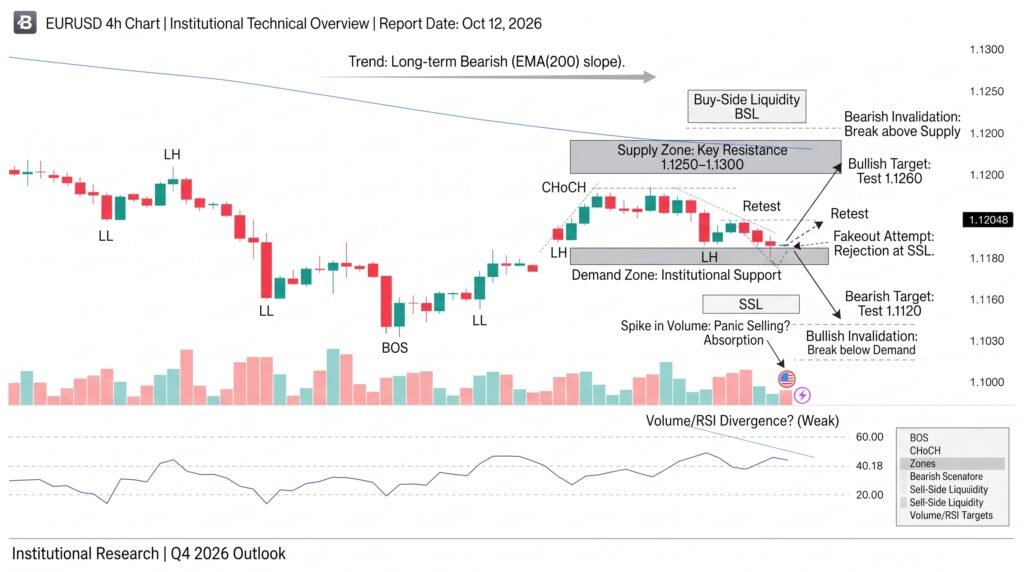
The daily Relative Strength Index (RSI) stood near 27, placing the pair in conventionally oversold territory. Although this can precede a short-term bounce, it does not guarantee a reversal while selling pressure remains dominant.
Key levels for traders include:
- 1.1330: 20-day EMA resistance and the first recovery barrier.
- 1.1200: Psychological level currently being tested.
- 1.1161: One-year low and critical downside support.
A daily close above 1.1330 would help ease bearish pressure. Conversely, a sustained break below 1.1161 could expose EUR/USD to further losses.
Conclusion
EUR/USD is receiving limited support from hopes of lower energy prices, but French fiscal concerns and uncertainty surrounding U.S. inflation continue to constrain the recovery. Wednesday’s CPI report could determine whether dollar strength intensifies or eases. Until the pair reclaims 1.1330, the technical bias remains bearish, with 1.1161 serving as the critical level to defend.
Sources & Methodology
Primary-source standard: Market-moving facts should link to original data releases, regulator notices, company filings or official project announcements whenever available. Secondary reporting is used for additional context, not as a substitute for original evidence.
Page last reviewed: