
EUR/USD remained under pressure on Wednesday as the U.S. Dollar recovered and Treasury yields moved higher, leaving the euro vulnerable to another leg lower. The pair traded near 1.1238 during the Asian session, down 0.18%, while the U.S. Dollar Index climbed 0.18% to just above 102.00. The rebound came after the dollar weakened a day earlier when the rise in U.S. yields temporarily stalled. With yields recovering again and investors awaiting the Federal Reserve minutes, the near-term outlook remains tilted toward further EUR/USD weakness.
U.S. Yields Strengthen Dollar Support
The dollar’s latest recovery is closely linked to renewed strength in the U.S. Treasury market. The 10-year Treasury yield has returned above 5.3%, increasing the relative yield advantage of U.S. dollar assets and making it harder for EUR/USD to sustain a rebound.
Markets are now focused on the September FOMC minutes, scheduled for release Wednesday at 18:00 GMT. The minutes could provide additional insight into how Fed policymakers assessed inflation, employment and the timing of future rate increases.
Recent market pricing indicates that expectations for an October Fed rate hike have fallen sharply. Investors are assigning roughly a 20% probability to an October increase, reducing the immediate rate advantage for the dollar even as elevated Treasury yields continue to support the currency.
Key dollar drivers include:
- The Dollar Index is trading above 102.
- U.S. Treasury yields have moved back above 5.3%.
- October Fed hike expectations have fallen to around 20%.
French Debt Adds Pressure on Euro
The euro is also facing pressure from deteriorating fiscal conditions in France. French public debt reached €3.596 trillion at the end of June, equivalent to 119% of GDP, according to France’s national statistics office. The ratio is the highest since 1946 and has become a major concern for investors assessing the sustainability of French government finances.
France’s fiscal deficit is projected at 5.4% of GDP in 2026, well above the European Union threshold of 3%. The government’s efforts to reduce spending and raise revenue face political resistance, complicating efforts to stabilize public finances.
Rising French borrowing costs have further unsettled the euro. The spread between French and German government debt has widened significantly, while France’s 10-year borrowing cost has approached 5%. The fiscal strain has contributed to renewed concerns about financial stability across the euro area.
EUR/USD Technical Outlook Turns Bearish
EUR/USD was trading at 1.1238, well below its 20-day exponential moving average at 1.1376. The technical structure remains bearish after a series of lower closes, while the 14-day Relative Strength Index stood near 25, indicating that the pair is approaching oversold territory.
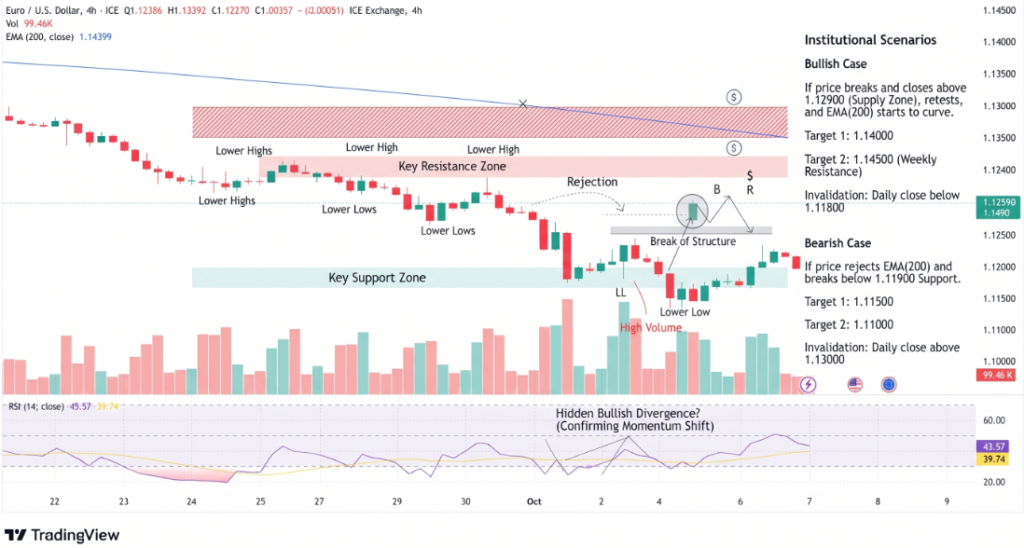
The 1.1160 area has become an important support level for traders. A sustained break below that zone could reinforce the bearish structure and expose the pair to deeper losses. Conversely, a recovery above the 20-day EMA at 1.1376 would weaken the immediate bearish signal and suggest that selling pressure is easing.
Conclusion
EUR/USD remains vulnerable as a stronger U.S. dollar, elevated Treasury yields and mounting French fiscal concerns weigh on the euro. The pair’s position below 1.1376 keeps the technical bias negative, while 1.1160 is an important downside threshold. The September Fed minutes, U.S. yield moves and developments in France’s budget negotiations will be central to the next major move.
Sources & Methodology
Primary-source standard: Market-moving facts should link to original data releases, regulator notices, company filings or official project announcements whenever available. Secondary reporting is used for additional context, not as a substitute for original evidence.
Page last reviewed: