
The euro advanced toward $1.1210 against the U.S. dollar on Wednesday as easing Treasury yields and a weaker greenback supported the currency pair ahead of September’s U.S. inflation report. The recovery followed Tuesday’s gains, although concerns over French public finances and expectations for European Central Bank (ECB) policy limited the euro’s upside. Investors are watching inflation data for clues about whether the Federal Reserve will raise interest rates again this year. The technical outlook remains cautious, with EUR/USD trading below a key moving average.
Dollar Weakens Before US CPI Data
The EUR/USD exchange rate traded near 1.1210 during Asian hours, extending its recovery as the dollar retreated from recent highs. The U.S. Dollar Index (DXY), which measures the greenback against six major currencies, eased toward 102.10 after reaching 102.61 on Monday.
The decline in U.S. bond yields also reduced support for the dollar. The benchmark 10-year Treasury yield slipped toward 5.20% from a recent peak of 5.36%. Lower yields can weaken the dollar by reducing the relative return available on U.S. government debt.
Markets are turning to the September Consumer Price Index (CPI) report for the next major policy signal. Forecasts cited in the original report put annual headline inflation at 3.6% and core inflation, which excludes food and energy, at 2.5%.
Analysts at Societe Generale expect the Federal Reserve outlook to remain broadly unchanged even if core inflation reaches 2.5%. However, stronger-than-expected figures could revive expectations of additional tightening.
According to the CME FedWatch Tool, traders have largely anticipated an October pause, while pricing in a potential rate increase in December. These expectations could shift quickly if inflation surprises markets.
ECB Outlook and French Debt Risks
The euro faces competing forces. A softer dollar has helped the single currency recover, but uncertainty over French public finances and the ECB’s next decision could restrict further gains.
A Reuters poll conducted October 5-8 found that 70 of 73 economists expected the ECB to keep its deposit rate at 2.50% on October 29. However, 64 of 73 anticipated a 25-basis-point increase in December.
The outlook highlights the challenge facing European policymakers: persistent inflation must be balanced against economic growth and borrowing costs. France’s debt burden and political uncertainty add another source of pressure for euro investors.
Key factors for traders include:
- U.S. inflation: A stronger CPI reading could lift the dollar and weigh on EUR/USD.
- Treasury yields: Further declines could support the euro’s recovery.
- ECB policy: Expectations of a December rate increase may offer some support, although French fiscal risks remain a concern.
EUR/USD Technical Analysis and Outlook
EUR/USD traded around 1.1210 but remained below its 20-day exponential moving average (EMA) at 1.1303. This level acts as initial resistance and indicates that the broader short-term trend remains bearish.
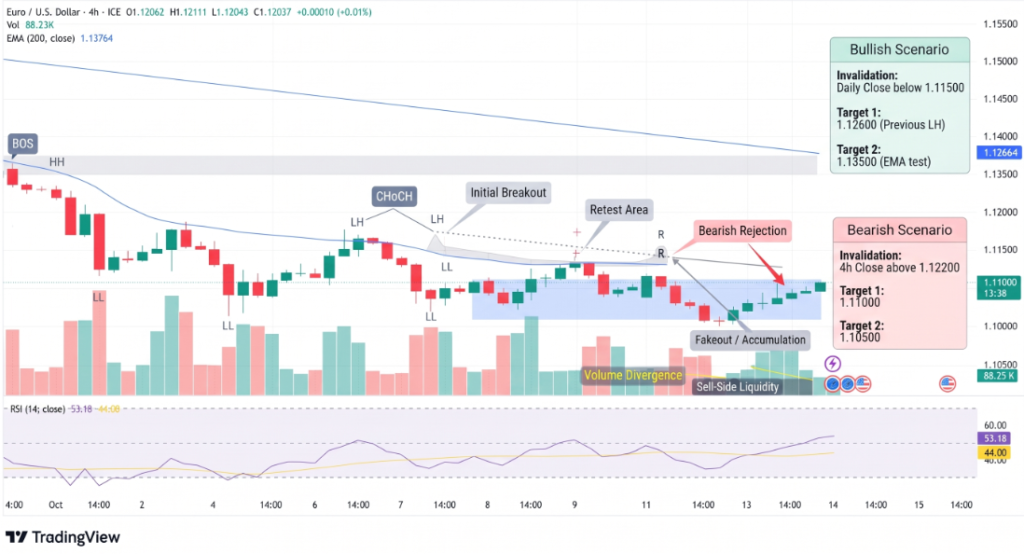
The Relative Strength Index (RSI) stood at 32.15, close to the conventional oversold threshold of 30. The reading signals persistent selling pressure, although it does not guarantee an immediate rebound.
On the downside, the October 12 low at 1.1153 is the immediate support level. A decisive break below it could expose 1.1100. Conversely, a daily close above 1.1303 would weaken the bearish technical signal and create room for a deeper recovery.
Conclusion:
EUR/USD remains vulnerable despite its rebound toward 1.1210. The U.S. CPI report is the immediate catalyst, with inflation, Treasury yields and Fed expectations likely to determine the dollar’s next move. A sustained break above 1.1303 would improve the euro’s technical outlook, while a fall below 1.1153 could renew selling pressure.
Sources & Methodology
Primary-source standard: Market-moving facts should link to original data releases, regulator notices, company filings or official project announcements whenever available. Secondary reporting is used for additional context, not as a substitute for original evidence.
Page last reviewed: