
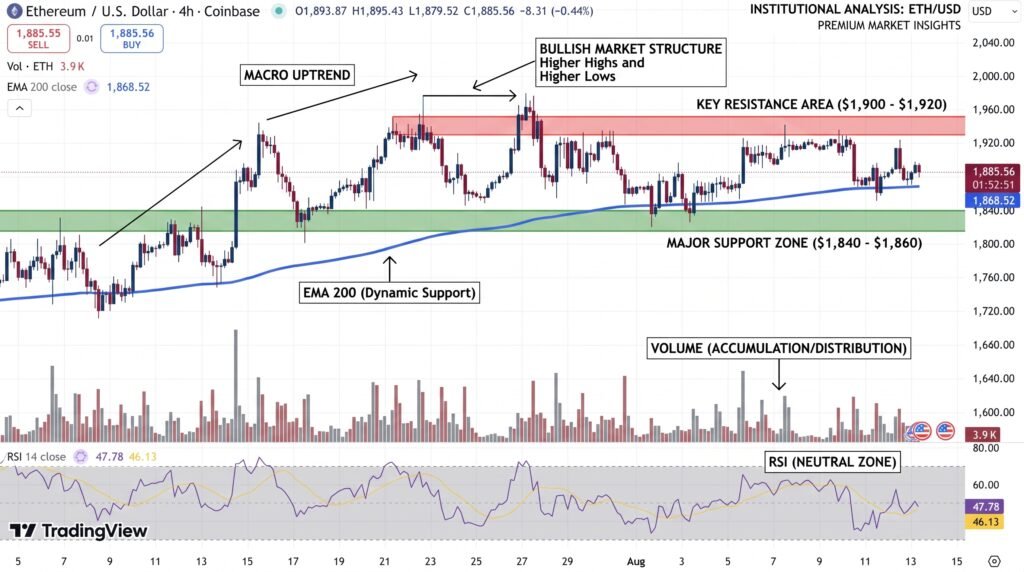
Ethereum traded near $1,895 on Thursday, up 0.42%, as Fidelity’s filing to add staking to its spot Ether ETF drove renewed institutional interest even while the broader crypto market stayed subdued. Fidelity submitted the amendment to the Securities and Exchange Commission on Tuesday, and the SEC made it publicly available on EDGAR August 10, proposing to stake up to 100% of the Fidelity Ethereum Fund’s holdings under normal market conditions. The filing coincided with a session in which ETH ETFs were the only crypto fund category to post net inflows.
Fidelity’s Staking Plan and Fee Structure
The preliminary prospectus would let FETH stake its Ether under normal conditions, defined as periods without major network disruption or unusual redemption activity, while excluding amounts reserved for redemptions, expenses, and liquidity needs. Fidelity would retain 85% of gross staking rewards, allocating the remaining 15% to fees split among the sponsor, custodians, and node operators, with Blockdaemon, Figment, and Galaxy Digital Trading Cayman named as intended node operators. The fund plans quarterly cash distributions to shareholders, though Fidelity has said payouts are not guaranteed and depend on network conditions and validator performance. That 15% fee applies only to gross staking rewards, separate from FETH’s existing 0.25% annual management fee charged on total Ether holdings regardless of whether staking is active.
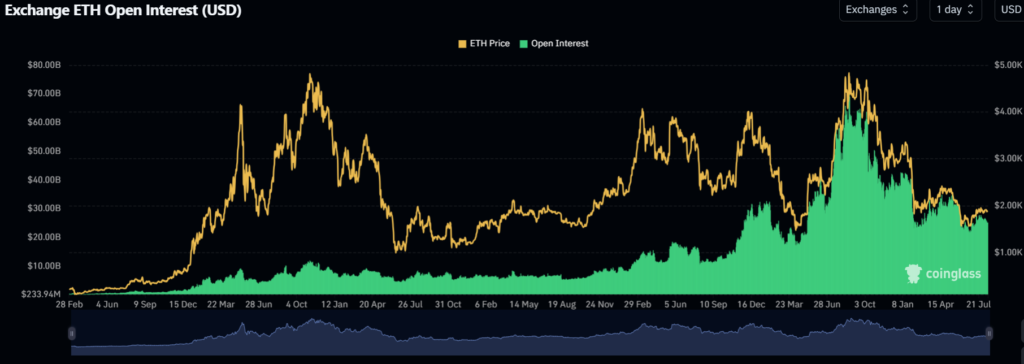
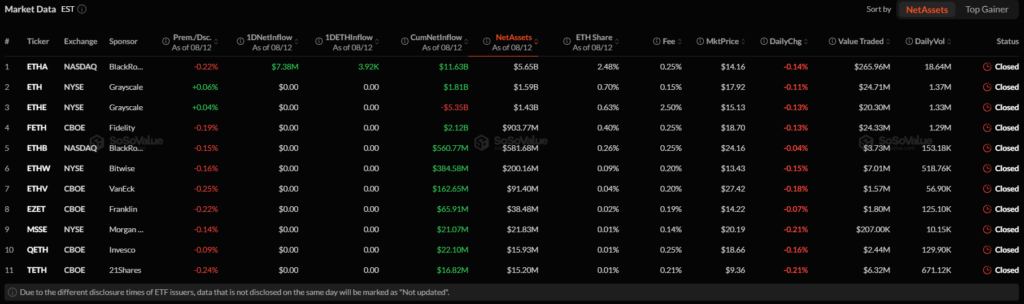
FETH held roughly $898 million to $903 million in net assets at the time of filing and has recorded approximately $2.13 billion in cumulative net inflows since its July 2024 launch. Fidelity is not the first major issuer to pursue this path: Grayscale became the first U.S. issuer to enable staking in a spot crypto ETF in October 2025, and BlackRock launched a purpose-built staking vehicle, the iShares Staked Ethereum Trust, in February 2026, distributing 82% of rewards to investors monthly, a slightly lower shareholder share than Fidelity’s proposed 85% but on a more frequent schedule. Bitwise separately proposed staking for its own Ethereum ETF before withdrawing the plan in September 2025.
Inflows Diverge as Staking Ratio Hits a Record
The filing’s timing lines up with a broader shift in fund flows. SoSoValue data showed ETH ETFs were the only crypto ETF category to post net inflows on August 12, while bitcoin ETFs recorded $61 million in outflows and other altcoin ETFs saw zero net flows that session. The divergence comes as Ethereum’s staking ratio has climbed to an all-time high near 34% of total supply, a trend that has fueled debate within the developer community over EIP-8361, a proposed upgrade that would gradually eliminate new staking rewards once staked ETH reaches roughly 60.25 million tokens, about 50% of supply. Critics have pushed back on the proposal, arguing developers should prioritize expanding Ethereum’s utility rather than capping staking participation.
- FETH’s staking amendment would apply an annualized net yield estimate of roughly 2.2%, translating to about $5.28 per share per year in cash before expenses at ETH’s current price near $1,908
- Ethereum’s Relative Strength Index has climbed from 44 to 50 over recent sessions, suggesting selling pressure is easing even as the token trades within a narrowing range between $1,800 and $1,950
Conclusion
Fidelity’s filing signals that staking has become a genuine competitive differentiator among U.S. Ether ETFs rather than a niche feature, following Grayscale and BlackRock into a segment that generates on-chain income beyond simple price exposure. Whether the SEC approves the amendment on a timeline that lets Fidelity begin staking before competitors further extend their lead remains the open question, but the immediate market reaction, concentrated inflows into ETH funds even as bitcoin and other altcoin ETFs stalled, suggests institutional investors are already treating staking capability as a meaningful factor in fund selection.
Sources & Methodology
Primary-source standard: Market-moving facts should link to original data releases, regulator notices, company filings or official project announcements whenever available. Secondary reporting is used for additional context, not as a substitute for original evidence.
Page last reviewed: