
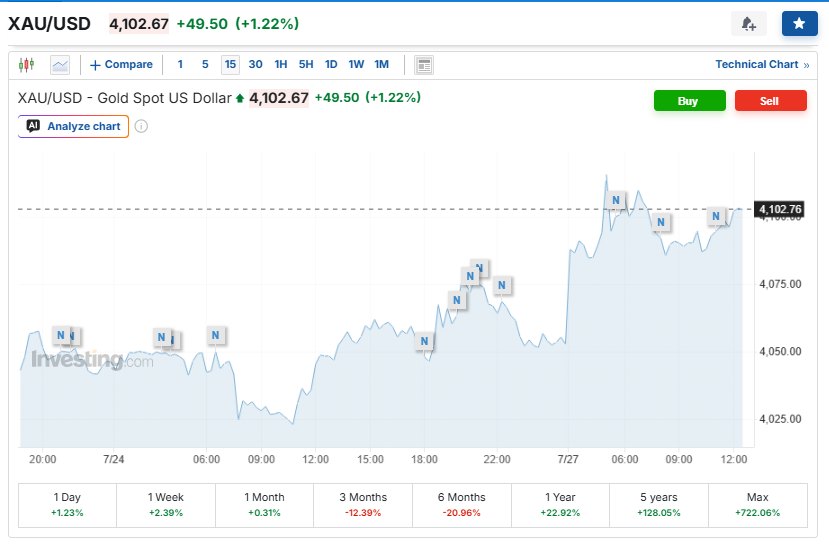
Gold climbed above $4,100 an ounce on Monday, supported by a weaker US dollar and a sharp drop in oil prices after the United States and Iran paused military strikes over the weekend. Investors also positioned for the Federal Reserve’s 28–29 July meeting, where policymakers are expected to leave interest rates unchanged.
Spot gold rose as much as 1.3% to $4,103.99, while US gold futures for August delivery advanced 0.9% to $4,106.10, according to Univest. Earlier in the session, Investing.com reported spot bullion up 1.1% at $4,096.36 and August futures 0.68% higher at $4,098.60. (Univest)
Dollar and Oil Declines Support Gold
The US Dollar Index fell around 0.3%, making dollar-denominated bullion less expensive for buyers using other currencies. US Treasury yields also declined, with the benchmark 10-year yield easing to around 4.64%, as falling energy prices reduced some of the market’s near-term inflation concerns. (Investing.com UK)
Oil recorded the larger move. Brent crude futures fell $5.58, or 5.77%, to $91.20 a barrel, while West Texas Intermediate declined $4.91, or 5.50%, to $84.40. The sell-off followed a pause in US and Iranian attacks after two weeks of hostilities, raising hopes that diplomatic efforts could reduce supply risks around the Strait of Hormuz. (Investing.com)
Brent had traded above $100 a barrel during the conflict as shipping disruptions added a geopolitical premium to energy markets. The subsequent drop towards $91 reduced fears that another oil shock would keep US inflation and interest rates elevated for longer. (Reuters)
Why Gold Rose Despite Lower Geopolitical Risk
A pause in military activity would normally reduce safe-haven demand for gold. Monday’s rally instead reflected the inflation and interest-rate implications of cheaper oil.
Gold does not pay interest, making it sensitive to changes in bond yields and monetary-policy expectations. Lower energy prices can weaken inflation forecasts, reduce pressure on Treasury yields and improve the relative appeal of non-yielding assets.
The move was therefore driven less by demand for protection from the Middle East conflict and more by the combination of a softer dollar, lower yields and expectations that the Federal Reserve may not need to tighten policy as aggressively as previously feared.
Other metals also advanced. Silver gained roughly 2%, while platinum rose between 2.3% and 2.9% during Monday’s session. (Investing.com UK)
Fed Decision Becomes the Next Catalyst
The Federal Open Market Committee begins its two-day meeting on Tuesday and will announce its decision at 2:00 p.m. Eastern Time on Wednesday, followed by Chair Kevin Warsh’s press conference at 2:30 p.m. (Federal Reserve)
Markets broadly expect the Fed to leave benchmark rates unchanged. Attention will instead focus on Warsh’s assessment of inflation, the economic impact of elevated energy costs and whether policymakers remain open to another rate increase later in 2026.
Warsh took office as Federal Reserve chair on 22 May 2026 and will preside over this week’s policy meeting. (Federal Reserve)
Gold Holds Near Recent Highs
Gold gained almost 1% last week despite volatile trading linked to the Middle East conflict, changes in oil prices and shifting expectations for US monetary policy. Monday’s rise returned bullion above the psychologically important $4,100 level. (Investing.com)
Source: Investing.com
The metal’s ability to rally alongside equities also showed that the session was not a conventional flight to safety. European shares gained 0.7%, airline stocks rose around 3%, and energy shares fell as investors priced in lower fuel costs and reduced geopolitical risk. (Reuters)
That combination suggests gold is currently trading more closely with the outlook for the dollar, real yields and Federal Reserve policy than with safe-haven flows alone.
What Happens Next?
The immediate test for gold will be whether spot prices can remain above $4,100 as traders assess the Fed’s policy statement and Warsh’s press conference.
A dovish message, further dollar weakness or a sustained decline in Treasury yields could support another move higher. Conversely, warnings that inflation remains too elevated—or that another rate increase is still under consideration—could lift yields and pressure bullion.
Middle East developments remain another source of volatility. A durable pause in US-Iran hostilities could keep oil prices under pressure and reduce inflation risks. Renewed attacks or further disruption to traffic through the Strait of Hormuz could push crude higher and revive direct safe-haven demand for gold.
Sources & Methodology
Primary-source standard: Market-moving facts should link to original data releases, regulator notices, company filings or official project announcements whenever available. Secondary reporting is used for additional context, not as a substitute for original evidence.
Page last reviewed: