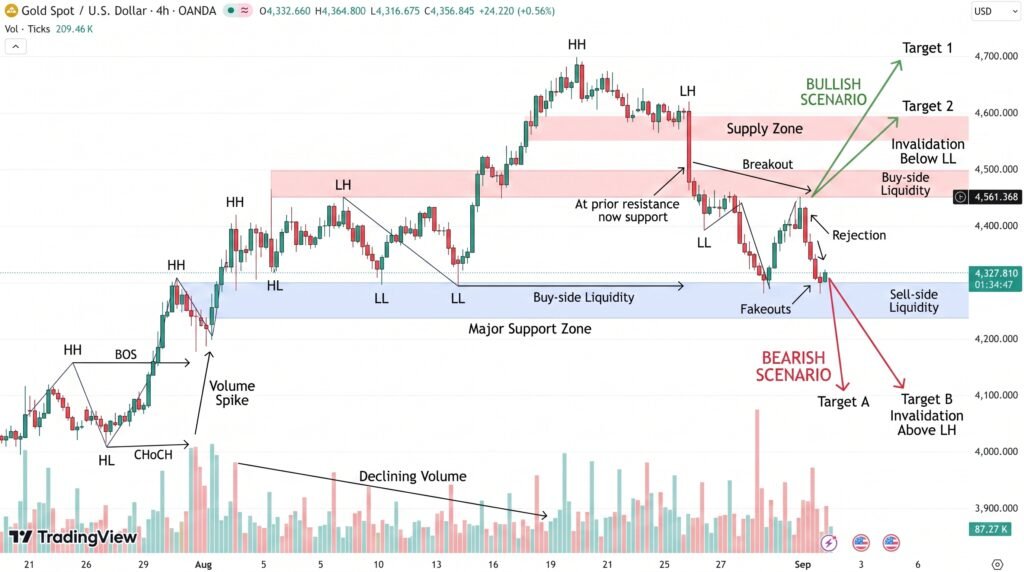
Gold prices fell to a more than three-week low on Wednesday as renewed U.S.-Iran tensions pushed oil prices higher, lifted Treasury yields and strengthened expectations for another Federal Reserve rate increase. Spot gold fell 0.6% to around $4,302.99 an ounce, while December gold futures declined 1.1% to $4,349.90. Markets are increasingly focused on whether higher energy costs will keep inflation elevated and force the Federal Reserve to maintain a restrictive policy stance.
Iran Tensions Drive Oil and Inflation
Gold has fallen for four consecutive sessions as investors reassess the effect of the latest escalation between Washington and Tehran. Renewed U.S. strikes on Iran have raised concerns about energy supplies through the Strait of Hormuz, a critical route for global oil shipments.
Brent crude rose 0.9% to $95.45 a barrel on Wednesday, reaching a five-week high. Higher crude prices can feed into transportation, production and consumer costs, increasing the risk that inflation remains above the Federal Reserve’s target for longer.
That relationship is important for gold. Although bullion is traditionally viewed as a hedge against inflation and geopolitical risk, higher inflation can produce a different market response when it increases expectations for tighter monetary policy. Higher interest rates raise the opportunity cost of holding an asset such as gold, which does not pay interest.
The market is now pricing roughly a 68% probability of a Federal Reserve rate increase at the September meeting, according to Reuters. The September FOMC meeting is scheduled for September 15-16.
Rising Treasury Yields Weigh on Gold
The pressure on bullion is also coming from the bond market. The U.S. 10-year Treasury yield reached 4.8122% on Wednesday, its highest level in almost three years, while the 30-year yield remained around 5.28%.
Higher Treasury yields can reduce demand for gold because investors can earn greater returns from interest-bearing government securities. The stronger U.S. dollar adds another headwind because dollar-priced gold becomes more expensive for overseas buyers.
The bond-market move follows a sharp rise in long-term yields during August. On Aug. 19, the 30-year Treasury yield briefly reached 5.337%, its highest level since 2007, before falling after the Treasury announced larger buyback operations for longer-dated debt.
For traders, the main pressures are now closely connected:
- Gold near $4,303 an ounce
- Brent crude around $95.45
- U.S. 10-year yield near 4.81%
- About 68% odds of a September Fed hike
Gold Faces a Critical Policy Test
Gold’s decline comes after a powerful August rally, leaving investors to determine whether the current move represents a short-term correction or a deeper change in market positioning. The answer will depend heavily on oil prices, Treasury yields, the dollar and incoming U.S. economic data.
The Federal Reserve’s September decision will be particularly important because policymakers must balance inflation risks against economic growth and employment. The central bank’s official calendar confirms that the September 15-16 meeting will include updated economic projections.
The immediate market focus is therefore shifting away from geopolitical headlines alone and toward their economic consequences. If oil remains above $90 a barrel and Treasury yields continue rising, gold could face additional selling pressure despite continued demand for protection against geopolitical risk.
For now, the market is sending a clear signal: higher oil, higher yields and a stronger dollar are outweighing gold’s traditional geopolitical support. A sustained decline in those pressures could stabilize bullion, but another rise in inflation expectations or Fed-hike probabilities would leave gold vulnerable to further losses.
Sources & Methodology
Primary-source standard: Market-moving facts should link to original data releases, regulator notices, company filings or official project announcements whenever available. Secondary reporting is used for additional context, not as a substitute for original evidence.
Page last reviewed: